
Level:
Correct: 0
Incorrect: 0
Marks: 0/0
Exam Practice
Course:
Topics:
Avg
score:
–
Topics
done:
0/22

Core practical: investigating circuits

Practise 16 exam-style questions on Core practical: investigating circuits for Edexcel GCSE Combined Science (Foundation Physics Paper 2). Write your answer as you would in the exam and get it marked in seconds against the mark scheme, point by point, with the Study Helper on hand if you get stuck.

  • 16 questions
  • 1–6 marks each
  • Instant marking
  • No sign-up needed
16 questions, marked as you go

Sample questions with model answers

Here are 4 of the questions in this topic, each with a model answer, an explanation of why it earns the marks and the mark scheme an examiner would use.

Question 1

1 mark

Ali sets five different potential differences across a fixed resistor and measures the current in the resistor each time.

Which of these is a control variable in Ali's investigation?

Choose your answer.

  • A the temperature of the resistor
  • B the current in the resistor
  • C the potential difference across the resistor
  • D the resistance of the variable resistor

Model answer

A

The temperature of the resistor must be kept constant, because its resistance changes if it gets hotter.

Explanation

A control variable is something that is kept the same so that it does not affect the results. Here the potential difference is changed (independent variable) and the current is measured (dependent variable). The temperature of the resistor is kept the same, for example by switching off between readings.

Mark scheme
  1. 1 mark

    A / the temperature of the resistor

    The only correct answer is A: the temperature of the resistor must be kept the same, because a change in temperature would change its resistance. B is not correct because the current is the dependent variable (it is measured); C is not correct because the potential difference is the independent variable (it is changed on purpose); D is not correct because the variable resistor is adjusted on purpose to change the potential difference, so it is not kept the same. Accept the letter or the option. If more than one option is given, do not award the mark.
Question 2

2 marks

A resistor is labelled 47 Ω. In the core practical, Mason measures a current of 0.064 A in the resistor when the potential difference across it is 3.0 V.

Show that his readings give a resistance of about 47 Ω.

Model answer

V = I × R, so R = V ÷ I
R = 3.0 ÷ 0.064
R = 46.9 Ω, which is about 47 Ω

Explanation

Recall V = I × R and rearrange it to R = V ÷ I. In a 'show that' question you must show the substitution and give the answer to more significant figures than the value in the question (46.9 Ω, not just 47 Ω). Writing 47 Ω without working scores nothing.

Mark scheme
  1. 1 mark

    rearrangement and substitution: (R =) 3.0 ÷ 0.064 / 3.0 = 0.064 × R

    This is a 'show that' question, so the marks are for the working: the given value on its own scores 0. The equation is not given: students must recall V = I × R. 3.0 × 0.064 = 0.19 and 0.064 ÷ 3.0 = 0.021 score 0.

  2. 1 mark

    evaluation: 46.9 (Ω) / 46.88 (Ω) / 46.875 (Ω)

    The answer must be given to at least 3 significant figures (46.9), or more. Do not accept 47 on its own for this mark.

Question 3

3 marks

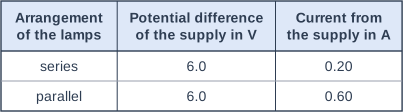
Kieran connects two identical filament lamps to a 6.0 V supply, first in series and then in parallel. He records the current from the supply each time. The table shows his results.

Calculate the net resistance of the two lamps in series.

Use the readings to explain whether the net resistance of the lamps in parallel is larger or smaller than this.

Use the equation

V = I × R

Table with columns "Arrangement of the lamps", "Potential difference of the supply in V", "Current from the supply in A". Arrangement of the lamps: series; Potential difference of the supply in V: 6.0; Current from the supply in A: 0.20 | Arrangement of the lamps: parallel; Potential difference of the supply in V: 6.0; Current from the supply in A: 0.60.

Model answer

R = V ÷ I = 6.0 ÷ 0.20 = 30 Ω
In parallel the current from the supply is 0.60 A, three times larger than in series, with the same 6.0 V supply. A larger current for the same potential difference means a smaller resistance, so the net resistance of the lamps in parallel is smaller than 30 Ω.

Explanation

Use the supply p.d. and the current from the supply to find the net resistance of the series arrangement. For the comparison, the supply p.d. is the same in both circuits, so the arrangement with the larger current must have the smaller net resistance. A common mistake is to think that adding lamps in parallel increases the net resistance.

Mark scheme
  1. 1 mark

    rearrangement and substitution: (R =) 6.0 ÷ 0.20 / 6.0 = 0.20 × R; or a correct final answer of 30 Ω with no working

    An answer of 30 Ω with no working scores marking points 1 and 2. 6.0 × 0.20 = 1.2 and 0.20 ÷ 6.0 = 0.033 score 0 for the calculation.

  2. 1 mark

    evaluation: 30 (Ω)

    Ignore units.

  3. 1 mark

    smaller, because the current (from the supply) is larger / three times larger in parallel for the same supply p.d.

    The mark needs 'smaller' linked to the larger current with the same supply p.d. Accept 6.0 ÷ 0.60 = 10 Ω, which is less than 30 Ω. A reason based only on 'parallel circuits have more paths', without using the readings, does not score.

Question 4

4 marks

Joel's resistor is a coil of thin copper wire. He keeps the potential difference across the coil at 6.0 V, but he forgets to switch off the circuit between readings.

When he first switches on, the current in the coil is 0.30 A. Five minutes later, the current is 0.27 A.

Calculate the resistance of the coil at the start and after five minutes.

Explain why the resistance has changed.

Model answer

At the start: R = V ÷ I = 6.0 ÷ 0.30 = 20 Ω
After five minutes: R = 6.0 ÷ 0.27 = 22 Ω
The current was left on, so it heated the coil of wire. The resistance of a metal wire increases as its temperature increases, so the resistance rose from 20 Ω to 22 Ω and the current fell, even though the p.d. stayed at 6.0 V.

Explanation

Use R = V ÷ I for each current: the same p.d. with a smaller current means a larger resistance. A current heats a resistor, and a hotter metal wire has a higher resistance, just as the resistance of a filament lamp increases as the filament gets hotter. This is why the circuit should be switched off between readings, so that the temperature (a control variable) stays the same.

Mark scheme
  1. 1 mark

    (R at the start =) 6.0 ÷ 0.30 = 20 (Ω); or a correct final answer of 20 Ω with no working

    An answer of 20 Ω and 22 Ω with no working scores marking points 1 and 2. The equation is not given: students must recall V = I × R. 6.0 × 0.30 = 1.8 and 6.0 × 0.27 = 1.6 (wrong method) score 0 for the calculation.

  2. 1 mark

    (R after five minutes =) 6.0 ÷ 0.27 = 22 (Ω) / 22.2 (Ω)

    Accept any value that rounds to 22 (Ω), e.g. 22.22.

  3. 1 mark

    the current heats the coil / the coil gets hotter (because the current was left on)

    Accept the temperature of the wire increases.

  4. 1 mark

    the resistance of the (copper) wire increases as its temperature increases (so the current falls for the same p.d.)

    Accept 'like the filament of a lamp, the hotter the wire, the larger its resistance'. Accept the ions in the hot wire vibrate more, so the electrons collide with them more often. Do not accept 'the battery is running out' (the p.d. was kept at 6.0 V).

Ready to try the rest? Every answer you write is marked against the mark scheme, so you can see exactly where the marks are.

Study Helper Hints first, answers after you try

Stuck on this one? Ask for a hint and I’ll point you in the right direction, without giving the answer away. Once you’ve checked your answer, I’ll show you how the marks are awarded.