
Level:
Correct: 0
Incorrect: 0
Marks: 0/0
Exam Practice
Course:
Topics:
Avg
score:
–
Topics
done:
0/22

Electromagnetism and solenoids

Practise 16 exam-style questions on Electromagnetism and solenoids for Edexcel GCSE Combined Science (Foundation Physics Paper 2). Write your answer as you would in the exam and get it marked in seconds against the mark scheme, point by point, with the Study Helper on hand if you get stuck.

  • 16 questions
  • 1–6 marks each
  • Instant marking
  • No sign-up needed
16 questions, marked as you go

Sample questions with model answers

Here are 4 of the questions in this topic, each with a model answer, an explanation of why it earns the marks and the mark scheme an examiner would use.

Question 1

1 mark

There is a current in a long straight wire. Point P is 3 cm from the wire.

Which change would make the magnetic field at P weaker?

Choose your answer.

  • A increasing the current
  • B moving P further from the wire
  • C reversing the direction of the current
  • D leaving the current switched on for longer

Model answer

B - moving P further from the wire

Explanation

The strength of the magnetic field around a long straight wire depends on two things: the size of the current and the distance from the wire. The field is stronger for a larger current and weaker further from the wire. Reversing the current changes only the direction of the field.

Mark scheme
  1. 1 mark

    B / moving P further from the wire

    The only correct answer is B: the strength of the field around a long straight wire decreases as the distance from the wire increases. A is not correct because a larger current makes the field stronger; C is not correct because reversing the current reverses the direction of the field but does not change its strength; D is not correct because the field strength depends on the size of the current, not on how long it has been switched on. Accept the letter or the option. If more than one option is given, do not award the mark.
Question 2

2 marks

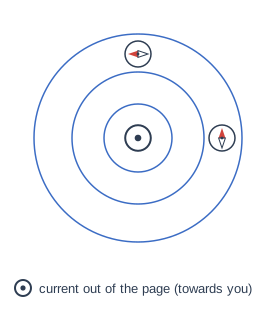
The diagram shows a long straight wire seen end-on, with the current flowing out of the page. Two plotting compasses, X and Y, are near the wire.

The current is then switched off.

Describe and explain what happens to the needles of compasses X and Y.

A straight wire seen end-on as a small circle containing a dot (current out of the page, towards you). 3 concentric circular field lines surround it, getting further apart further from the wire. Compass X is above the wire, between the second and third field-line circles; its needle's north end points to the left. Compass Y is to the right of the wire, between the second and third field-line circles; its needle's north end points upwards.

Model answer

Both needles turn until they point in the same direction, north. When the current is switched off, the wire no longer has a magnetic field, so the only field acting on the compasses is the Earth's magnetic field, and both needles line up with it.

Explanation

A wire has a magnetic field only while there is a current in it. With the current on, the needles follow the circular field around the wire, so X and Y point in different directions. With the current off, they line up with the Earth's field, so they all point north. Switching the current on and off and watching the needles is how you show that a current creates a magnetic effect.

Mark scheme
  1. 1 mark

    both needles turn to point in the same direction / (magnetic) north

    accept 'they point the same way as each other' / 'they go back to pointing north'. Do not accept 'the needles stop moving' or 'the needles point at the wire'.

  2. 1 mark

    with no current there is no magnetic field from the wire, so the needles line up with the Earth's magnetic field

    accept 'the wire's field disappears, so only the Earth's field acts on them'. Both ideas are needed: no field from the wire AND the Earth's field.

Question 3

2 marks

To show the magnetic effect of a current, a teacher connects a short, thick copper wire directly across the terminals of a 1.5 V cell, with no other components. A plotting compass is placed under the wire.

The teacher connects the wire for only a few seconds at a time.

Suggest two reasons why.

Model answer

The thick copper wire has a very low resistance, so there is a very large current and the wire gets hot, which could burn someone. The large current also uses up the energy in the cell very quickly, so the cell would go flat or be damaged.

Explanation

With no other components the wire is a short circuit: a very small resistance gives a very large current. That large current is useful because it gives a strong field to move the compass, but it heats the wire and drains the cell quickly, so the circuit is connected only briefly.

Mark scheme
  1. 1 mark

    the thick wire has a very low resistance, so the current is very large and the wire gets hot (and could burn someone)

    Any two from marking points 1 to 3, max 2. accept 'the wire heats up' / 'risk of burns'.

  2. 1 mark

    the cell would go flat quickly / its energy store would be used up quickly

    accept 'to save the cell' / 'the battery runs down'. Ignore 'to save electricity' unless linked to the cell.

  3. 1 mark

    the (large current makes the) cell get hot / the cell could be damaged

    accept 'the cell could overheat'.

Question 4

4 marks

Zainab uses a magnetic field sensor to measure the strength of the magnetic field at different distances from a long straight wire. She takes readings for two different currents. Her readings are for the wire's field only.

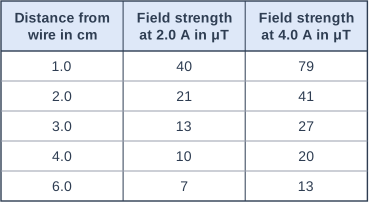
The table shows her results.

Describe how the strength of the magnetic field depends on the distance from the wire and on the current. Use data from the table in your answer.

Table with columns "Distance from wire in cm", "Field strength at 2.0 A in μT", "Field strength at 4.0 A in μT". Distance from wire in cm: 1.0; Field strength at 2.0 A in μT: 40; Field strength at 4.0 A in μT: 79 | Distance from wire in cm: 2.0; Field strength at 2.0 A in μT: 21; Field strength at 4.0 A in μT: 41 | Distance from wire in cm: 3.0; Field strength at 2.0 A in μT: 13; Field strength at 4.0 A in μT: 27 | Distance from wire in cm: 4.0; Field strength at 2.0 A in μT: 10; Field strength at 4.0 A in μT: 20 | Distance from wire in cm: 6.0; Field strength at 2.0 A in μT: 7; Field strength at 4.0 A in μT: 13.

Model answer

The field gets weaker as the distance from the wire increases. It falls quickly at first and then more slowly: at 2.0 A it is 40 μT at 1.0 cm, about half of that (21 μT) at 2.0 cm and about half again (10 μT) at 4.0 cm, so doubling the distance roughly halves the field.

A larger current gives a stronger field at every distance. Doubling the current from 2.0 A to 4.0 A roughly doubles the field strength, for example from 10 μT to 20 μT at 4.0 cm.

Explanation

Describe each variable separately and support each trend with a pair of values from the table. The field gets weaker with distance, but not in equal steps; and at any one distance the larger current gives about twice the field. Quoting numbers without saying what they show, or describing a trend with no numbers, loses marks.

Mark scheme
  1. 1 mark

    the field strength decreases as the distance from the wire increases

    Max 3 if no data from the table are used. accept 'the field is weaker further from the wire' / 'the field is stronger closer to the wire'.

  2. 1 mark

    the decrease is not linear: the field falls quickly at first and then more slowly / doubling the distance (about) halves the field strength, e.g. at 2.0 A it is 40 μT at 1.0 cm, 21 μT at 2.0 cm and 10 μT at 4.0 cm

    accept any correct description of the pattern with matching values from the table, e.g. 'at 4.0 A it falls by 38 μT from 1.0 cm to 2.0 cm but by only 7 μT from 4.0 cm to 6.0 cm'. Do not accept 'the field halves for every 1 cm'.

  3. 1 mark

    a larger current gives a stronger field (at the same distance), e.g. at 1.0 cm it is 40 μT at 2.0 A but 79 μT at 4.0 A

    accept 'the 4.0 A readings are bigger at every distance'.

  4. 1 mark

    doubling the current (about) doubles the field strength, e.g. at 4.0 cm it goes from 10 μT to 20 μT

    accept 'the field strength is (directly) proportional to the current' with a supporting pair of values; accept any matching pair, e.g. 21 μT and 41 μT at 2.0 cm, 13 μT and 27 μT at 3.0 cm.

Ready to try the rest? Every answer you write is marked against the mark scheme, so you can see exactly where the marks are.

Study Helper Hints first, answers after you try

Stuck on this one? Ask for a hint and I’ll point you in the right direction, without giving the answer away. Once you’ve checked your answer, I’ll show you how the marks are awarded.