
Level:
Correct: 0
Incorrect: 0
Marks: 0/0
Exam Practice
Course:
Topics:
Avg
score:
–
Topics
done:
0/22

Elastic distortion and springs

Practise 17 exam-style questions on Elastic distortion and springs for Edexcel GCSE Combined Science (Foundation Physics Paper 2). Write your answer as you would in the exam and get it marked in seconds against the mark scheme, point by point, with the Study Helper on hand if you get stuck.

  • 17 questions
  • 1–6 marks each
  • Instant marking
  • No sign-up needed
17 questions, marked as you go

Sample questions with model answers

Here are 4 of the questions in this topic, each with a model answer, an explanation of why it earns the marks and the mark scheme an examiner would use.

Question 1

1 mark

The spring constant of a spring tells you how stiff the spring is.

Which is the unit of spring constant?

Choose your answer.

  • A N
  • B N/m
  • C N m
  • D J

Model answer

B - N/m.

Explanation

The spring constant k is the force needed per metre of extension, so its unit is N/m. Take care not to confuse N/m (newtons per metre) with N m (newton metres).

Mark scheme
  1. 1 mark

    B / N/m

    The only correct answer is B: the spring constant is the force needed for each metre of extension (force ÷ extension), so its unit is newtons per metre, N/m. A is not correct because N is the unit of force; C is not correct because N m (newton metre) is a force multiplied by a distance, not a force divided by an extension; D is not correct because J is the unit of energy, such as the energy stored in a stretched spring. Accept the letter or the option. If more than one option is given, do not award the mark.
Question 2

2 marks

A car has a steel spring above each wheel. When the car goes over a bump, the springs are compressed. They then return to their original length.

Explain why these springs must distort elastically and not inelastically.

Model answer

The springs are compressed every time the car goes over a bump. Because they distort elastically, they return to their original length when the force is removed, so they are ready for the next bump. If they distorted inelastically, they would stay permanently compressed, so the car would sit lower and the springs would not work properly any more.

Explanation

Elastic distortion is a change of shape that disappears when the forces are removed; inelastic distortion is a permanent change of shape. Anything that must be stretched or compressed again and again, such as a car spring, must only be distorted elastically.

Mark scheme
  1. 1 mark

    elastic distortion means that the springs return to their original length / shape when the force is removed

    An explanation linking two points. accept 'so they are ready to be compressed again by the next bump'.

  2. 1 mark

    if they distorted inelastically they would stay (permanently) compressed / shorter, so the car would sit lower / the springs would not work for the next bump

    accept 'the springs would be permanently damaged / changed in shape'. Ignore 'so the ride is comfortable' on its own.

Question 3

3 marks

A spring inside a retractable pen is compressed by 4.0 mm when a force of 1.2 N pushes the button.

Calculate the spring constant of the spring in N/m.

Use the equation
F = k × x

Model answer

x = 4.0 mm = 0.0040 m
F = k × x
1.2 = k × 0.0040
k = 1.2 ÷ 0.0040 = 300 N/m

Explanation

The spring constant must be in N/m, so convert the compression from millimetres to metres first (divide by 1000). Then rearrange F = k × x to k = F ÷ x. Forgetting to convert gives 0.3, a power-of-ten error.

Mark scheme
  1. 1 mark

    conversion: 4.0 mm = 0.0040 m; or a correct final answer of 300 N/m with no working

    An answer of 300 N/m with no working scores 3 marks. 300 to any other power of ten (for example 0.3, from leaving the compression in mm) scores 2 marks. 1.2 × 0.0040 = 0.0048 and 0.0040 ÷ 1.2 = 0.0033 are wrong methods: they score marking point 1 only if the conversion is seen.

  2. 1 mark

    rearrangement and substitution: (k =) 1.2 ÷ 0.0040; or a correct final answer of 300 N/m with no working

    accept 1.2 = k × 0.0040. allow ecf from their conversion.

  3. 1 mark

    evaluation: 300 (N/m)

    Ignore units.

Question 4

4 marks

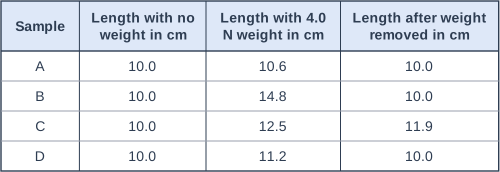
Amara tests four samples, A, B, C and D, made from different materials. Each sample is 10.0 cm long. She hangs the same 4.0 N weight from each sample and measures its length. She then removes the weight and measures the length of the sample again.

The table shows her results.

Give the letter of the sample that was distorted inelastically and the letter of the stiffest sample. Explain each of your answers using data from the table.

Table with columns "Sample", "Length with no weight in cm", "Length with 4.0 N weight in cm", "Length after weight removed in cm". Sample: A; Length with no weight in cm: 10.0; Length with 4.0 N weight in cm: 10.6; Length after weight removed in cm: 10.0 | Sample: B; Length with no weight in cm: 10.0; Length with 4.0 N weight in cm: 14.8; Length after weight removed in cm: 10.0 | Sample: C; Length with no weight in cm: 10.0; Length with 4.0 N weight in cm: 12.5; Length after weight removed in cm: 11.9 | Sample: D; Length with no weight in cm: 10.0; Length with 4.0 N weight in cm: 11.2; Length after weight removed in cm: 10.0.

Model answer

C was distorted inelastically. After the weight was removed, its length was 11.9 cm, not its original 10.0 cm, so it did not return to its original length.

A is the stiffest. With the same 4.0 N force, A stretched by only 10.6 − 10.0 = 0.6 cm, which is the smallest extension of the four samples (B 4.8 cm, C 2.5 cm, D 1.2 cm). So A has the largest spring constant.

Explanation

Inelastic distortion means the object does not return to its original length when the force is removed, so compare the first and last columns. Stiffness is about how far a sample stretches for the same force: the smaller the extension, the stiffer the sample and the larger its spring constant. Many students choose B as the inelastic sample because it stretched the most, but B went back to 10.0 cm.

Mark scheme
  1. 1 mark

    C (was distorted inelastically)

    Mark each point separately. Do not award marking point 1 if more than one letter is given for the inelastic sample.

  2. 1 mark

    C did not return to its original length when the weight was removed: its length was 11.9 cm, not 10.0 cm / it stayed 1.9 cm longer

    accept 'it stayed stretched' or 'it is permanently longer' with a value from the table. The idea of the length after the weight was removed is needed: do not accept 'C stretched a lot' (B stretched more).

  3. 1 mark

    A (is the stiffest)

    Do not award marking point 3 if more than one letter is given for the stiffest sample.

  4. 1 mark

    A had the smallest extension for the same force: 10.6 − 10.0 = 0.6 cm / A needs the largest force for each cm of extension, so it has the largest spring constant

    accept 'A stretched the least (by 0.6 cm)'. Do not accept 'A is the strongest' or 'A returned to its original length' (A, B and D all did).

Ready to try the rest? Every answer you write is marked against the mark scheme, so you can see exactly where the marks are.

Study Helper Hints first, answers after you try

Stuck on this one? Ask for a hint and I’ll point you in the right direction, without giving the answer away. Once you’ve checked your answer, I’ll show you how the marks are awarded.