
Level:
Correct: 0
Incorrect: 0
Marks: 0/0
Exam Practice
Course:
Topics:
Avg
score:
–
Topics
done:
0/22

Mains electricity and electrical safety

Practise 18 exam-style questions on Mains electricity and electrical safety for Edexcel GCSE Combined Science (Foundation Physics Paper 2). Write your answer as you would in the exam and get it marked in seconds against the mark scheme, point by point, with the Study Helper on hand if you get stuck.

  • 18 questions
  • 1–6 marks each
  • Instant marking
  • No sign-up needed
18 questions, marked as you go

Sample questions with model answers

Here are 4 of the questions in this topic, each with a model answer, an explanation of why it earns the marks and the mark scheme an examiner would use.

Question 1

1 mark

A ceiling light is switched off at the wall switch. The switch is correctly connected in the live wire.

Which statement about the light fitting is correct?

Choose your answer.

  • A it is cut off from the 230 V of the live wire
  • B its neutral wire is now at 230 V
  • C there is still a small current in its lamp
  • D its earth wire is now at 230 V

Model answer

A

Explanation

Switches are put in the live wire so that, when the switch is off, the appliance is disconnected from the high potential difference of the live wire. If the switch were in the neutral wire, the lamp would go off, but the light fitting would still be connected to 230 V and could give someone a shock.

Mark scheme
  1. 1 mark

    A / it is cut off from the 230 V of the live wire

    The only correct answer is A: a switch in the live wire disconnects the light fitting from the live wire, so no part of the fitting is at 230 V when it is switched off. B is not correct because the neutral wire stays at about 0 V; C is not correct because an open switch breaks the circuit, so there is no current in the lamp; D is not correct because the earth wire stays at 0 V (earth potential). Accept the letter or the option. If more than one option is given, do not award the mark.
Question 2

2 marks

Touching the live wire of a circuit that is switched on is much more dangerous than touching the neutral wire, although both should be avoided.

Explain why. Assume that the person is standing on the ground and touches only one wire.

Model answer

The live wire is at about 230 V, but the person and the ground are at 0 V, so there is a large p.d. across the person and a large current passes through their body to earth. The neutral wire is at about 0 V, the same as earth, so there is almost no p.d. across the person and almost no current through them.

Explanation

What matters is the potential difference across the person's body. The live wire is about 230 V above earth, while the neutral wire is at about 0 V, close to earth. A common error is to say the neutral wire is safe because it has no current: it does carry current, but it is at almost the same potential as earth.

Mark scheme
  1. 1 mark

    the live wire is at (a high p.d. of) about 230 V compared with the ground / earth, so there is a large p.d. across the person and a (large) current passes through them to earth

    allow so the person gets an electric shock, for the second part, if the high p.d. of the live wire is given.

  2. 1 mark

    the neutral wire is at (about) 0 V / the same potential as earth, so there is (almost) no p.d. across the person and (almost) no current through them

    Do not accept 'there is no current in the neutral wire' as the reason: the neutral wire does carry the current back to the supply.

Question 3

3 marks

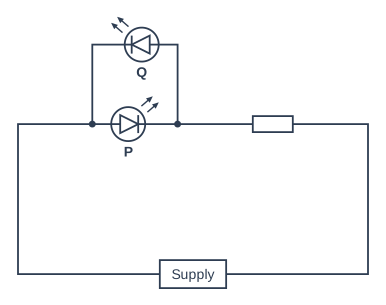
A student connects two LEDs, P and Q, in parallel with each other but pointing in opposite directions. The diagram shows the circuit. The box labelled Supply shows where she connects a supply.

She tests two supplies, X and Y, in turn. One is a battery. The other is an a.c. supply with a very low frequency of 1 Hz.

- With supply X, LED P stays lit and LED Q stays off.
- With supply Y, LEDs P and Q flash on and off, one after the other.

Identify which supply is the a.c. supply. Explain your answer.

Circuit diagram. There is no power supply. Going round the loop clockwise from the top left corner: two branches in parallel (one branch has LED P pointing forwards (its triangle points the way we are going round); the other branch has LED Q pointing backwards (its triangle points against the way we are going round)); then a resistor; then component Supply (drawn as a box labelled Supply); and back to the start.

Model answer

Supply Y is the a.c. supply.
An LED only lets current pass through it in one direction. With supply X, the current is always in the same direction (d.c. from the battery), so only LED P, which points that way, lights. With supply Y, the current keeps changing direction, so P lights when the current goes one way and Q lights when it goes the other way, which is why they flash one after the other.

Explanation

The key ideas are that an LED (a diode) conducts in one direction only, and that the movement of charge in an a.c. circuit keeps changing direction while d.c. flows one way only. A frequency of 1 Hz is slow enough to see each LED take its turn. Saying 'Y because both LEDs light' without explaining the direction of the current scores only the first mark.

Mark scheme
  1. 1 mark

    Y (is the a.c. supply)

    Any three from marking points 1 to 4, max 3. Y with no explanation scores 1 mark.

  2. 1 mark

    an LED / a diode only lets current pass in one direction / an LED only lights when the current passes through it in its forward direction

    allow an LED has a very high resistance in the reverse direction.

  3. 1 mark

    with Y (a.c.) the current / movement of charge keeps changing direction, so P and Q each light in turn

    allow the p.d. of Y keeps reversing, so first one LED and then the other is forward biased / conducts.

  4. 1 mark

    with X (a battery, d.c.) the current is in one direction only, so only P (the LED pointing that way) lights

    allow X gives a direct current, so Q (pointing the other way) never conducts.

Question 4

4 marks

A phone charger plugs into the mains. The output of the charger to the phone has a potential difference of 9.0 V and a current of 3.0 A.

When the phone's battery is charged from flat to full, the energy in the chemical store of the battery increases by 64 800 J.

Calculate the time, in minutes, that it takes to charge the battery from flat to full.

Assume that all the energy from the charger's output is transferred to the chemical store of the battery.

Use the equations

P = I × V

P = E ÷ t

Model answer

P = I × V = 3.0 × 9.0 = 27 W
P = E ÷ t, so t = E ÷ P
t = 64 800 ÷ 27 = 2400 s
t = 2400 ÷ 60 = 40 minutes

Explanation

The charger's power tells you how much energy goes into the battery's chemical store each second: 27 W means 27 J every second. Divide the total energy needed by the energy transferred each second to get the time in seconds, then divide by 60 for minutes. Multiplying the energy by the power is a common wrong rearrangement.

Mark scheme
  1. 1 mark

    (P =) 3.0 × 9.0 = 27 (W); or a correct final answer of 40 minutes with no working

    An answer of 40 minutes with no working scores 4 marks. An answer of 2400 (s) scores 3 marks (marking points 1 to 3). An answer of 27 (the power only) scores 1 mark. 64 800 × 27 or 27 ÷ 64 800 (wrong rearrangement) scores marking point 1 only. allow the route t = E ÷ (I × V) = 64 800 ÷ (3.0 × 9.0) for full marks. Also allow the route through charge: Q = E ÷ V = 64 800 ÷ 9.0 = 7200 (C) scores marking point 1, and t = Q ÷ I = 7200 ÷ 3.0 scores marking point 2.

  2. 1 mark

    rearrangement and substitution: (t =) 64 800 ÷ 27 / 27 = 64 800 ÷ t; or a correct final answer of 40 minutes with no working

    ecf their power from marking point 1.

  3. 1 mark

    (t =) 2400 (s); or a correct final answer of 40 minutes with no working

    ecf their power.

  4. 1 mark

    conversion to minutes: 40 (minutes)

    ecf their time in seconds ÷ 60. Ignore units.

Ready to try the rest? Every answer you write is marked against the mark scheme, so you can see exactly where the marks are.

Study Helper Hints first, answers after you try

Stuck on this one? Ask for a hint and I’ll point you in the right direction, without giving the answer away. Once you’ve checked your answer, I’ll show you how the marks are awarded.