
Level:
Correct: 0
Incorrect: 0
Marks: 0/0
Exam Practice
Course:
Topics:
AQA GCSE Psychology (Paper 1) Smart practice A mixed round aimed at your weak spots
Unit 1
Memory
Processes of memory
Processes of memory
Memory as an active process
Unit 2
Perception
Sensation and perception; visual cues and constancies
Sensation and perception, visual cues and constancies
Gibson's direct theory of perception - the influence of nature
Gibson's direct theory of perception
Visual illusions
Visual illusions
Gregory's constructivist theory of perception - the influence of nurture
Gregory's constructivist theory of perception
Factors affecting perception
Unit 3
Development
Early brain development
Piaget's stage theory and the development of intelligence; the role of Piaget's theory in education
Piaget's stage theory and the development of intelligence
The effects of learning on development
Unit 4
Research methods
Avg
score:
–
Topics
done:
0/24

Visual illusions

Practise 26 exam-style questions on Visual illusions for AQA GCSE Psychology (Paper 1). Write your answer as you would in the exam and get it marked in seconds against the mark scheme, point by point, with the Study Helper on hand if you get stuck.

  • 26 questions
  • 1–9 marks each
  • Instant marking
  • No sign-up needed
20 questions, marked as you go

Sample questions with model answers

Here are 4 of the questions in this topic, each with a model answer, an explanation of why it earns the marks and the mark scheme an examiner would use.

Question 1

1 mark

In the figure, bars A and B are exactly the same length.

Which one of the following statements about how most people perceive the figure is correct?

Choose your answer.

  • Bar A looks longer, because it seems to be further away
  • Bar B looks longer, because it seems to be nearer
  • Bar A looks longer, because it seems to be nearer
  • Both bars look the same length, because they are equal
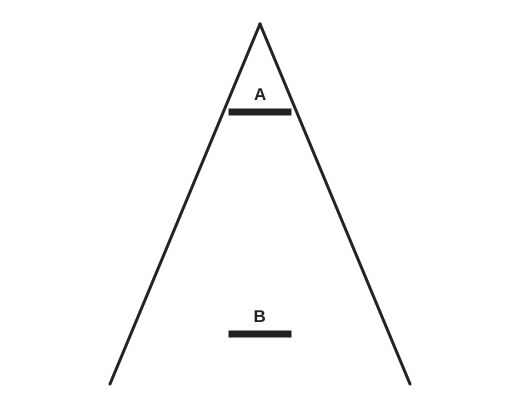
Two straight lines start far apart at the bottom of the picture and lean towards each other until they meet near the top, like railway tracks going into the distance. Between them are two thick horizontal bars: one (A) high up, where the lines are close together, and one (B) near the bottom, where the lines are far apart.

Model answer

Bar A looks longer, because it seems to be further away

Explanation

This is the Ponzo illusion: the converging lines act like the linear perspective of railway tracks, so bar A, near where the lines meet, seems further away. Because of size constancy, the brain scales up the image of an object it judges to be further away, so bar A is perceived as longer although both bars are the same length. A common mistake is to think the lower bar looks longer because it seems nearer.

Mark scheme
  1. 1 mark

    Bar A looks longer, because it seems to be further away

    If more than one option is given, 0 marks.
Question 2

2 marks

A psychologist, Dr Tamura (fictional), investigated whether the angle of the fins affects the strength of the Müller-Lyer illusion. On a computer screen, each participant saw a line with outward fins drawn at 30 degrees to the line, and on another trial the same line with outward fins drawn at 60 degrees. Each time, they used the arrow keys to change the length of a plain line until it looked the same length as the line with fins. The computer recorded the length of the plain line in millimetres.

Identify the independent variable and the dependent variable in this study.

Model answer

Independent variable: the angle of the outward fins - 30 degrees or 60 degrees to the line.
Dependent variable: the length, in millimetres, that each participant set the plain line to so that it looked the same length as the line with fins.

Explanation

The independent variable is what Dr Tamura changed between trials: the angle of the fins. The dependent variable is what was measured: the length of the plain line set by each participant, which shows how strong the illusion was. Writing just 'the fins' or 'the illusion' is too vague.

Mark scheme
  1. 1 mark

    Independent variable: the angle of the fins (30 degrees or 60 degrees to the line)

    Accept 'whether the fins were at 30 or 60 degrees'. The answer must refer to the angle of the fins. Do not accept 'the fins' or 'the Müller-Lyer illusion' alone, or 'the length of the plain line' (this is the dependent variable).

  2. 1 mark

    Dependent variable: the length, in millimetres, that participants set the plain line to (so that it looked the same length as the line with fins)

    Accept 'how long participants made the plain line', 'the length recorded by the computer', 'the strength of the illusion measured by the length of the plain line'. Do not accept 'the illusion' or 'perception' alone, or a result (e.g. 'the line looked longer with 30-degree fins').

Question 3

3 marks

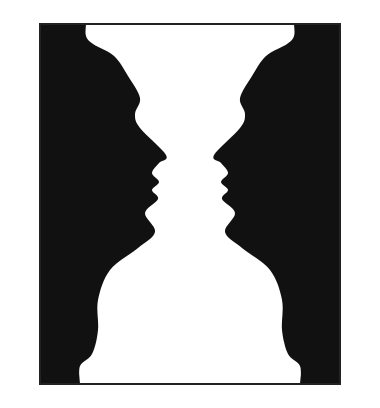
Ayesha looks at the figure and sees a white vase. A moment later she sees two faces looking at each other, and then the vase again.

Explain why the figure can be perceived in two different ways.

A black and white picture, the same on the left and the right. A white area runs down the middle between two black areas at the sides. From the top, the white area is wide, then narrows; each edge has a small bump, then a large pointed bump about a third of the way down that almost meets the bump on the other side, then two small rounded bumps close together, a rounder bump, and then the edges curve out to a wide flat bottom.

Model answer

The figure is ambiguous: the same image has two equally likely interpretations. If Ayesha's brain treats the white area as the figure and the black areas as the background, she sees a vase; if it treats the black areas as the figure, she sees two faces in profile. The edges belong equally to the vase and the faces, and there are no other cues to show which is correct, so her brain cannot settle on one interpretation and keeps switching between them. She can only see one interpretation at a time.

Explanation

A top answer names ambiguity and explains it: two equally possible interpretations, with nothing in the image to decide between them, so perception switches. Describing what Ayesha sees is not enough, because that is in the question. Saying both images can be seen at once is wrong.

Mark scheme
  1. 3 marks

    Up to 3 marks for a relevant explanation. 3 marks: a clear and detailed explanation. 2 marks: a limited explanation. 1 mark: a very limited/muddled explanation.

    Possible content: the figure is ambiguous; the same image has two equally likely interpretations; if the white area is treated as the figure and the black areas as the background, a vase is seen, and if the black areas are treated as the figure, two faces in profile are seen; the edges belong equally to the vase and the faces, and there are no other cues to show which interpretation is correct; so the brain cannot settle on one interpretation and switches between them; only one interpretation can be seen at a time. Credit other relevant content. NOTE: A description of what Ayesha sees is not an explanation, because it is part of the question stem. NOTE: For a clear and detailed explanation, the answer must refer to ambiguity or two equally possible interpretations AND to perception switching between them (or the figure and background swapping). Do not credit fiction, misinterpreted depth cues or size constancy.

Question 4

6 marks

Read the following information.

A psychologist wants to find out whether people only see the white triangle in the Kanizsa triangle when the gaps in the three black discs line up with each other. She has two versions of the illusion: the usual version, and a version in which each disc has been turned round so that its gap points away from the centre. She plans to show each version on a screen for two seconds.

Imagine you carry out this experiment. Identify:
- the experimental design you will use
- how you will measure the dependent variable
- one extraneous variable and how you will control it
- the results you will expect to find.

Model answer

Experimental design: independent groups - each participant sees only one version, so seeing the usual triangle cannot affect what they report for the other version.
Dependent variable: after the figure disappears, each participant draws what they saw, and I record whether they drew a complete triangle with three edges.
Extraneous variable: some participants may already know the Kanizsa triangle and expect to see a triangle. I will control this by asking before the study whether they have seen the figure, and only using people who have not.
Expected results: more participants who see the usual version will draw a complete triangle than participants who see the version with the discs turned round.

Explanation

Treat each bullet separately: a design, a measurable DV, an extraneous variable with a control that fits it, and results that name both versions of the figure. The expected result follows from fiction: the brain fills in a triangle only when the gaps line up to suggest one. A results statement such as 'Group 1 will do better' is limited to 1 mark.

Mark scheme
  1. 1 mark

    1 mark for a relevant experimental design: independent groups / repeated measures / matched pairs

    Any of the three experimental designs is creditworthy. Independent groups is the most suitable (seeing the usual triangle first could affect what participants report for the turned-round version), but repeated measures is acceptable, especially with counterbalancing. Accept 'independent measures'. Do not accept a research method (e.g. 'laboratory experiment') as a design. NOTE: If the candidate has written more than one design, only mark the first one.

  2. 1 mark

    1 mark for a clear, measurable way of recording the dependent variable

    For example: ask each participant to draw what they saw and record whether they drew a complete triangle with three edges; ask each participant to describe what they saw and count how many mention a triangle; ask participants to rate how clearly they saw a triangle on a scale from 0 (no triangle) to 10 (very clear triangle). Do not accept 'see whether they see a triangle' with no way of recording it.

  3. 1 mark

    1 mark for a relevant extraneous variable

    For example: some participants may already know the Kanizsa triangle; the instructions or question asked (e.g. 'Can you see a triangle?' is a leading question); how long each figure is shown; screen size or brightness; distance from the screen; lighting; participants' eyesight; participant variables between groups.

  4. 1 mark

    1 mark for an appropriate way of controlling the relevant extraneous variable

    It must control the extraneous variable identified. For example: ask before the study whether participants have seen the figure and only use those who have not; use standardised instructions that do not mention a triangle; show each figure for exactly two seconds using a computer; use the same screen, brightness, distance and lighting for everyone; randomly allocate participants to conditions; counterbalance the order of the versions (repeated measures).

  5. 2 marks

    Up to 2 marks for relevant expected results. 2 marks: a clear and accurate description of the expected results with both conditions of the IV. 1 mark: a limited or muddled description of the expected results.

    Examples: 'More participants who see the usual version will draw a complete triangle than participants who see the version with the discs turned round.' (2 marks) 'Participants will rate the triangle as clearer in the usual version than in the turned-round version.' (2 marks) 'People will see a triangle in the normal one.' (1 mark) 'Group 1 will see more triangles than Group 2.' (1 mark) Credit other relevant content.

Ready to try the rest? Every answer you write is marked against the mark scheme, so you can see exactly where the marks are.

Study Helper Hints first, answers after you try

Stuck on this one? Ask for a hint and I’ll point you in the right direction, without giving the answer away. Once you’ve checked your answer, I’ll show you how the marks are awarded.