
Level:
Correct: 0
Incorrect: 0
Marks: 0/0
Exam Practice
Course:
Topics:
AQA GCSE Psychology (Paper 1) Smart practice A mixed round aimed at your weak spots
Unit 1
Memory
Processes of memory
Processes of memory
Memory as an active process
Unit 2
Perception
Sensation and perception; visual cues and constancies
Sensation and perception, visual cues and constancies
Gibson's direct theory of perception - the influence of nature
Gibson's direct theory of perception
Visual illusions
Visual illusions
Gregory's constructivist theory of perception - the influence of nurture
Gregory's constructivist theory of perception
Factors affecting perception
Unit 3
Development
Early brain development
Piaget's stage theory and the development of intelligence; the role of Piaget's theory in education
Piaget's stage theory and the development of intelligence
The effects of learning on development
Unit 4
Research methods
Avg
score:
–
Topics
done:
0/24

Gregory's constructivist theory of perception

Practise 24 exam-style questions on Gregory's constructivist theory of perception for AQA GCSE Psychology (Paper 1). Write your answer as you would in the exam and get it marked in seconds against the mark scheme, point by point, with the Study Helper on hand if you get stuck.

  • 24 questions
  • 1–9 marks each
  • Instant marking
  • No sign-up needed
20 questions, marked as you go

Sample questions with model answers

Here are 4 of the questions in this topic, each with a model answer, an explanation of why it earns the marks and the mark scheme an examiner would use.

Question 1

1 mark

Sanjay looks at the figure. He notices that the cube keeps flipping: first one square seems to be at the front, then the other.

According to Gregory's constructivist theory, which one of the following best explains this?

Choose your answer.

  • His brain keeps switching between two equally likely hypotheses
  • His eyes keep converging and then relaxing
  • The light reaching his eyes keeps changing
  • His brain has no stored knowledge of cubes
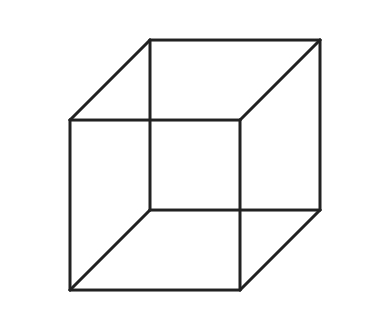
A line drawing of a cube made of 12 straight lines, all the same thickness: two overlapping squares of the same size, one up and to the right of the other, with each corner of one square joined to the matching corner of the other by a sloping line. Every edge is drawn, including the ones that would be hidden in a solid cube.

Model answer

His brain keeps switching between two equally likely hypotheses

Explanation

Gregory explained the Necker cube as a figure with two equally likely hypotheses: with no depth cues to show which face is nearer, the brain cannot decide between them and keeps switching. The light reaching Sanjay's eyes does not change, and he clearly does use stored knowledge of cubes, because he sees a 3D cube rather than a set of flat lines.

Mark scheme
  1. 1 mark

    His brain keeps switching between two equally likely hypotheses

    If more than one option is given, 0 marks.

Question 2

2 marks

A psychologist, Dr Achterhof (fictional), wants to find out whether age affects how people perceive the Ponzo illusion. She will show the same Ponzo figure to a group of six-year-olds and to a group of adults. Each participant will say whether the upper bar or the lower bar looks longer, or whether the bars look the same length.

Write a suitable null hypothesis for this study.

Model answer

There will be no difference in the number of six-year-olds and the number of adults who say that the upper bar in the Ponzo figure looks longer.

Explanation

A null hypothesis predicts no difference or no effect. For 2 marks it must name both conditions of the IV (six-year-olds and adults) and an operationalised DV (the number who say the upper bar looks longer). Predicting that adults will be fooled more is an alternative hypothesis, which was not asked for.

Mark scheme
  1. 2 marks

    Up to 2 marks for a suitable null hypothesis. 2 marks: there must be both conditions of the IV and a clear DV which makes the statement operational. 1 mark: the hypothesis lacks some clarity.

    Examples: 'There will be no difference in the number of six-year-olds and adults who say that the upper bar looks longer.' (2 marks) 'Being six years old or an adult will not affect whether participants say that the upper bar of the Ponzo figure looks longer.' (2 marks) 'Age will not affect perception of the Ponzo illusion.' (1 mark) 'There will be no difference between children and adults.' (1 mark) Credit other relevant null hypotheses. NOTE: Do not accept alternative hypotheses, aims, questions or statements of results (e.g. 'there was no difference').

Question 3

3 marks

A psychology student wanted to see whether familiarity helps people to recognise an object seen from an unusual angle. She showed a photograph of the town's clock tower, taken from directly above it, to 28 students who walk past the tower every day. 19 of them recognised it.

Calculate the percentage of students who recognised the clock tower.
Give your answer to two significant figures. Show your workings.

Model answer

19 ÷ 28 × 100 = 67.857...%
To two significant figures: 68%

Explanation

Divide the number who recognised the tower (19) by the total number of students (28) and multiply by 100 to get 67.857...%. For two significant figures keep the 6 and the 7, then round up because the next digit is 8, giving 68%. Giving 67.9 (three significant figures) or 67 (rounded down) loses a mark.

Mark scheme
  1. 3 marks

    3 marks for the correct percentage to two significant figures: 68. 2 marks for the correct percentage but not rounded to two significant figures, e.g. 67.9 or 67.86, OR 2 marks for the 'correct' percentage but rounded incorrectly, e.g. 67. 1 mark for correct workings but incorrect/no answer: 19 ÷ 28 × 100.

    A correct answer with no workings scores 3 marks. Accept 68%. 67 (rounded incorrectly) scores 2 marks. 0.68 is a proportion, not a percentage: 1 mark if correct workings are shown. Do not accept 32 (9 ÷ 28, the students who did not recognise it) for the answer marks.

Question 4

6 marks

A student says that visual illusions are the best evidence for Gregory's theory.

Describe and evaluate how Gregory's constructivist theory explains visual illusions.

Model answer

Gregory argued that perception involves making inferences, or hypotheses, from visual cues and stored knowledge. Visual illusions happen when these inferences are wrong. In the Müller-Lyer illusion, past experience of buildings leads the brain to read the fins as corners: outward fins as the inside corner of a room, which is far away, and arrowheads as the outside corner of a building, which is near. The line that seems further away is scaled up by size constancy, so it looks longer. In the Necker cube, there are two equally likely hypotheses and nothing to choose between them, so perception flips. In the Kanizsa triangle, the brain infers the most likely explanation of the gaps, a white triangle lying on top, and so sees edges that are not there.

A strength is that the theory explains a wide range of illusions, which Gibson's direct theory struggles to do, since it claims we perceive the world directly and accurately. Cross-cultural research suggesting that people from less 'carpentered' environments are less affected by the Müller-Lyer illusion supports the idea that the depth meaning of the fins is learned. However, illusions persist even when we know they are illusions: measuring the lines does not stop them looking different, which suggests stored knowledge does not always control perception. Illusions are also artificial 2D drawings, so they may not reflect how we perceive the rich 3D world. Overall, illusions are good evidence that inference plays a role when information is limited, but not the best evidence about everyday perception.

Explanation

A Level 3 answer explains at least two illusions in Gregory's terms (wrong hypotheses based on past experience, misapplied size constancy) and evaluates how far illusions support the theory, for example noting that they persist even when we know the truth and are artificial 2D images. It ends with a judgement on the student's claim. Describing what illusions look like without Gregory's explanation is limited.

Mark scheme
  1. 6 marks

    Levels of response (6 marks). AO1 - 3 marks and AO3 - 3 marks.
    Level 3 Detailed (5-6 marks): AO1: Relevant knowledge and understanding of how Gregory's constructivist theory explains visual illusions is accurate with detail. AO3: Analysis and evaluation of how Gregory's constructivist theory explains visual illusions is effective. Any conclusions drawn are sound and fully expressed. Relevant terminology is used consistently throughout. The answer demonstrates a high level of substantiated reasoning, is clear, coherent and focused.
    Level 2 Clear (3-4 marks): AO1: Relevant knowledge and understanding of how Gregory's constructivist theory explains visual illusions is present but there are occasional inaccuracies/omissions. AO3: There may be some effective analysis and evaluation of how Gregory's constructivist theory explains visual illusions. There may be an attempt to draw conclusions. Relevant terminology is occasionally used. The answer occasionally demonstrates substantiated reasoning, but may lack clarity, coherence, focus and logical structure.
    Level 1 Basic (1-2 marks): AO1: Knowledge and understanding of how Gregory's constructivist theory explains visual illusions is present but limited. AO3: Analysis and evaluation of how Gregory's constructivist theory explains visual illusions is of limited effectiveness or may be absent. Any attempts to draw conclusions are not always successful or present. Relevant terminology may not be used at all or may be muddled.
    0 marks: No relevant content.

    Possible content (not a checklist): AO1 - perception involves inferences or hypotheses from visual cues and stored knowledge; illusions occur when these inferences are wrong; Müller-Lyer illusion: past experience of buildings leads the brain to read outward fins as the inside corner of a room (far) and arrowheads as the outside corner of a building (near), so size constancy scales up the line that seems further away; Ponzo illusion: converging lines are read as linear perspective, so the upper bar seems further away and is scaled up; Ames room: from experience we assume rooms are rectangular, so distances are misjudged; Necker cube: two equally likely hypotheses, so perception flips; Kanizsa triangle: the brain infers the most likely explanation of the gaps (a white triangle on top), so it sees edges that are not there. AO3 - the theory explains a wide range of illusions, which Gibson's direct theory struggles to do; cross-cultural research (e.g. people from less 'carpentered' environments being less affected by the Müller-Lyer illusion) supports the idea that the depth meaning of the fins is learned; however, illusions persist even when we know they are illusions (e.g. after measuring the lines), suggesting stored knowledge does not always control perception; illusions are artificial 2D drawings, designed to mislead and often viewed briefly, so they may not reflect perception of the real 3D world; they show what happens when information is limited, not how perception normally works; conclusion, e.g. illusions are good evidence for the role of inference but not the best evidence about everyday perception. Credit other relevant content. NOTE: Descriptions of illusions that do not explain them in terms of Gregory's theory (inference, hypotheses, past experience) are limited. NOTE: General evaluation of Gregory's theory that is not linked to illusions should be credited only if it is used to judge how well illusions support the theory.

Ready to try the rest? Every answer you write is marked against the mark scheme, so you can see exactly where the marks are.

Study Helper Hints first, answers after you try

Stuck on this one? Ask for a hint and I’ll point you in the right direction, without giving the answer away. Once you’ve checked your answer, I’ll show you how the marks are awarded.