
Level:
Correct: 0
Incorrect: 0
Marks: 0/0
Exam Practice
Course:
Topics:
AQA GCSE Psychology (Paper 1) Smart practice A mixed round aimed at your weak spots
Unit 1
Memory
Processes of memory
Processes of memory
Memory as an active process
Unit 2
Perception
Sensation and perception; visual cues and constancies
Sensation and perception, visual cues and constancies
Gibson's direct theory of perception - the influence of nature
Gibson's direct theory of perception
Visual illusions
Visual illusions
Gregory's constructivist theory of perception - the influence of nurture
Gregory's constructivist theory of perception
Factors affecting perception
Unit 3
Development
Early brain development
Piaget's stage theory and the development of intelligence; the role of Piaget's theory in education
Piaget's stage theory and the development of intelligence
The effects of learning on development
Unit 4
Research methods
Avg
score:
–
Topics
done:
0/24

Gibson's direct theory of perception

Practise 24 exam-style questions on Gibson's direct theory of perception for AQA GCSE Psychology (Paper 1). Write your answer as you would in the exam and get it marked in seconds against the mark scheme, point by point, with the Study Helper on hand if you get stuck.

  • 24 questions
  • 1–9 marks each
  • Instant marking
  • No sign-up needed
20 questions, marked as you go

Sample questions with model answers

Here are 4 of the questions in this topic, each with a model answer, an explanation of why it earns the marks and the mark scheme an examiner would use.

Question 1

1 mark

Gibson argued that the optic array is rich in information. For example, when you look across a pebble beach, the pebbles near your feet look large and widely spaced, while those further away look smaller and more tightly packed together.

Which one of the following describes this source of information?

Choose your answer.

  • Affordance
  • Convergence
  • Motion parallax
  • Texture gradient

Model answer

Texture gradient

Explanation

A texture gradient is the way the texture of a surface looks finer and more tightly packed the further away it is, giving direct information about distance. Gibson saw it as part of the rich information in the optic array. Motion parallax only occurs when the observer moves, and convergence depends on the eyes turning inwards.

Mark scheme
  1. 1 mark

    Texture gradient

    The texture of a surface appears finer and more densely packed as it gets further away. Motion parallax needs movement, convergence is a binocular cue and an affordance is a possibility for action. If more than one option is given, 0 marks.
Question 2

2 marks

A psychologist, Dr Nakashima (fictional), showed 45 participants two short video clips of the same garden. One clip was filmed with the camera moving slowly sideways, so that near and far objects moved across the screen at different speeds. The other clip was filmed with the camera kept still. Afterwards, 36 participants said that the moving clip gave a stronger sense of depth, and 9 said that the still clip did.

Write the ratio of participants who chose the moving clip to participants who chose the still clip in its simplest form.

Model answer

36:9
Both numbers divide by 9: 36 / 9 = 4 and 9 / 9 = 1
Ratio = 4:1

Explanation

Write the ratio in the order asked (moving clip first) and divide both numbers by their highest common factor, 9, to get 4:1. Dividing only by 3 gives 12:3, which is correct but not in its simplest form. The moving clip contains motion parallax, which Gibson saw as an important source of depth information.

Mark scheme
  1. 2 marks

    2 marks for the correct ratio in its simplest form: 4:1. 1 mark for the correct ratio but not in its simplest form.

    Correct answer: 36:9 = 4:1 (both divided by 9). 1 mark: 36:9, 12:3 or another equivalent ratio that is not in its simplest form. A correct answer of 4:1 scores 2 marks even without workings. Do not accept 1:4 (the order asked for is moving clip to still clip).

Question 3

3 marks

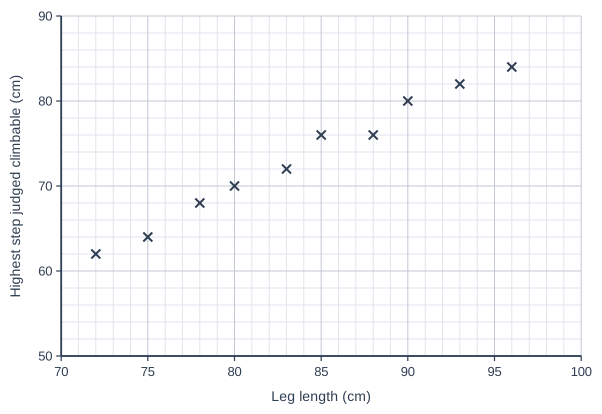
A psychologist, Dr Okwuosa (fictional), asked 10 adults to look at a set of steps of different heights and say which was the highest step they could climb onto without using their hands. She also measured each adult's leg length. The scatter diagram shows the results.

Identify the type of correlation shown in the scatter diagram. Explain how these results support Gibson's idea of affordances.

Scatter graph on a grid of small squares. The horizontal axis is "Leg length (cm)", from 70 to 100, numbered every 5, with 5 small squares between numbered values (each small square is 1). The vertical axis is "Highest step judged climbable (cm)", from 50 to 90, numbered every 10, with 5 small squares between numbered values (each small square is 2). 10 points are plotted as crosses: (72, 62), (75, 64), (78, 68), (80, 70), (83, 72), (85, 76), (88, 76), (90, 80), (93, 82) and (96, 84).

Model answer

Positive correlation. Adults with longer legs judged higher steps to be climbable, so the height of step that affords climbing depends on the relationship between the step and each person's own body. The participants could judge this just by looking, without measuring anything, which supports Gibson's idea that affordances - the possibilities for action that objects offer - are perceived directly, in relation to the perceiver.

Explanation

The scatter diagram shows a positive correlation: as leg length increases, so does the highest step judged climbable. To explain the support for affordances, link this pattern to the idea that what an object allows us to do is perceived directly and depends on our own body. Remember that a correlation does not show cause, and participants may also have learnt from experience which steps they can climb.

Mark scheme
  1. 1 mark

    Positive correlation

    Accept 'strong positive correlation'. Do not accept negative correlation or no correlation.

  2. 2 marks

    Up to 2 marks for explaining how the results support Gibson's idea of affordances. 2 marks: a clear and accurate explanation. 1 mark: a limited or muddled explanation.

    Possible content: adults with longer legs judged higher steps to be climbable, so what a step affords (climbing) depends on the relationship between the step and the perceiver's own body; the participants judged this simply by looking, without measuring or calculating, which supports Gibson's claim that affordances are perceived directly from the environment, without inference; the same step affords climbing for one person but not for another, so affordances are perceived in relation to the perceiver. NOTE: For 2 marks the answer must use the pattern in the results (longer legs, higher step judged climbable) AND link it to affordances being possibilities for action that are perceived directly or in relation to the perceiver. NOTE: Answers that only define affordances without using the results are limited (MAX 1 mark). Credit other relevant content.

Question 4

6 marks

Read the following information.

Femi passed his driving test last month. On his first drive on a motorway, he found that he could judge his speed, keep a safe distance from the car in front and spot when there was a gap he could move into, all without having to think about it.

How can Gibson's direct theory of perception be used to explain Femi's driving? Refer to Femi in your answer.

Model answer

Gibson's direct theory says that the real world provides enough information for us to perceive it directly, without inference, and that our perceptual abilities are innate. As we move, the optic array changes in ways that tell us about speed, distance and direction, through optic flow and motion parallax, and we perceive the affordances of objects - what they allow us to do.

This could explain Femi's driving. As he drives forwards, the road and the surroundings flow outwards and past him; the faster this optic flow, the faster he is going, so he can judge his speed directly. As he gets closer to the car in front, its image expands in his view, telling him directly that the gap is shrinking, so he can keep a safe distance. A gap in the next lane is perceived as an affordance - a space he can move into - without any calculation. This explains why he could do all of this without having to think about it.

However, the theory may not fully explain Femi's behaviour. He has had driving lessons, so his skill may depend on past experience and learnt knowledge, as Gregory's constructivist theory argues, rather than on innate abilities. Gibson's theory would also struggle to explain mistakes, for example if Femi misjudged a gap in fog or heavy rain. Overall, Gibson's theory explains well how Femi uses rich information on a clear motorway, but learning is likely to play a part too.

Explanation

This question has equal marks for describing the theory, applying it to Femi and analysing how well it explains his driving, so a top answer does all three. Linking optic flow to judging speed and affordances to spotting a gap shows clear application, and noting that his driving lessons point to learning gives balanced analysis. End with a judgement about how far the theory explains his behaviour.

Mark scheme
  1. 6 marks

    Levels of response (6 marks). AO1 - 2 marks, AO2 - 2 marks and AO3 - 2 marks.
    Level 3 Detailed (5-6 marks): AO1: Relevant knowledge and understanding of Gibson's direct theory of perception is accurate with detail. AO2: Clear and accurate application of knowledge and understanding of Gibson's direct theory of perception as referred to in the information about Femi. AO3: Analysis of how Gibson's direct theory of perception can be used to explain Femi's driving is effective. Any conclusions drawn are sound and fully expressed. Relevant terminology is used consistently throughout. The answer demonstrates a high level of substantiated reasoning, and is clear, coherent and focused.
    Level 2 Clear (3-4 marks): AO1: Relevant knowledge and understanding of Gibson's direct theory of perception is present but there are occasional inaccuracies/omissions. AO2: Reasonable application of knowledge and understanding of Gibson's direct theory of perception as referred to in the information about Femi. AO3: There may be some effective analysis of how Gibson's direct theory of perception can be used to explain Femi's driving. There may be an attempt to draw conclusions. Relevant terminology is occasionally used. The answer occasionally demonstrates substantiated reasoning, but may lack clarity, coherence, focus and logical structure.
    Level 1 Basic (1-2 marks): AO1: Knowledge and understanding of Gibson's direct theory of perception is present but limited. AO2: Limited or muddled application of knowledge and understanding of Gibson's direct theory of perception as referred to in the information about Femi. AO3: Analysis of how Gibson's direct theory of perception can be used to explain Femi's driving is of limited effectiveness or muddled or may be absent. Any attempts to draw conclusions are not always successful or present. Relevant terminology may not be used at all or may be muddled.
    0 marks: No relevant content.

    Possible content (not a checklist): AO1 - the real world presents enough information for direct perception without inference; perception is innate and bottom-up; the optic array contains rich information about distance, speed and direction, such as optic flow and motion parallax; affordances are the possibilities for action that objects offer and are perceived directly. AO2 - as Femi drives forwards, the road and surroundings flow outwards and past him, and the rate of this optic flow tells him his speed directly; as he closes on the car in front, its image expands in his view, telling him directly that the gap is shrinking; roadside objects close to him appear to move faster than distant ones (motion parallax), giving information about distance; a gap in the next lane is perceived as an affordance (a space he can move into); he does all this without thinking, which fits the idea that no inference is needed. AO3 - strength: the theory explains why Femi's perception is fast and accurate in a real, information-rich environment, and Gibson developed his ideas from real-world situations such as pilots landing; weakness: Femi has had driving lessons, so his skill may depend on past experience and learnt knowledge, as Gregory's constructivist theory argues, rather than on innate abilities; the theory would struggle to explain mistakes, e.g. if Femi misjudged a gap in fog, heavy rain or at night; conclusion, e.g. Gibson's theory explains Femi's perception on a clear motorway well, but learning is likely to play a part too. Credit other relevant content. NOTE: The AO2 may be embedded in the AO1 or separate; both are equally acceptable. NOTE: Reference to Femi judging his speed, keeping a safe distance or spotting a gap is not enough by itself for relevant content because it is part of the question stem.

Ready to try the rest? Every answer you write is marked against the mark scheme, so you can see exactly where the marks are.

Study Helper Hints first, answers after you try

Stuck on this one? Ask for a hint and I’ll point you in the right direction, without giving the answer away. Once you’ve checked your answer, I’ll show you how the marks are awarded.