
Level:
Correct: 0
Incorrect: 0
Marks: 0/0
Exam Practice
Course:
Topics:
AQA GCSE Psychology (Paper 1) Smart practice A mixed round aimed at your weak spots
Unit 1
Memory
Processes of memory
Processes of memory
Memory as an active process
Unit 2
Perception
Sensation and perception; visual cues and constancies
Sensation and perception, visual cues and constancies
Gibson's direct theory of perception - the influence of nature
Gibson's direct theory of perception
Visual illusions
Visual illusions
Gregory's constructivist theory of perception - the influence of nurture
Gregory's constructivist theory of perception
Factors affecting perception
Unit 3
Development
Early brain development
Piaget's stage theory and the development of intelligence; the role of Piaget's theory in education
Piaget's stage theory and the development of intelligence
The effects of learning on development
Unit 4
Research methods
Avg
score:
–
Topics
done:
0/24

Processes of memory

Practise 26 exam-style questions on Processes of memory for AQA GCSE Psychology (Paper 1). Write your answer as you would in the exam and get it marked in seconds against the mark scheme, point by point, with the Study Helper on hand if you get stuck.

  • 26 questions
  • 1–9 marks each
  • Instant marking
  • No sign-up needed
20 questions, marked as you go

Sample questions with model answers

Here are 4 of the questions in this topic, each with a model answer, an explanation of why it earns the marks and the mark scheme an examiner would use.

Question 1

1 mark

Kwame is learning spellings. He knows that 'knight' is pronounced the same as 'night', and when he writes the words from memory he often mixes them up.

Which type of encoding is suggested by Kwame mixing up these two words?

Choose your answer.

  • Acoustic
  • Procedural
  • Semantic
  • Visual

Model answer

Acoustic

Explanation

Acoustic encoding stores information by its sound. 'Knight' and 'night' sound the same but look different and mean different things, so confusing them suggests they were stored by their sound. Semantic encoding is by meaning and visual encoding is by appearance, while procedural is a type of long-term memory, not a type of encoding.

Mark scheme
  1. 1 mark

    Acoustic

    If more than one option is given, 0 marks.
Question 2

2 marks

Read the following information.

June is 82. She can describe her wedding day in 1966 in detail, including what the weather was like. She knows that water boils at 100 degrees Celsius and that 'bonjour' is French for 'hello'. She can still knit a scarf while watching television, without looking at her hands.

Identify one example of semantic memory and one example of procedural memory from the information about June.

Model answer

Semantic memory: June knows that water boils at 100 degrees Celsius.
Procedural memory: June can knit a scarf without looking at her hands.

Explanation

Facts and meanings (the boiling point of water, what 'bonjour' means) are semantic, and a skill done automatically, like knitting without looking, is procedural. The wedding day is a personal experience, so it is episodic and earns no credit here. AQA's June 2022 Paper 1 report notes that some students lost marks by giving their own examples instead of using the information in the question.

Mark scheme
  1. 1 mark

    1 mark for a correct example of semantic memory: knowing that water boils at 100 degrees Celsius / knowing that 'bonjour' is French for 'hello'.

    Credit other appropriate wording. Do not credit the wedding day (episodic memory). NOTE: Examples must come from the information about June; the candidate's own examples are not creditworthy. NOTE: If the candidate has written more than one answer, only mark the first one.

  2. 1 mark

    1 mark for a correct example of procedural memory: knitting a scarf (without looking at her hands).

    Credit other appropriate wording. Do not credit watching television on its own. NOTE: Examples must come from the information about June; the candidate's own examples are not creditworthy. NOTE: If the candidate has written more than one answer, only mark the first one.

Question 3

3 marks

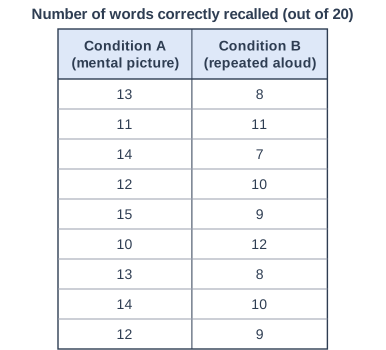
In an experiment on encoding, two groups of nine students heard the same list of 20 words. Students in Condition A made a mental picture of each word. Students in Condition B repeated each word aloud. The table shows the number of words each student correctly recalled.

Calculate the mean number of words recalled in Condition A. Give your answer to three significant figures. Show your workings.

Number of words correctly recalled (out of 20). Table with columns "Condition A (mental picture)", "Condition B (repeated aloud)". Condition A (mental picture): 13; Condition B (repeated aloud): 8 | Condition A (mental picture): 11; Condition B (repeated aloud): 11 | Condition A (mental picture): 14; Condition B (repeated aloud): 7 | Condition A (mental picture): 12; Condition B (repeated aloud): 10 | Condition A (mental picture): 15; Condition B (repeated aloud): 9 | Condition A (mental picture): 10; Condition B (repeated aloud): 12 | Condition A (mental picture): 13; Condition B (repeated aloud): 8 | Condition A (mental picture): 14; Condition B (repeated aloud): 10 | Condition A (mental picture): 12; Condition B (repeated aloud): 9.

Model answer

Total for Condition A = 13 + 11 + 14 + 12 + 15 + 10 + 13 + 14 + 12 = 114
Mean = 114 รท 9 = 12.666...
Mean = 12.7 (to three significant figures)

Explanation

Add the nine scores in Condition A (114) and divide by the number of students (9) to get 12.666... Three significant figures means keeping the first three digits, 1, 2 and 6, and rounding up because the next digit is 6, giving 12.7. Writing 12.6 is a common rounding error, and using Condition B's scores is a common misreading of the table.

Mark scheme
  1. 3 marks

    3 marks for the correct mean to three significant figures: 12.7. 2 marks for the correct mean but not rounded to three significant figures (e.g. 12.67, 12.666...) OR 2 marks for the 'correct' mean but rounded incorrectly (e.g. 12.6). 1 mark for correct workings but incorrect/no answer: 114 / 9.

    A correct answer of 12.7 with no workings scores full marks. Accept 12.67 or 12.666... (or 12.6 recurring) or 13 for 2 marks (correct but not to three significant figures). 1 mark for correct workings shown (adding the nine scores to get 114 and dividing by 9) with an incorrect or missing answer. 12.6 (rounded incorrectly) scores 2 marks, as in AQA's June 2024 Paper 2 mark scheme. Do not accept the mean of Condition B (9.33) for more than the workings mark.

Question 4

6 marks

Imagine you are going to carry out an experiment to find out whether people remember words better when they think about the words' meaning than when they think about how the words sound.

Describe how you would carry out this experiment. You need to include:
- the experimental design you would use and why it is suitable
- the task participants would do and the data you would collect
- the results you would expect to find.

Model answer

I would use an independent groups design, with different participants in each condition, so that there are no order effects such as practice from doing two memory tasks, and participants are less likely to guess the aim.

Each participant would see the same 20 common words on a screen, one every 3 seconds. In the meaning condition, participants would answer a question about each word's meaning, for example whether it is a type of food. In the sound condition, they would answer a question about each word's sound, for example whether it rhymes with 'bat'. Afterwards both groups would have two minutes to write down as many of the words as they can remember. I would record the number of words each participant correctly recalled and calculate the mean for each condition.

I would expect participants in the meaning condition to recall more words, on average, than participants in the sound condition.

Explanation

Full marks need all three bullet points: a named design with a reason that fits this experiment, a task where the only difference is thinking about meaning versus sound plus the data recorded (words correctly recalled), and results that name both conditions. AQA's June 2025 Paper 1 report notes that results written only as 'Group 1' and 'Group 2' were limited to 1 mark, so always name the conditions.

Mark scheme
  1. 2 marks

    Up to 2 marks for a suitable experimental design that is justified. 2 marks: a suitable design with a clear justification that fits this experiment. 1 mark: a suitable design identified with no justification, or with a muddled justification.

    Examples: 'Independent groups, so that there are no order effects, such as practice, from doing two memory tasks' (2 marks). 'Repeated measures, so that differences in participants' memory ability cannot explain the results' (2 marks). 'Independent groups' (1 mark). Accept matched pairs with a relevant justification. Accept other relevant justifications, e.g. participants are less likely to guess the aim if they only do one condition. PLUS

  2. 2 marks

    Up to 2 marks for a description of the task and the data to be collected. 2 marks: a clear and accurate description of a task in which participants process words by their meaning in one condition and by their sound in the other, AND the data collected (e.g. the number of words correctly recalled). 1 mark: a limited or muddled description, or a task with no data (or data with no clear task).

    Example: 'Participants see 20 words; one group answers a question about each word's meaning (Is it a type of food?), the other a question about its sound (Does it rhyme with bat?); then they write down as many words as they can in two minutes and I count the number correctly recalled' (2 marks). NOTE: The task and results marks can only be awarded if the experiment compares thinking about meaning with thinking about sound. NOTE: A task based on a known study is creditworthy if it is clearly described and compares thinking about meaning with thinking about sound; naming a study without describing the task is limited (max 1 mark for this part). PLUS

  3. 2 marks

    Up to 2 marks for the results expected. 2 marks: a clear and accurate description of the expected results with both conditions of the independent variable (more words recalled after thinking about meaning than after thinking about sound). 1 mark: a limited or muddled description of the expected results.

    Examples: 'The meaning group will recall more words, on average, than the sound group' (2 marks). 'Group A will recall more words than Group B' with the conditions not identified (1 mark). 'More words will be recalled' (1 mark). Do not credit results that do not fit the task described.

Ready to try the rest? Every answer you write is marked against the mark scheme, so you can see exactly where the marks are.

Study Helper Hints first, answers after you try

Stuck on this one? Ask for a hint and I’ll point you in the right direction, without giving the answer away. Once you’ve checked your answer, I’ll show you how the marks are awarded.