
Level:
Correct: 0
Incorrect: 0
Marks: 0/0
Exam Practice
Course:
Topics:
AQA GCSE Psychology (Paper 1) Smart practice A mixed round aimed at your weak spots
Unit 1
Memory
Processes of memory
Processes of memory
Memory as an active process
Unit 2
Perception
Sensation and perception; visual cues and constancies
Sensation and perception, visual cues and constancies
Gibson's direct theory of perception - the influence of nature
Gibson's direct theory of perception
Visual illusions
Visual illusions
Gregory's constructivist theory of perception - the influence of nurture
Gregory's constructivist theory of perception
Factors affecting perception
Unit 3
Development
Early brain development
Piaget's stage theory and the development of intelligence; the role of Piaget's theory in education
Piaget's stage theory and the development of intelligence
The effects of learning on development
Unit 4
Research methods
Avg
score:
–
Topics
done:
0/24

Designing research: experiments and designs

Practise 26 exam-style questions on Designing research: experiments and designs for AQA GCSE Psychology (Paper 1). Write your answer as you would in the exam and get it marked in seconds against the mark scheme, point by point, with the Study Helper on hand if you get stuck.

  • 26 questions
  • 1–9 marks each
  • Instant marking
  • No sign-up needed
20 questions, marked as you go

Sample questions with model answers

Here are 4 of the questions in this topic, each with a model answer, an explanation of why it earns the marks and the mark scheme an examiner would use.

Question 1

1 mark

Psychologists choose the type of experiment that suits their research aim.

For which one of the following research aims would a natural experiment be most suitable?

Choose your answer.

  • To find out whether caffeine affects reaction times
  • To find out whether students buy more fruit in a school canteen when it is placed next to the till
  • To find out whether living through a major flood affects children's anxiety levels
  • To find out whether people conform more in groups of three or groups of eight

Model answer

To find out whether living through a major flood affects children's anxiety levels

Explanation

A natural experiment suits an IV that the researcher cannot or should not manipulate, such as living through a flood, so the researcher compares people who have and have not experienced it. The caffeine and group-size aims suit laboratory experiments, where the IV can be controlled, and the canteen fruit aim suits a field experiment, where the IV is changed in an everyday setting.

Mark scheme
  1. 1 mark

    To find out whether living through a major flood affects children's anxiety levels

    If more than one option is given, 0 marks.
Question 2

2 marks

Dr Patel (fictional) asked each participant to complete a reaction-time test twice: first after drinking a glass of water and then after drinking an energy drink.

Explain what is meant by 'order effects'. Use Dr Patel's study in your answer.

Model answer

Order effects are changes in performance caused by the order in which participants do the conditions, rather than by the independent variable. In Dr Patel's study everyone did the reaction-time test after the energy drink second, so they might react faster simply because they had practised the test (a practice effect), or slower because they were bored or tired (a fatigue effect).

Explanation

A clear answer says that the change is caused by doing the task more than once (practice, boredom or fatigue) rather than by the IV, and links it to the energy drink always coming second. Order effects happen in repeated measures designs, because only then does each participant do more than one condition.

Mark scheme
  1. 2 marks

    Up to 2 marks for a definition of order effects. 2 marks: a clear and accurate definition. 1 mark: a limited or muddled definition.

    Possible content: Changes in participants' performance that are caused by the order in which they complete the conditions rather than by the IV, e.g. practice effects (participants get better at the reaction-time test the second time) or fatigue/boredom effects (they do worse the second time). In Dr Patel's study everyone did the energy drink condition second, so faster reaction times might be due to practice rather than the energy drink. Credit other relevant content. NOTE: To be considered clear and accurate, the answer must explain that performance is affected by the order / by doing the task more than once rather than by the IV, AND apply this to Dr Patel's study. NOTE: Naming practice or fatigue effects without explaining them is limited (MAX 1 mark).

Question 3

3 marks

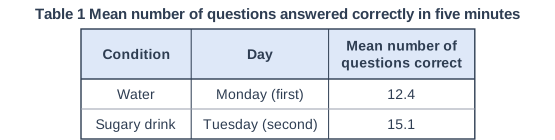
Dr Ferris (fictional) used a repeated measures design to test whether people answer more mental arithmetic questions correctly in five minutes after a sugary drink than after a glass of water. All 20 participants did the water condition on Monday and the sugary drink condition on Tuesday, using a different set of questions of the same difficulty. The results are shown in Table 1.

Dr Ferris concluded that a sugary drink improves mental arithmetic. Use the information in Table 1 to explain why this conclusion may not be valid.

Table 1 Mean number of questions answered correctly in five minutes. Table with columns "Condition", "Day", "Mean number of questions correct". Condition: Water; Day: Monday (first); Mean number of questions correct: 12.4 | Condition: Sugary drink; Day: Tuesday (second); Mean number of questions correct: 15.1.

Model answer

Every participant did the sugary drink condition second, on Tuesday. The mean number of questions answered correctly rose from 12.4 after water to 15.1 after the sugary drink, an increase of 2.7, but this could be a practice effect: by Tuesday the participants had already spent five minutes answering similar mental arithmetic questions, so they may have got better at them whatever they drank. Because the order of the conditions was the same for everyone, Dr Ferris cannot separate the effect of the drink from the effect of practice. She should have counterbalanced, with half the participants doing the sugary drink condition first.

Explanation

The key is spotting that the sugary drink condition always came second, so the improvement of 2.7 questions could be caused by practice rather than the drink. Using the figures from Table 1 and explaining the order effect precisely is what lifts an answer to 3 marks.

Mark scheme
  1. 3 marks

    Up to 3 marks for an explanation. 3 marks: a clear and detailed explanation. 2 marks: a limited explanation. 1 mark: a very limited/muddled explanation.

    Possible content: All participants did the sugary drink condition second, so the higher mean (15.1 compared with 12.4, a difference of 2.7 questions) may be due to a practice effect: by Tuesday participants had already had experience of answering this kind of question under time pressure, so they may have improved anyway. The order of the conditions was the same for everyone, so Dr Ferris cannot tell whether the drink or practice caused the improvement. Other differences between Monday and Tuesday (e.g. tiredness, mood) could also have affected the results. She should have used counterbalancing (half the participants doing each condition first). Credit other relevant content. NOTE: Answers that do not use the data in Table 1 (MAX 2 marks). NOTE: Answers that only state 'order effects' without explanation are very limited.

Question 4

6 marks

You have been asked to carry out an experiment to investigate whether sitting at the front or at the back of a classroom affects the test scores of Year 10 students.

In your answer, identify:
- the type of experiment you would use and why it is suitable
- the experimental design you would use and why it is suitable
- the results you would expect to find from your experiment, including both conditions of the independent variable.

Model answer

Type of experiment: a field experiment, carried out during normal lessons with the teacher deciding where students sit. This is suitable because students would be in their own classroom, having a real lesson and taking a real end-of-topic test, so their behaviour would be natural and the results would have high ecological validity.
Experimental design: independent groups, with students randomly allocated to sit in the front two rows or the back two rows. This is suitable because each student would sit in only one position and take the 50-mark test only once, so there would be no practice effects.
Expected results: I would expect students who sit at the front to have a higher mean score on the 50-mark test than students who sit at the back.

Explanation

Each bullet carries separate marks, so name a type of experiment and a design and justify each one with a reason that fits this study. The expected results must compare both conditions (front and back) using a measurable score to earn both marks.

Mark scheme
  1. 1 mark

    1 mark for identifying a suitable type of experiment.

    e.g. field experiment (during normal lessons, with the teacher deciding where students sit) or laboratory experiment (e.g. a lesson and test in a classroom set up and controlled by the researcher). Do not accept natural experiment, because the researcher would decide where students sit.

  2. 1 mark

    1 mark for an appropriate justification of the type of experiment chosen.

    e.g. field - students would be in their normal classroom with a real lesson and test, so behaviour is natural and ecological validity is higher; laboratory - extraneous variables such as noise, the lesson content and the test can be controlled, so differences in scores can be put down to where students sat. NOTE: The justification must fit the type of experiment identified.

  3. 1 mark

    1 mark for identifying an experimental design.

    Independent groups, repeated measures or matched pairs.

  4. 1 mark

    1 mark for an appropriate justification of the experimental design chosen.

    e.g. independent groups - each student sits in only one position and takes the test once, so there are no practice effects; repeated measures - each student sits at the front for one topic and at the back for another, so differences in ability cannot explain the results (two equally difficult topics and tests would be needed); matched pairs - students matched on previous test scores, so ability is controlled without order effects. NOTE: The design marks can be awarded even if the type of experiment is not suitable.

  5. 2 marks

    Up to 2 marks for the expected results. 2 marks: a clear and accurate description of the expected results with both conditions of the IV. 1 mark: a limited or muddled description of the expected results.

    Examples: 'Students who sit at the front will have a higher mean score on the 50-mark test than students who sit at the back.' (2 marks). 'Students at the front will do better.' (1 mark). Accept expected results that predict lower scores or no difference, as long as both conditions are described clearly.

Ready to try the rest? Every answer you write is marked against the mark scheme, so you can see exactly where the marks are.

Study Helper Hints first, answers after you try

Stuck on this one? Ask for a hint and I’ll point you in the right direction, without giving the answer away. Once you’ve checked your answer, I’ll show you how the marks are awarded.