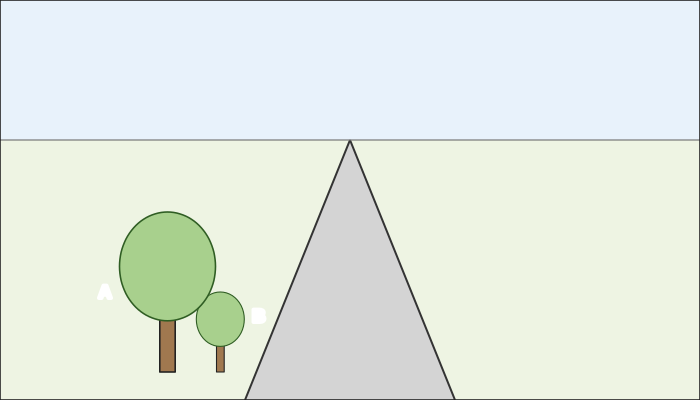
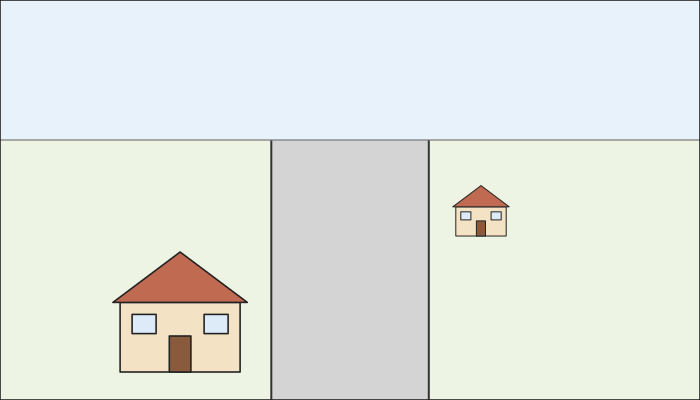
Kai is painting a picture of a long, straight street with people walking along the pavement. He wants some of the people to look a long way away and others to look close to the viewer.
Describe how monocular depth cues help people to perceive depth in a flat picture. Refer to Kai's painting in your answer.
Model answer
Monocular depth cues are cues that can be detected with only one eye, so they can be shown in a flat picture, and they allow the brain to perceive depth in a two-dimensional image.
Height in plane means that objects further away appear higher in the visual field, closer to the horizon, while nearer objects appear lower down. Kai should paint the people who are far away higher up the picture, near the point where the street meets the horizon, and the people close to the viewer near the bottom of the picture.
Relative size means that when two objects are known to be similar in size, the one that looks smaller is perceived as further away. Because viewers assume people are roughly the same size, Kai should paint the distant people much smaller than the near ones.
Occlusion is when one object partly covers another, so the object in front is perceived as closer. Kai could paint some of the nearer people so that they partly hide the people behind them.
Linear perspective is when parallel lines appear to converge as they get further away. Kai should paint the edges of the pavement and the rows of shop fronts so that they get closer together and meet at a point on the horizon, with the distant people placed near that point.
Using several cues together will make the depth in Kai's painting more convincing, because they all give the viewer's brain the same information about distance.
Explanation
A Level 3 answer describes each cue accurately in general terms (AO1) and then says exactly how Kai could use it in his painting (AO2). Covering three or four cues in detail is better than listing all four with no explanation. Binocular cues cannot be shown in a flat painting, so they earn no credit here.