
Level:
Correct: 0
Incorrect: 0
Marks: 0/0
Exam Practice
Course:
Topics:
AQA GCSE Psychology (Paper 1) Smart practice A mixed round aimed at your weak spots
Unit 1
Memory
Processes of memory
Processes of memory
Memory as an active process
Unit 2
Perception
Sensation and perception; visual cues and constancies
Sensation and perception, visual cues and constancies
Gibson's direct theory of perception - the influence of nature
Gibson's direct theory of perception
Visual illusions
Visual illusions
Gregory's constructivist theory of perception - the influence of nurture
Gregory's constructivist theory of perception
Factors affecting perception
Unit 3
Development
Early brain development
Piaget's stage theory and the development of intelligence; the role of Piaget's theory in education
Piaget's stage theory and the development of intelligence
The effects of learning on development
Unit 4
Research methods
Avg
score:
–
Topics
done:
0/24

Descriptive statistics

Practise 24 exam-style questions on Descriptive statistics for AQA GCSE Psychology (Paper 1). Write your answer as you would in the exam and get it marked in seconds against the mark scheme, point by point, with the Study Helper on hand if you get stuck.

  • 24 questions
  • 1–6 marks each
  • Instant marking
  • No sign-up needed
20 questions, marked as you go

Sample questions with model answers

Here are 4 of the questions in this topic, each with a model answer, an explanation of why it earns the marks and the mark scheme an examiner would use.

Question 1

1 mark

In a study of depth perception, eight participants stood in a park and estimated how far away a particular tree was, in metres. Their estimates were:

14, 22, 18, 25, 16, 20, 30, 19

What is the median of these estimates?

Model answer

In order: 14, 16, 18, 19, 20, 22, 25, 30
The two middle values are 19 and 20, so the median = (19 + 20) ÷ 2 = 19.5 m

Explanation

Put the estimates in order first. With an even number of values there are two middle values (19 and 20), so the median is halfway between them: 19.5 m. AQA's June 2024 Paper 2 report notes that only half of students found the median correctly when there was an even number of scores, often because they gave the mean instead.

Mark scheme
  1. 1 mark

    1 mark for the correct answer: 19.5

    This is the only accepted response. Accept 19.5 m. Do not accept 19 or 20 (only one of the two middle values) or 20.5 (the mean, or the middle of the unordered list).
Question 2

2 marks

A researcher asked 30 students which revision method they used most often: flashcards, mind maps, re-reading notes or practice questions. She used the mode to identify the most popular method.

Which two of the following statements about the mode are correct?

Choose two answers.

It can be used with data in categories, such as revision methods   It is found by adding all the scores and dividing by the number of scores   A set of data can have more than one mode   It is always the middle value when the data are put in order   It is the difference between the highest and lowest values

Model answer

It can be used with data in categories, such as revision methods; A set of data can have more than one mode

Explanation

The mode is the most frequently occurring value, so it is the only average that works for categories such as revision methods, and if two values are equally common there are two modes. The other statements describe the mean (adding and dividing), the median (the middle value) and the range (highest minus lowest).

Mark scheme
  1. 1 mark

    It can be used with data in categories, such as revision methods

    If more than two options are given, only mark the first two.

  2. 1 mark

    A set of data can have more than one mode

    If more than two options are given, only mark the first two.

Question 3

2 marks

A psychologist tested 16 students on a concentration task one morning. Eight students had slept for at least eight hours the night before and eight had slept for less than five hours. Both groups had a mean score of 15. The range of scores was 6 for the students who had slept well and 23 for the students who had slept badly.

What do the ranges suggest about the scores in the two groups? Explain your answer.

Model answer

The scores of the students who had slept badly were far more spread out than the scores of those who had slept well (a range of 23 compared with 6). This suggests that the well-rested students performed similarly to each other, but lack of sleep affected students very differently: some probably struggled to concentrate while others coped well. The identical means (15) would have hidden this difference.

Explanation

A range describes spread, not the average, so the larger range (23) means the scores of the students who slept badly varied much more than the scores of those who slept well (6). For 2 marks, go beyond restating the numbers and say what they suggest, for example that lack of sleep affected some students far more than others. Notice that the identical means would have hidden this difference.

Mark scheme
  1. 2 marks

    Up to 2 marks for a suggestion with an explanation. 2 marks: a clear and accurate explanation. 1 mark: a limited or muddled explanation.

    Possible content: The scores of the students who had slept badly were much more spread out than the scores of those who had slept well (a range of 23 compared with 6), even though the mean was the same (15). This suggests that the students who slept well performed more consistently/similarly, while lack of sleep affected students very differently: some may have coped well and others badly. The means alone would hide this difference. Credit other relevant content. NOTE: To be considered clear and accurate, the answer must compare the spread of scores in both groups using the ranges (or the idea of consistency) AND offer an interpretation. Example 2-mark answer: 'Scores were far more spread out for the students who slept badly (23 compared with 6), so their concentration varied much more; some coped with little sleep while others struggled, even though the average was the same.' Example 1-mark answer: 'The students who slept badly had a bigger range.'

Question 4

5 marks

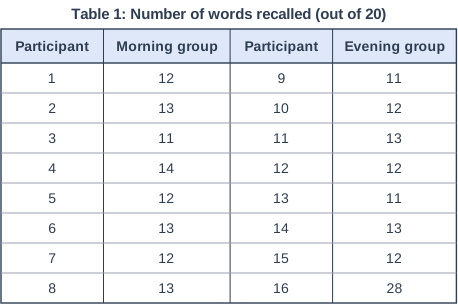
A researcher tested whether time of day affects memory. Eight participants learned a list of 20 words in the morning and eight different participants learned the list in the evening. Table 1 shows the number of words each participant recalled. The researcher calculated the range for each group to compare how spread out the scores were.

Briefly evaluate the use of the range as a measure of dispersion. In your answer, refer to the results in Table 1.

Table 1: Number of words recalled (out of 20). Table with columns "Participant", "Morning group", "Participant", "Evening group". Participant: 1; Morning group: 12; Participant: 9; Evening group: 11 | Participant: 2; Morning group: 13; Participant: 10; Evening group: 12 | Participant: 3; Morning group: 11; Participant: 11; Evening group: 13 | Participant: 4; Morning group: 14; Participant: 12; Evening group: 12 | Participant: 5; Morning group: 12; Participant: 13; Evening group: 11 | Participant: 6; Morning group: 13; Participant: 14; Evening group: 13 | Participant: 7; Morning group: 12; Participant: 15; Evening group: 12 | Participant: 8; Morning group: 13; Participant: 16; Evening group: 28.

Model answer

The range has the strength of being quick and easy to calculate: the morning group's range is 14 - 11 = 3 and the evening group's is 28 - 11 = 17. It gives a simple first impression of how spread out the scores are, and here it shows that the evening group contains at least one unusual score.

However, the range only uses the highest and lowest scores and ignores everything in between, so it is easily distorted by one extreme score. In the evening group, seven of the eight participants recalled between 11 and 13 words, but participant 16 recalled 28. Because of this single score, the evening range (17) suggests that the evening scores were much more spread out than the morning scores, when without it the evening range would be only 2, even smaller than the morning range of 3.

Overall, the range is a useful quick measure, but it can be misleading when there is an extreme score, so researchers should look at the raw data as well.

Explanation

Top-level answers calculate both ranges, show how one extreme score (28) makes the evening range misleading, and balance this weakness against the range's strengths. They end with a conclusion about when the range is, and is not, a good measure of spread. Answers that list strengths and weaknesses of the range without using Table 1 cannot reach the top level.

Mark scheme
  1. 5 marks

    Levels of response (5 marks). AO2 - 2 marks and AO3 - 3 marks.
    Level 3 Detailed (4-5 marks): AO2: Clear application of knowledge and understanding of evaluation of the range to the study of time of day and memory. AO3: Analysis and evaluation of the use of the range as a measure of dispersion is effective. Any conclusions drawn are sound and fully expressed. Relevant terminology is used consistently throughout. The answer demonstrates a high level of substantiated reasoning, is clear, coherent and focused.
    Level 2 Clear (2-3 marks): AO2: Reasonable application of knowledge and understanding of evaluation of the range to the study of time of day and memory. AO3: There may be some effective analysis and evaluation of the use of the range as a measure of dispersion. There may be an attempt to draw conclusions. Relevant terminology is usually used. The answer frequently demonstrates substantiated reasoning, and is clear, generally coherent and focused although structure may lack some logic.
    Level 1 Basic (1 mark): AO2: Limited application of knowledge and understanding of evaluation of the range to the study of time of day and memory. AO3: Analysis and evaluation of the use of the range as a measure of dispersion is of limited effectiveness or may be absent. Any attempts to draw conclusions are not always successful or present. Relevant terminology is occasionally used. The answer occasionally demonstrates substantiated reasoning, but may lack clarity, coherence, focus and logical structure.
    0 marks: No relevant content.

    Possible content (not a checklist): AO2 - The morning group's range is 3 (14 - 11) and the evening group's range is 17 (28 - 11). This suggests that the evening scores were far more spread out, but this is caused by just one participant (participant 16, who recalled 28 words); without this score the evening range would be only 2 (13 - 11), smaller than the morning range. So the range gives a misleading picture of the evening group. Accept ranges calculated as highest - lowest + 1 (4, 18 and 3). AO3 - Strengths: the range is quick and easy to calculate and to understand; it gives a simple indication of how spread out the scores are; it takes extreme scores into account, which may be important (e.g. one person who recalled far more words than the others). Weaknesses: it uses only the highest and lowest scores, so it ignores how all the other scores are spread; one extreme score can make the range very large and unrepresentative of the rest of the data. Conclusion: the range is useful as a quick first measure of spread but should be interpreted with care, alongside the raw data and other descriptive statistics, especially when there is an extreme score. Credit other relevant content. NOTE: The AO2 may be embedded in the AO3 or separate; both are equally acceptable. NOTE: Reference to 'the range being calculated for each group' is not enough by itself for relevant content because it is part of the question stem.

Ready to try the rest? Every answer you write is marked against the mark scheme, so you can see exactly where the marks are.

Study Helper Hints first, answers after you try

Stuck on this one? Ask for a hint and I’ll point you in the right direction, without giving the answer away. Once you’ve checked your answer, I’ll show you how the marks are awarded.