Level:
Correct: 0
Incorrect: 0
Marks: 0/0
Exam Practice
Course:
Topics:
AQA GCSE Psychology (Paper 1) Smart practice A mixed round aimed at your weak spots
Unit 1
Memory
Processes of memory
Processes of memory
Memory as an active process
Unit 2
Perception
Sensation and perception; visual cues and constancies
Sensation and perception, visual cues and constancies
Gibson's direct theory of perception - the influence of nature
Gibson's direct theory of perception
Visual illusions
Visual illusions
Gregory's constructivist theory of perception - the influence of nurture
Gregory's constructivist theory of perception
Factors affecting perception
Unit 3
Development
Early brain development
Piaget's stage theory and the development of intelligence; the role of Piaget's theory in education
Piaget's stage theory and the development of intelligence
The effects of learning on development
Unit 4
Research methods
Avg
score:
–
Topics
done:
0/24

Structures of memory: the multi-store model

Practise 31 exam-style questions on Structures of memory: the multi-store model for AQA GCSE Psychology (Paper 1). Write your answer as you would in the exam and get it marked in seconds against the mark scheme, point by point, with the Study Helper on hand if you get stuck.

  • 31 questions
  • 1–9 marks each
  • Instant marking
  • No sign-up needed
20 questions, marked as you go

Sample questions with model answers

Here are 4 of the questions in this topic, each with a model answer, an explanation of why it earns the marks and the mark scheme an examiner would use.

Question 1

1 mark

In a serial position experiment, participants hear a list of 20 words and then recall as many as they can, in any order.

According to the multi-store model, which words are recalled well because they are still in short-term memory?

Choose your answer.

  • The first few words
  • The words in the middle
  • The last few words
  • All the words equally

Model answer

The last few words

Explanation

The recency effect is explained by the last few words still being in short-term memory when recall begins. The first few words are recalled well for a different reason: they have been rehearsed and transferred to long-term memory (the primacy effect). Short-term memory holds only about 7 plus or minus 2 items, so it cannot hold all 20 words.

Mark scheme
  1. 1 mark

    The last few words

    If more than one option is given, 0 marks.

Question 2

2 marks

Murdock found both a primacy effect and a recency effect in his serial position curve study.

Outline the conclusions that were drawn from these two effects.

Model answer

The primacy effect was taken to show that the first words had been rehearsed and transferred to long-term memory, so they could be recalled from there. The recency effect was taken to show that the last words were still in short-term memory when recall began. Together these suggest there are separate short-term and long-term stores.

Explanation

Each mark needs the right store linked to the right effect: start of the list with long-term memory, end of the list with short-term memory. Swapping them is the commonest error, and saying only that there are 'two stores' does not show which effect each store explains.

Mark scheme
  1. 1 mark

    1 mark for the primacy effect: the first words were recalled well because they had been (rehearsed and) transferred to long-term memory.

    Accept: the first words were stored in long-term memory. Do not accept 'the first words were in short-term memory'.

  2. 1 mark

    1 mark for the recency effect: the last words were recalled well because they were still in short-term memory (when recall began).

    Do not accept 'the last words were in long-term memory'. NOTE: A general conclusion that there are separate short-term and long-term memory stores, without linking either store to the start or the end of the list, gains 1 mark only. Credit 'the likelihood of recalling a word depends on its position in the list' as an alternative for one mark only.

Question 3

3 marks

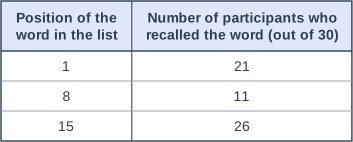
In a serial position experiment, 30 participants each heard a list of 15 words and then recalled as many as they could. The table shows how many participants recalled the words in three of the positions.

Calculate the percentage of participants who recalled the word in position 8. Give your answer to two significant figures. Show your workings.

Table with columns "Position of the word in the list", "Number of participants who recalled the word (out of 30)". Position of the word in the list: 1; Number of participants who recalled the word (out of 30): 21 | Position of the word in the list: 8; Number of participants who recalled the word (out of 30): 11 | Position of the word in the list: 15; Number of participants who recalled the word (out of 30): 26.

Model answer

11 ÷ 30 = 0.3666...
0.3666... × 100 = 36.666...%
To two significant figures: 37%

Explanation

Divide the number of participants who recalled the word (11) by the total (30) and multiply by 100 to get 36.666...%. To two significant figures you keep the 3 and the 6 and round up, because the next digit is 6, giving 37%. AQA's June 2023 Paper 1 report identifies giving answers to two significant figures as an area of particular weakness, so check your rounding.

Mark scheme
  1. 3 marks

    3 marks for the correct percentage to two significant figures: 37%. 2 marks for the correct percentage but not rounded to two significant figures (e.g. 36.7%, 36.67%) OR 2 marks for the 'correct' percentage but rounded incorrectly (e.g. 36%). 1 mark for correct workings but incorrect/no answer: 11 / 30 × 100.

    A correct answer of 37% with no workings scores full marks. Accept 37 without the % sign. 36% (rounded incorrectly) scores 2 marks. An answer of 0.37 or 0.367 (a decimal, not a percentage) gains 1 mark. Do not accept percentages based on position 1 (70%) or position 15 (86.7%).

Question 4

6 marks

Read the following information.

At a busy party, Noor is chatting with friends while music plays. She hardly notices the other conversations around her, but she turns round when someone across the room says her name. Her friend introduces her to Theo, and Noor repeats 'Theo, Theo' in her head while they talk. A month later she sees Theo in town and recalls his name straight away.

Describe the multi-store model of memory. Refer to Noor in your answer.

Model answer

The multi-store model describes memory as three separate stores, with information flowing between them in a fixed order. All the information from our senses first enters sensory memory, which holds it in the same form as it was received from the senses, has a very large capacity and lasts less than one second. At the party, all the music and conversations reach Noor's sensory memory, but most of it is lost almost immediately because she does not pay attention to it.

Information that we pay attention to is transferred to short-term memory. When Noor hears her name across the room, she attends to it, so it passes into her short-term memory. Short-term memory mainly encodes information acoustically, has a capacity of about 7 plus or minus 2 items and holds information for up to 30 seconds. Information in short-term memory is lost unless it is rehearsed.

Rehearsal keeps information in short-term memory and transfers it to long-term memory. By repeating 'Theo, Theo' in her head while they talk, Noor rehearses his name, so it is transferred to her long-term memory. Long-term memory mainly encodes information semantically, has an unlimited capacity and can hold information for up to a lifetime.

When information is needed, it is retrieved from long-term memory back into short-term memory. A month later, when Noor sees Theo in town, she retrieves his name from long-term memory and recalls it straight away.

Explanation

Level 3 answers describe all three stores with their coding, capacity and duration, explain the roles of attention and rehearsal, and match each stage to a moment at the party. Answers that list the stores without the processes that move information between them, or that add evaluation, lose time and marks.

Mark scheme
  1. 6 marks

    Levels of response (6 marks). AO1 - 4 marks and AO2 - 2 marks.
    Level 3 Detailed (5-6 marks): AO1: Relevant knowledge and understanding of the multi-store model of memory is accurate with detail. AO2: Clear and accurate application of knowledge and understanding of the multi-store model of memory to Noor's experiences at the party. Relevant terminology is used consistently throughout. The answer demonstrates a high level of substantiated reasoning, and is clear, coherent and focused.
    Level 2 Clear (3-4 marks): AO1: Relevant knowledge and understanding of the multi-store model of memory is present but there are occasional inaccuracies/omissions. AO2: Reasonable application of knowledge and understanding of the multi-store model of memory to Noor's experiences at the party. Relevant terminology is usually used. The answer frequently demonstrates substantiated reasoning and is clear, generally coherent and focused although structure may lack some logic.
    Level 1 Basic (1-2 marks): AO1: Knowledge and understanding of the multi-store model of memory is present but limited. AO2: Limited application of knowledge and understanding of the multi-store model of memory to Noor's experiences at the party. Relevant terminology is occasionally used. The answer occasionally demonstrates substantiated reasoning, but may lack clarity, coherence, focus and logical structure.
    0 marks: No relevant content.

    Possible content (not a checklist): AO1 - Information flows through three stores: sensory, short-term and long-term memory. Sensory memory: coding in the same form as received from the senses, very large capacity, duration less than one second. Information that is attended to is transferred to short-term memory; unattended information is lost. Short-term memory: mainly acoustic coding, capacity about 7 plus or minus 2 items, duration up to 30 seconds. Rehearsal keeps information in short-term memory and transfers it to long-term memory; unrehearsed information is lost. Long-term memory: mainly semantic coding, unlimited capacity, duration up to a lifetime. Information is retrieved from long-term memory back into short-term memory when needed. AO2 - All the sounds at the party reach Noor's sensory memory, but most are lost because she does not attend to them; she attends to her name, so it passes into short-term memory; repeating 'Theo, Theo' is rehearsal, which transfers his name to long-term memory; a month later she retrieves his name from long-term memory. Credit other relevant content. NOTE: The AO2 may be embedded in the AO1 or separate; both are equally acceptable. NOTE: Evaluation of the model is not required and gains no credit. NOTE: Reference to Noor's actions is not enough by itself for relevant content because it is part of the question stem.

Ready to try the rest? Every answer you write is marked against the mark scheme, so you can see exactly where the marks are.

Study Helper Hints first, answers after you try

Stuck on this one? Ask for a hint and I’ll point you in the right direction, without giving the answer away. Once you’ve checked your answer, I’ll show you how the marks are awarded.