
Level:
Correct: 0
Incorrect: 0
Marks: 0/0
Exam Practice
Course:
Topics:
AQA GCSE Psychology (Paper 1) Smart practice A mixed round aimed at your weak spots
Unit 1
Memory
Processes of memory
Processes of memory
Memory as an active process
Unit 2
Perception
Sensation and perception; visual cues and constancies
Sensation and perception, visual cues and constancies
Gibson's direct theory of perception - the influence of nature
Gibson's direct theory of perception
Visual illusions
Visual illusions
Gregory's constructivist theory of perception - the influence of nurture
Gregory's constructivist theory of perception
Factors affecting perception
Unit 3
Development
Early brain development
Piaget's stage theory and the development of intelligence; the role of Piaget's theory in education
Piaget's stage theory and the development of intelligence
The effects of learning on development
Unit 4
Research methods
Avg
score:
–
Topics
done:
0/24

Early brain development

Practise 22 exam-style questions on Early brain development for AQA GCSE Psychology (Paper 1). Write your answer as you would in the exam and get it marked in seconds against the mark scheme, point by point, with the Study Helper on hand if you get stuck.

  • 22 questions
  • 1–9 marks each
  • Instant marking
  • No sign-up needed
20 questions, marked as you go

Sample questions with model answers

Here are 4 of the questions in this topic, each with a model answer, an explanation of why it earns the marks and the mark scheme an examiner would use.

Question 1

1 mark

The flow chart shows how the main structures of the brain develop from a simple neural structure in the womb. This first structure has been replaced by the letter X.

Name structure X.
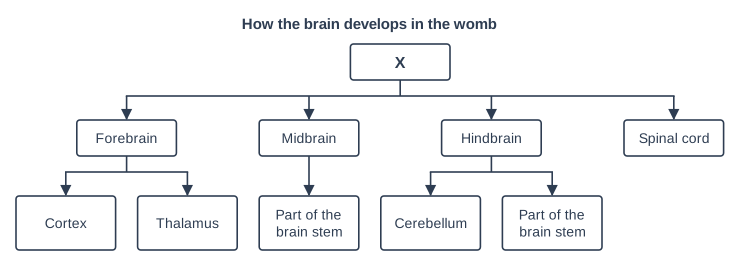
How the brain develops in the womb. Flow chart of 10 boxes joined by arrows, read from top to bottom. The first box is box X. From box X, 4 arrows branch out side by side: the 1st from the left arrow leads to "Forebrain"; the 2nd from the left arrow leads to "Midbrain", which leads to "Part of the brain stem"; the 3rd from the left arrow leads to "Hindbrain"; the 4th from the left arrow leads to "Spinal cord". From "Forebrain", 2 arrows branch out side by side: the left arrow leads to "Cortex"; the right arrow leads to "Thalamus". From "Hindbrain", 2 arrows branch out side by side: the left arrow leads to "Cerebellum"; the right arrow leads to "Part of the brain stem".

Model answer

The neural tube.

Explanation

The brain and spinal cord begin as a simple neural structure called the neural tube, which forms within the first month of pregnancy. The front end of the tube divides into the forebrain, which forms the cortex and thalamus, and the midbrain and hindbrain, which form the brain stem (the hindbrain also forms the cerebellum), while the rest of the tube becomes the spinal cord. A common mistake is to name one of the later structures, such as the spinal cord, instead of the tube they all develop from.

Mark scheme
  1. 1 mark

    1 mark for neural tube

    Accept 'the neural tube' / 'a tube of (neural) cells'. Do not accept 'neurons', 'nervous system', 'spinal cord' or 'brain stem': the spinal cord and brain stem develop from X. NOTE: If the candidate has written more than one answer, only mark the first one.
Question 2

2 marks

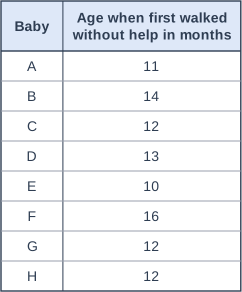
A psychologist, Dr Okwu (fictional), recorded the age at which eight babies first walked without help. The results are shown in the table.

Calculate the mean age at which the babies first walked. Show your workings.

Table with columns "Baby", "Age when first walked without help in months". Baby: A; Age when first walked without help in months: 11 | Baby: B; Age when first walked without help in months: 14 | Baby: C; Age when first walked without help in months: 12 | Baby: D; Age when first walked without help in months: 13 | Baby: E; Age when first walked without help in months: 10 | Baby: F; Age when first walked without help in months: 16 | Baby: G; Age when first walked without help in months: 12 | Baby: H; Age when first walked without help in months: 12.

Model answer

11 + 14 + 12 + 13 + 10 + 16 + 12 + 12 = 100
100 ÷ 8 = 12.5 months

Explanation

To find the mean, add all eight values and divide by the number of babies: 100 ÷ 8 = 12.5 months. Check you have included every value and divided by 8, not by the number of different ages. Do not confuse the mean with the median or mode, which are both 12 months here.

Mark scheme
  1. 2 marks

    2 marks for the correct answer: 12.5 (months). 1 mark for correct workings but incorrect/no answer.

    Workings: 11 + 14 + 12 + 13 + 10 + 16 + 12 + 12 = 100; 100 ÷ 8 = 12.5. A correct answer with no workings scores 2 marks. Accept 12½. The unit is not required. An answer of 12 or 13 (incorrectly rounded) with correct workings scores 1 mark. Do not accept 12 as the median or mode instead of the mean.

Question 3

4 marks

A leaflet for parents-to-be says, "Your baby's brain starts as a simple tube of cells and becomes a complex organ that keeps developing long after birth."

Describe how the brain develops, from simple neural structures in the womb to the brain of a young child. Include the brain stem, thalamus, cerebellum and cortex in your answer.

Model answer

The brain develops from a simple neural structure called the neural tube, which forms within the first month of pregnancy. The front of the tube divides into the forebrain, midbrain and hindbrain, and the rest becomes the spinal cord. The forebrain forms the cortex and the thalamus, the midbrain and hindbrain form the brain stem, and the hindbrain also forms the cerebellum. The brain stem, which controls autonomic functions such as breathing and heart rate, is one of the first parts to develop and is well developed at birth. The thalamus relays sensory information to the cortex. The cerebellum, which coordinates movement and balance, grows rapidly in the first year. The cortex, responsible for cognition, is the least developed part at birth and the last to mature, in a person's twenties.

Explanation

Top-level answers describe development as a process, starting with the neural tube and showing how and when the four structures develop, with each one's function. Listing the structures and their functions without describing how they develop limits the answer to Level 1. Remember that the brain stem is well developed at birth, while the cortex is the last to mature.

Mark scheme
  1. 4 marks

    Levels of response (4 marks). AO1 - 4 marks.
    Level 2 Clear (3-4 marks): Clear and accurate knowledge and understanding of early brain development with some detail. Relevant terminology is used consistently throughout. The answer demonstrates a high level of substantiated reasoning, and is clear, coherent and focused.
    Level 1 Basic (1-2 marks): Limited or muddled knowledge and understanding of early brain development is present. Relevant terminology is occasionally used. The answer occasionally demonstrates substantiated reasoning, but may lack clarity, coherence, focus and logical structure.
    0 marks: No relevant content.

    Possible content (not a checklist): AO1 - the brain develops from a simple neural structure, the neural tube, which forms in the first month of pregnancy; the front of the tube divides into the forebrain, midbrain and hindbrain, and the rest becomes the spinal cord; the forebrain forms the cortex and the thalamus; the midbrain and hindbrain form the brain stem; the hindbrain also forms the cerebellum; the brain stem (autonomic functions such as breathing and heart rate) is one of the first parts to develop and is well developed at birth; the thalamus relays sensory information to the cortex (sensory processing); the cerebellum coordinates movement and balance and grows rapidly in the first year after birth; the cortex (cognition, e.g. thinking, language, reasoning) is the least developed part at birth and the last to mature, developing into a person's twenties; at birth the brain is about a quarter of adult size, roughly doubles in size in the first year and is more than 80% of adult size by about age 3. Accept approximate timings consistent with these. Credit other relevant content. NOTE: If answers only address parts of the brain and their functions and not early brain development, the answer can only be considered Level 1/Basic. NOTE: Reference to 'a simple tube of cells' alone is not enough by itself for relevant content because it is part of the question stem.

Question 4

6 marks

Research suggests that stimulation can help young children's brains to develop. A psychologist wants to test whether music and movement classes improve balance in three-year-olds.

You will use two groups of three-year-olds from the same nursery. Group 1 will go to a weekly music and movement class for 10 weeks. Group 2 will not go to the class. After 10 weeks, each child will walk along a straight line taped to the nursery floor, and you will count how many steps they take before stepping off the line.

Imagine you carry out this experiment. Identify:
- the experimental design you will use and the type of experiment it is
- one ethical issue that could arise with children this young, and how you would deal with it
- the results you would expect.

Model answer

- Experimental design: independent groups, because different children are in Group 1 and Group 2.
- Type of experiment: a field experiment, because the psychologist decides which children go to the class (the IV), but the children are tested in their everyday setting, the nursery.
- Ethical issue: informed consent. The children are too young to give consent themselves, so I would explain the study to their parents and ask them to sign a consent form, and also check that each child is happy to take part.
- Expected results: children in Group 1, who went to the music and movement class, will take more steps along the line before stepping off than children in Group 2, who did not go to the class.

Explanation

Answer every bullet point: the design, the type of experiment, an ethical issue with a way of dealing with it that suits three-year-olds, and the expected results. For 2 marks on the results, name both conditions of the IV and the DV (steps taken along the line), not just 'Group 1 will do better'. This is a field experiment because the IV is controlled by the psychologist but the children stay in their normal setting.

Mark scheme
  1. 1 mark

    1 mark for a relevant experimental design: independent groups

    Accept 'independent measures'. Each child is in only one condition (Group 1 or Group 2). Do not accept repeated measures or matched pairs.

  2. 1 mark

    1 mark for a relevant type of experiment: field experiment

    The psychologist decides which children go to the class (manipulates the IV), and the children are tested in their everyday setting, the nursery. Do not accept laboratory experiment or natural experiment.

  3. 1 mark

    1 mark for a relevant ethical issue, e.g. informed consent / right to withdraw / protection from harm / confidentiality / debrief / respect

    NOTE: If the candidate has identified more than one ethical issue, only mark the first one.

  4. 1 mark

    1 mark for an appropriate way of dealing with the ethical issue identified, e.g. explain the study to parents and ask them to sign a consent form, and check each child is happy to take part / stop the task if a child becomes upset and let them stop at any time / put soft mats down and have an adult walk beside each child so no one is hurt if they fall / use numbers or letters instead of names in any report / afterwards, explain to parents what the study was about and how the results will be used / offer the class to Group 2 after the study

    The way of dealing with the issue must fit the issue identified and the study.

  5. 2 marks

    Up to 2 marks for relevant expected results. 2 marks: a clear and accurate description of the expected results with both conditions of the IV. 1 mark: a limited or muddled description of the expected results.

    Examples: 'Children who went to the music and movement class will take more steps along the line before stepping off than children who did not go to the class.' (2 marks) 'Children who went to the class will have better balance.' (1 mark: only one condition of the IV) 'Group 1 will do better than Group 2.' (1 mark) Credit other relevant content.

Ready to try the rest? Every answer you write is marked against the mark scheme, so you can see exactly where the marks are.

Study Helper Hints first, answers after you try

Stuck on this one? Ask for a hint and I’ll point you in the right direction, without giving the answer away. Once you’ve checked your answer, I’ll show you how the marks are awarded.