Level:
Correct: 0
Incorrect: 0
Marks: 0/0
Exam Practice
Course:
Topics:
AQA GCSE Psychology (Paper 1) Smart practice A mixed round aimed at your weak spots
Unit 1
Memory
Processes of memory
Processes of memory
Memory as an active process
Unit 2
Perception
Sensation and perception; visual cues and constancies
Sensation and perception, visual cues and constancies
Gibson's direct theory of perception - the influence of nature
Gibson's direct theory of perception
Visual illusions
Visual illusions
Gregory's constructivist theory of perception - the influence of nurture
Gregory's constructivist theory of perception
Factors affecting perception
Unit 3
Development
Early brain development
Piaget's stage theory and the development of intelligence; the role of Piaget's theory in education
Piaget's stage theory and the development of intelligence
The effects of learning on development
Unit 4
Research methods
Avg
score:
–
Topics
done:
0/24

Computation

Practise 24 exam-style questions on Computation for AQA GCSE Psychology (Paper 1). Write your answer as you would in the exam and get it marked in seconds against the mark scheme, point by point, with the Study Helper on hand if you get stuck.

  • 24 questions
  • 1–6 marks each
  • Instant marking
  • No sign-up needed
20 questions, marked as you go

Sample questions with model answers

Here are 4 of the questions in this topic, each with a model answer, an explanation of why it earns the marks and the mark scheme an examiner would use.

Question 1

1 mark

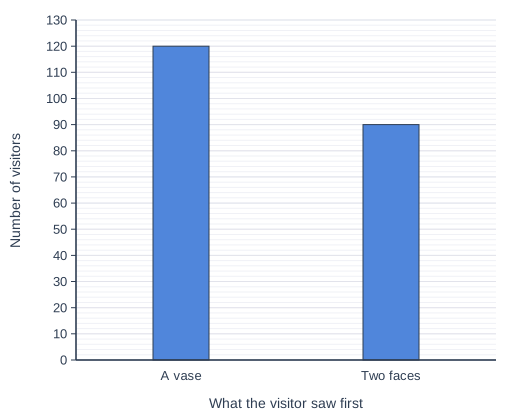
At a science fair, a psychologist showed Rubin's vase to 210 visitors and asked each visitor what they saw first: a vase or two faces. The bar chart shows the results.

Which is the correct ratio of visitors who saw a vase first compared to visitors who saw two faces first?

Choose your answer.

  • 1:4
  • 3:4
  • 4:3
  • 4:7
Bar chart of number of visitors for each what the visitor saw first: A vase 120, Two faces 90.

Model answer

4:3

Explanation

Read the numbers from the bar chart (120 saw a vase first and 90 saw two faces first), write them in the order asked, 120:90, and divide both by 30 to get 4:3. 3:4 is the ratio reversed, 4:7 compares the vase group with all 210 visitors, and 1:4 compares the difference (30) with the vase group.

Mark scheme
  1. 1 mark

    4:3

    If more than one option is given, 0 marks.
Question 2

2 marks

At a science museum, 45 visitors looked through the peephole of an Ames room in which two people of the same height were standing in different corners. 27 of the visitors said that one person looked much taller than the other.

Calculate the percentage of visitors who said that one person looked much taller than the other.

Show your workings.

Model answer

27/45 × 100 = 0.6 × 100 = 60%

Explanation

To find a percentage, divide the part by the whole and multiply by 100: 27 ÷ 45 = 0.6, and 0.6 × 100 = 60%. The question asks for a percentage, so stopping at 0.6 loses a mark. Check that you have divided by the total number of visitors (45), not by 100.

Mark scheme
  1. 2 marks

    2 marks for the correct answer: 60. 1 mark for correct workings but incorrect/no answer: 27/45 × 100.

    A correct answer with no workings scores 2 marks. Accept 60%. Accept other correct workings, e.g. 27 ÷ 45 = 0.6 then 0.6 × 100, or 3/5 × 100. An answer of 0.6 shows correct workings but is not a percentage (1 mark). Do not accept 27% or 40 (the percentage who did not say this). NOTE: Credit may be given for a correct answer written in the workings rather than on the answer line.

Question 3

3 marks

In a study of expectation, 35 participants tasted two spoonfuls of the same plain yoghurt. One spoonful had been coloured pink with a flavourless food colouring. 23 of the participants said that the pink yoghurt tasted of strawberry.

Calculate the percentage of participants who said that the pink yoghurt tasted of strawberry.

State your answer using two significant figures and show your workings.

Model answer

23/35 × 100 = 65.714...%
To two significant figures: 66%

Explanation

Divide 23 by 35 and multiply by 100 to get 65.714...%. For two significant figures keep the first two digits (6 and 5) and look at the next digit: it is 7, so the 5 rounds up to give 66%. AQA's June 2022 Paper 1 report notes that about a third of students lost a mark on a similar question by giving an unrounded answer (80.6) instead of two significant figures.

Mark scheme
  1. 3 marks

    3 marks for the correct percentage to two significant figures: 66. 2 marks for the correct percentage but not rounded to two significant figures (e.g. 65.7 or 65.71) OR for the 'correct' percentage but rounded incorrectly (65). 1 mark for correct workings but incorrect/no answer: 23/35 × 100.

    A correct answer with no workings scores 3 marks. Accept 66%. Accept other creditworthy workings, e.g. 23 ÷ 35 = 0.657... then × 100, or 100/35 × 23. An answer of 65 has been cut off (truncated) instead of rounded up (2 marks). Do not accept 34 (the percentage of participants who did not say this). NOTE: Credit may be given for correct answers written in the workings rather than on the answer line.

Question 4

4 marks

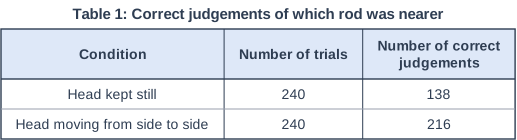
A psychologist investigated depth perception. Twenty participants each looked with one eye through a small window at two rods standing at slightly different distances, and said which rod was nearer. Each participant did 12 trials with their head kept still and 12 trials while moving their head from side to side. Table 1 shows the total number of correct judgements in each condition.

Explain how the results shown in Table 1 can be used to evaluate Gibson's direct theory of perception. Use the percentage of correct judgements in each condition in your answer.

Table 1: Correct judgements of which rod was nearer. Table with columns "Condition", "Number of trials", "Number of correct judgements". Condition: Head kept still; Number of trials: 240; Number of correct judgements: 138 | Condition: Head moving from side to side; Number of trials: 240; Number of correct judgements: 216.

Model answer

With their head moving, participants judged correctly on 90% of trials (216 out of 240), compared with only 57.5% when their head was still, which is little better than the 50% expected from guessing. Moving the head creates motion parallax: nearer objects appear to move more quickly across the visual field than objects further away. This supports Gibson's direct theory, which says that the environment, and our movement through it, gives enough information for depth to be perceived directly, without needing inferences from past experience. As participants used one eye, binocular cues were removed, so the improvement is likely to be due to motion parallax. However, the results do not rule out Gregory's theory, as the brain could be using motion parallax as a cue for inference, and the rods-and-window task was artificial.

Explanation

The best answers calculate both percentages (90% and 57.5%), notice that 57.5% is close to the 50% expected by guessing, and explain that the difference is due to motion parallax, which supports Gibson's direct theory. They also judge how far the results support the theory, for example by noting that constructivists could explain the same results. Describing Gibson's theory without using the table limits the answer to 1 mark.

Mark scheme
  1. 4 marks

    Levels of response (4 marks). AO3 - 4 marks.
    Level 2 Clear (3-4 marks): Analysis of how the results shown in Table 1 can be used to evaluate Gibson's direct theory of perception is effective. Any conclusions drawn are sound and fully expressed. Relevant terminology is used consistently throughout. The answer demonstrates a high level of substantiated reasoning, and is clear, coherent and focused.
    Level 1 Basic (1-2 marks): Analysis of how the results shown in Table 1 can be used to evaluate Gibson's direct theory of perception is of limited effectiveness or muddled. Any attempts to draw conclusions are not always successful. Relevant terminology is occasionally used. The answer occasionally demonstrates substantiated reasoning, but may lack clarity, coherence, focus and logical structure.
    0 marks: No relevant content.

    Possible content (not a checklist): AO3 - With the head moving, 90% of judgements were correct (216/240), compared with only 57.5% with the head still (138/240), which is only a little better than the 50% expected from guessing between two rods. Moving the head produces motion parallax: as we move, objects that are close to us appear to move quickly across the visual field and objects further away appear to move more slowly. This supports Gibson's direct theory, which says that the real world, and our movement through it, provides enough information (such as motion parallax) for depth to be perceived directly, without inferences based on past experience. Because participants used one eye, binocular depth cues were removed, so the improvement is likely to be due to motion parallax, a monocular depth cue. However, the results do not rule out Gregory's constructivist theory, as constructivists could argue that motion parallax is a cue that the brain uses to make inferences. The task was artificial (two rods seen through a small window), so it may not show how motion parallax is used in everyday perception, although the head-moving condition is closer to Gibson's view that perception happens as people move around their environment. Credit other relevant content. NOTE: Evaluation of Gibson's theory without using the results in Table 1 (MAX 1 mark). NOTE: Answers that use only the raw numbers rather than percentages cannot be considered fully effective (MAX 3 marks). NOTE: Reference to 'results being used to evaluate the theory' is not enough by itself for relevant content because it is part of the question stem.

Ready to try the rest? Every answer you write is marked against the mark scheme, so you can see exactly where the marks are.

Study Helper Hints first, answers after you try

Stuck on this one? Ask for a hint and I’ll point you in the right direction, without giving the answer away. Once you’ve checked your answer, I’ll show you how the marks are awarded.