
Level:
Correct: 0
Incorrect: 0
Marks: 0/0
Exam Practice
Course:
Topics:
AQA GCSE Economics (Paper 1) Smart practice A mixed round aimed at your weak spots
Unit 1
Economic foundations
Economic activity
Economic activity
The factors of production
Unit 2
Resource allocation
Markets and allocation of resources
Markets and the allocation of resources
Economic sectors
Economic sectors
Specialisation, division of labour, and exchange
Specialisation, division of labour and exchange
Unit 3
How prices are determined
Demand for goods and services
Supply for goods and services
Supply of goods and services
Equilibrium price
Equilibrium price
Intermarket relationships
Price elasticity of demand
Price elasticity of supply
Unit 4
Production, costs, revenue and profit
The importance of cost, revenue and profit for producers
Cost, revenue and profit for producers
Production and productivity
Economies of scale
Economies of scale
Unit 5
Competitive and concentrated markets
The importance of market structures on producers and consumers
Market structures
Competitive markets
Competitive markets
The labour market
The labour market
Unit 6
Market failure
Avg
score:
–
Topics
done:
0/21

The labour market

Practise 18 exam-style questions on The labour market for AQA GCSE Economics (Paper 1). Write your answer as you would in the exam and get it marked in seconds against the mark scheme, point by point, with the Study Helper on hand if you get stuck.

  • 18 questions
  • 1–15 marks each
  • Instant marking
  • No sign-up needed
18 questions, marked as you go

Sample questions with model answers

Here are 4 of the questions in this topic, each with a model answer, an explanation of why it earns the marks and the mark scheme an examiner would use.

Question 1

1 mark

Figure 1 shows a change in the labour market for bricklayers.

Which of the following could have caused the change shown in Figure 1?

Choose your answer.

  • A An increase in the number of new homes being built
  • B An increase in the wage rate paid to bricklayers
  • C More people training to become bricklayers
  • D A new machine that can lay bricks without workers
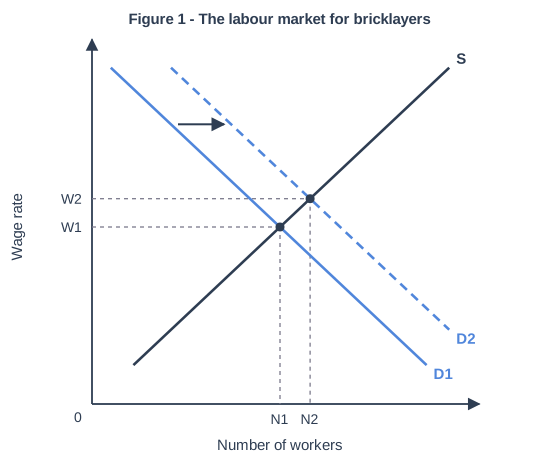
Figure 1 - The labour market for bricklayers. A supply and demand diagram with wage rate on the vertical axis and number of workers on the horizontal axis (no values are shown). D1 is a demand curve that slopes downwards from left to right. D2 is a demand curve (dashed) that slopes downwards from left to right, parallel to D1 and to the right of it. S is a supply curve that slopes upwards from left to right. An arrow shows a shift from D1 to D2. D1 and S cross at wage rate W1 and number of workers N1 (dashed lines to the axes). D2 and S cross at wage rate W2 and number of workers N2 (dashed lines to the axes). On the axes, W2 is higher than W1 and N2 is greater than N1.

Model answer

A An increase in the number of new homes being built

Figure 1 shows the demand for bricklayers shifting to the right from D1 to D2. The demand for labour is derived from the demand for what workers produce: building more homes means firms need more bricklayers at every wage rate.

Explanation

The demand curve for labour shifts right when the demand for the product the workers make rises (derived demand). A higher wage rate causes a movement along the curves, not a shift; more people training shifts supply, not demand; and a bricklaying machine would reduce demand for bricklayers, shifting it left.

Mark scheme
  1. 1 mark

    A / An increase in the number of new homes being built

    accept the letter or the option text. If more than one option is given, 0 marks.

Question 2

2 marks

Explain what is meant by the supply of labour to an occupation.

Model answer

The supply of labour to an occupation is the number of people who are willing and able to work in that occupation at each wage rate, in a given time period.

Explanation

A complete definition mirrors the definition of supply in a product market: the number of workers willing and able to work in the job at each wage rate. Confusing it with the number of jobs on offer, which is the demand for labour, scores 0.

Mark scheme
  1. 1 mark

    The number of workers / people available to work in that occupation.

    Partial definition: the core idea of the number of people offering to work in the job. 2-mark answer, e.g.: 'The number of people who are willing and able to work in an occupation at each wage rate (in a given time period).' 1-mark answer, e.g.: 'The number of people who want to do a job.' 0 marks: 'the number of jobs available' or 'the number of workers a firm wants to employ' (these describe the demand for labour).

  2. 1 mark

    Completes it: who are willing and able to work in the occupation at each (a given) wage rate (in a given time period).

    Award only if the first mark is awarded. Both 'willing' and 'able', or a link to the wage rate, are needed to complete the definition.

Question 3

3 marks

Priya earns a gross salary of £27,600 a year, paid in 12 equal monthly amounts. Each month her employer deducts:

- income tax of £250
- National Insurance of £100
- a pension contribution of 5% of her gross monthly pay.

Calculate Priya's monthly net pay.

Model answer

Monthly gross pay = £27,600 ÷ 12 = £2,300
Pension contribution = 5% × £2,300 = £115
Total deductions = £250 + £100 + £115 = £465
Monthly net pay = £2,300 - £465 = £1,835

Explanation

Convert the annual salary to monthly gross pay first, because the deductions are monthly. Then work out the pension as 5% of the monthly gross pay and subtract all three deductions. Common errors are forgetting the pension or taking 5% of the annual salary.

Mark scheme
  1. 1 mark

    Correct monthly gross pay of £2,300 (27,600 ÷ 12) or a correct pension contribution of £115; or a correct final answer of £1,835 with no working.

    An answer of £1,835 with no working scores 3 marks.

  2. 1 mark

    Correct total monthly deductions of £465 (250 + 100 + 115), or a correct method: 2,300 - 250 - 100 - 115.

    Award for the correct method even if there is an arithmetic slip in the final answer.

  3. 1 mark

    £1,835

    Accept 1835 with or without the £ sign. An annual net pay of £22,020 (correct, but not the monthly figure asked for) scores 2 marks. £1,950 (leaving out the pension) scores 1 mark for £2,300. An answer that takes 5% of the annual salary (£1,380) as the monthly pension scores 1 mark for £2,300.

Question 4

6 marks

Care workers look after elderly and disabled people in care homes and in their own homes. Many care workers in the UK are paid wages close to the legal minimum.

Explain two possible reasons why care workers are often paid low wages.

Model answer

First, the supply of care workers is large. Few formal qualifications are needed to start working as a care worker, and training is short, so many people are able to do the job, and many want the flexible or part-time hours it can offer. With a large number of people willing and able to work at each wage rate, the supply curve is far to the right, so the equilibrium wage is low and employers can easily replace workers who leave.

Second, employers have a limited ability to pay. Much care is paid for by local councils with tight budgets, or by families who are worried about cost. Care is very labour-intensive - one worker can only look after a few people - so wages are most of a care provider's costs. If a provider raised wages, it would have to charge councils and families more, and they may not be able or willing to pay. This keeps the demand for care workers at higher wages low, holding wages down.

Explanation

Each reason should be linked to the supply of or demand for labour and applied to care work for 3 marks: a large supply (low qualifications) and limited demand at higher wages (tight budgets, labour-intensive work) are two different reasons. Two versions of the same supply-side point cap the answer at 3 marks.

Mark scheme
  1. 3 marks

    First reason: e.g. a large supply of workers: few formal qualifications are needed to start the job, so many people are able to do it, and the large supply keeps the equilibrium wage low.
    3 marks: a full and precise explanation applying economic concepts and issues. 2 marks: a partial explanation applying economic concepts and issues but lacking detail. 1 mark: fragmented points made.

    Max 3 if both explanations make the same point. Apply the 3/2/1 scale to each reason separately. Possible answers (not exhaustive; credit other valid points): few qualifications or short training needed, so a large supply of labour; the job is seen as low skilled, so it is easy to replace workers; employers (care homes, agencies) have limited budgets because councils that pay for much of the care have tight budgets, so the demand for labour at higher wages is low; care is labour-intensive, so wages are a large share of costs; low productivity in money terms (one worker can only care for a few people); low trade union membership / weak bargaining power; many part-time or zero-hours jobs; workers who want flexible hours near home may accept lower pay; the job may be undervalued in society. A 3-mark explanation links the reason to the supply of or demand for care workers and so to a low wage, applied to care work.

  2. 3 marks

    Second, different reason: e.g. employers' limited ability to pay: many care services are paid for by local councils with tight budgets or by families, and care needs a lot of staff, so employers cannot afford to raise wages without raising their prices.
    3 marks: a full and precise explanation applying economic concepts and issues. 2 marks: a partial explanation applying economic concepts and issues but lacking detail. 1 mark: fragmented points made.

    Apply the same 3/2/1 scale. It must be a different reason from the first, not the same point reworded. See point 1 for possible answers.

Ready to try the rest? Every answer you write is marked against the mark scheme, so you can see exactly where the marks are.

Study Helper Hints first, answers after you try

Stuck on this one? Ask for a hint and I’ll point you in the right direction, without giving the answer away. Once you’ve checked your answer, I’ll show you how the marks are awarded.