Level:
Correct: 0
Incorrect: 0
Marks: 0/0
Exam Practice
Course:
Topics:
AQA GCSE Economics (Paper 1) Smart practice A mixed round aimed at your weak spots
Unit 1
Economic foundations
Economic activity
Economic activity
The factors of production
Unit 2
Resource allocation
Markets and allocation of resources
Markets and the allocation of resources
Economic sectors
Economic sectors
Specialisation, division of labour, and exchange
Specialisation, division of labour and exchange
Unit 3
How prices are determined
Demand for goods and services
Supply for goods and services
Supply of goods and services
Equilibrium price
Equilibrium price
Intermarket relationships
Price elasticity of demand
Price elasticity of supply
Unit 4
Production, costs, revenue and profit
The importance of cost, revenue and profit for producers
Cost, revenue and profit for producers
Production and productivity
Economies of scale
Economies of scale
Unit 5
Competitive and concentrated markets
The importance of market structures on producers and consumers
Market structures
Competitive markets
Competitive markets
The labour market
The labour market
Unit 6
Market failure
Avg
score:
–
Topics
done:
0/21

Non-competitive markets: monopoly and oligopoly

Practise 14 exam-style questions on Non-competitive markets: monopoly and oligopoly for AQA GCSE Economics (Paper 1). Write your answer as you would in the exam and get it marked in seconds against the mark scheme, point by point, with the Study Helper on hand if you get stuck.

  • 14 questions
  • 1–15 marks each
  • Instant marking
  • No sign-up needed
14 questions, marked as you go

Sample questions with model answers

Here are 4 of the questions in this topic, each with a model answer, an explanation of why it earns the marks and the mark scheme an examiner would use.

Question 1

1 mark

A monopoly is often described as a price maker. This means that the monopoly

Choose your answer.

  • A can choose its price, but consumers then decide how much to buy at that price.
  • B can sell any quantity it wants at any price it chooses.
  • C must accept the price set by the market.
  • D has its price set by the government.

Model answer

A can choose its price, but consumers then decide how much to buy at that price.

A monopoly has no close rivals, so it can set its own price. It still faces a downward-sloping demand curve: the higher the price it sets, the less consumers will buy.

Explanation

A price maker sets its own price because it faces little or no competition. But it cannot control demand, so a higher price means a smaller quantity sold - it cannot sell any quantity at any price. Accepting the market price describes a price taker in a competitive market.

Mark scheme
  1. 1 mark

    A / can choose its price, but consumers then decide how much to buy at that price.

    accept the letter or the option text. If more than one option is given, 0 marks.

Question 2

2 marks

Grantley's is one of four supermarket chains that together sell most of the groceries in Country Z. One of its rivals has just cut the prices of 500 everyday products.

State two ways in which Grantley's could respond.

Model answer

1. Cut the prices of the same products to match its rival.
2. Offer extra loyalty-card rewards so that customers stay with Grantley's.

Explanation

In an oligopoly firms are interdependent: each must react to what its few rivals do. Grantley's could respond with price competition (matching the cut) or non-price competition (advertising, loyalty rewards, quality or service). Two forms of price cutting count as one answer.

Mark scheme
  1. 2 marks

    Any two different ways from: cut its own prices (match the cut / start a price war) / increase advertising / offer loyalty-card rewards or discounts / special offers on other products / improve quality or customer service / introduce new products or own-brand ranges / keep its prices the same and rely on brand loyalty / offer price-match guarantees / longer opening hours or better delivery.

    1 mark for each different correct example, max 2. Accept any legal response to the rival's price cut. Do not credit two versions of the same method (e.g. 'cut prices' and 'lower prices'). Do not credit illegal actions such as secretly agreeing prices with the rival.

Question 3

2 marks

Explain one possible benefit to consumers of a market being supplied by a monopoly.

Model answer

A monopoly may be able to charge lower prices than many small firms could. Because it supplies the whole market, it produces on a very large scale and benefits from economies of scale, such as buying materials in bulk, so its average cost per unit is lower. If some of these savings are passed on, consumers pay less.

Explanation

Most effects of monopoly on consumers are harmful, but the specification asks for causes and consequences, which include possible benefits: economies of scale, innovation funded by profits and avoiding wasteful duplication. The second mark needs the chain - for example, large scale lowers average costs, which can lower prices.

Mark scheme
  1. 1 mark

    Identifies a valid benefit, e.g. lower prices from economies of scale / more innovation or research funded by high profits / avoids wasteful duplication (e.g. one set of pipes or rail track) / consistent standards / more stable prices / investment in better services

    2 marks = benefit explained; 1 mark = benefit identified; 0 = nothing worthy of credit. This indicative content is not exhaustive: credit any valid benefit, not only those listed. Possible answers: lower prices from economies of scale / more innovation or research funded by high profits / avoids wasteful duplication (e.g. one set of pipes or rail track) / consistent standards / more stable prices / investment in better services.

  2. 1 mark

    Explains it: develops the benefit with a linked reason or consequence, e.g. a monopoly produces on a very large scale, so its average costs may be lower than many small firms' would be, and it may pass some of the saving on in lower prices / high profits give it the money to invest in research and new products, which consumers benefit from

    Award only if the first mark is awarded. The explanation must say why or how (a linked step), not just repeat or reword the point identified.

Question 4

9 marks

Figure 1 - Home broadband in Country Z

In Country Z (invented), three firms supply 88% of home broadband connections. The firms' combined profits have risen in recent years. The firms say these profits pay for new full-fibre networks, which give much faster and more reliable connections. A consumer group says the firms face too little competition and that prices are rising faster than they should.

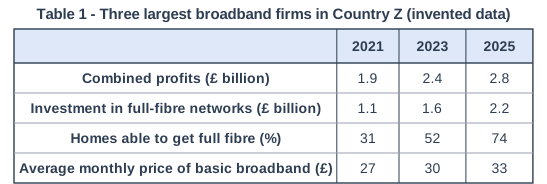
Table 1 shows data for the three largest broadband firms in Country Z.

Using Figure 1 and Table 1, assess whether the high profits made by firms in an oligopoly such as the home broadband market in Country Z are bad for consumers.

Table 1 - Three largest broadband firms in Country Z (invented data). Table with columns (row headings), "2021", "2023", "2025". Combined profits (£ billion); 2021: 1.9; 2023: 2.4; 2025: 2.8 | Investment in full-fibre networks (£ billion); 2021: 1.1; 2023: 1.6; 2025: 2.2 | Homes able to get full fibre (%); 2021: 31; 2023: 52; 2025: 74 | Average monthly price of basic broadband (£); 2021: 27; 2023: 30; 2025: 33.

Model answer

There is evidence that the high profits are bad for consumers. With three firms supplying 88% of connections, this is a concentrated oligopoly, so the firms are price makers and face little pressure to keep prices down. The average monthly price for basic broadband rose from £27 to £33, an increase of 22.2%, while the firms' combined profits rose from £1.9 billion to £2.8 billion, about 47%. Profits growing more than twice as fast as prices suggests the firms are using their market power to charge consumers more than it costs to supply them, transferring money from consumers to shareholders. With so few firms, they may avoid competing on price at all, simply following each other's price rises, and consumers have little choice.

However, the profits may also benefit consumers. The firms' investment in full-fibre networks doubled from £1.1 billion to £2.2 billion, and the share of homes able to get full fibre rose from 31% to 74%. In 2025 investment equalled about 79% of profits, compared with 58% in 2021, so a growing share of the profit is being put back into the network. Full fibre gives consumers much faster and more reliable connections, so part of the price rise buys a better product. Building a national network has very high fixed costs, and firms in a competitive market with low profits might not be able to afford it; large firms with economies of scale and high profits can.

Overall, I judge that the profits are not simply bad for consumers in this case, because most of them are being reinvested in a network that greatly improves quality. However, the evidence of rising prices in a market with little competition is a real concern. Whether the profits are bad for consumers depends on what happens once the network is finished: if investment then falls but prices and profits keep rising, consumers will lose out, and the government or a regulator may need to encourage new firms to enter or limit price rises.

Explanation

A Level 3 answer weighs the costs of oligopoly profits (higher prices, less choice, market power) against the benefits (investment, innovation, better quality), uses the data (prices +22%, profits +47%, investment doubled, full fibre 31% to 74%) and reaches a judgement that depends on whether profits are reinvested. Answers that assume high profits are always bad, or ignore the table, are capped at 6 marks.

Mark scheme
  1. 9 marks

    Levels of response (9 marks).
    Level 3 (7-9 marks): A fully justified conclusion with sustained evaluation, which is coherent and relevant, with judgements supported by evidence. A full analysis of the economic evidence, a well-developed and logical chain of reasoning. Comprehensive application of knowledge and understanding of pertinent concepts/issues relevant to the context; specialist language used throughout.
    Level 2 (4-6 marks): A partially justified conclusion with an evaluation, which is mostly coherent and relevant; judgements may not be fully supported by evidence. An incomplete analysis of the economic evidence; starts to develop a chain of reasoning. Good application of knowledge and understanding of concepts/issues mostly relevant to the context; specialist language used mostly appropriately.
    Level 1 (1-3 marks): A basic conclusion or assertion may be present based on evaluative judgements supported by little or no evidence. Analysis of discrete points of the economic evidence with no chain of reasoning attempted. Basic application of knowledge and understanding of concepts/issues with limited relevance to the context; may use non-specialist language.
    0 marks: Nothing written worthy of credit.

    Max 6 if the answer considers only one side or gives no judgement. Max 6 if the answer makes no use of the figure/data given. Indicative content (not exhaustive; credit other valid points). Bad for consumers: 88% share for three firms shows a concentrated oligopoly with barriers to entry, so firms are price makers; the average monthly price rose from £27 to £33 (+22.2%) while profits rose from £1.9bn to £2.8bn (+47.4%), suggesting firms use market power to raise prices; consumers have little choice; possible tacit collusion or price leadership; high profits are a transfer from consumers to shareholders; less pressure to improve customer service. Not bad / good for consumers: investment in full fibre doubled (£1.1bn to £2.2bn, +100%), funded by profits; homes able to get full fibre rose from 31% to 74% (43 percentage points), giving faster, more reliable broadband - quality has risen, so higher prices may partly reflect a better product; high fixed costs of networks need large firms with economies of scale; profits signal and fund innovation that a competitive market with low profits might not afford. Use of data: percentage changes; investment as a share of profit (58% in 2021, 79% in 2025). Overall: e.g. profits are only bad for consumers if they are not reinvested or if price rises exceed what quality improvements justify; here much of the profit is being reinvested, so the effect is mixed; depends on whether prices keep rising after the network is built, on regulation, and on whether new firms can enter.

Ready to try the rest? Every answer you write is marked against the mark scheme, so you can see exactly where the marks are.

Study Helper Hints first, answers after you try

Stuck on this one? Ask for a hint and I’ll point you in the right direction, without giving the answer away. Once you’ve checked your answer, I’ll show you how the marks are awarded.