Level:
Correct: 0
Incorrect: 0
Marks: 0/0
Exam Practice
Course:
Topics:
AQA GCSE Economics (Paper 1) Smart practice A mixed round aimed at your weak spots
Unit 1
Economic foundations
Economic activity
Economic activity
The factors of production
Unit 2
Resource allocation
Markets and allocation of resources
Markets and the allocation of resources
Economic sectors
Economic sectors
Specialisation, division of labour, and exchange
Specialisation, division of labour and exchange
Unit 3
How prices are determined
Demand for goods and services
Supply for goods and services
Supply of goods and services
Equilibrium price
Equilibrium price
Intermarket relationships
Price elasticity of demand
Price elasticity of supply
Unit 4
Production, costs, revenue and profit
The importance of cost, revenue and profit for producers
Cost, revenue and profit for producers
Production and productivity
Economies of scale
Economies of scale
Unit 5
Competitive and concentrated markets
The importance of market structures on producers and consumers
Market structures
Competitive markets
Competitive markets
The labour market
The labour market
Unit 6
Market failure
Avg
score:
–
Topics
done:
0/21

Cost, revenue and profit for producers

Practise 19 exam-style questions on Cost, revenue and profit for producers for AQA GCSE Economics (Paper 1). Write your answer as you would in the exam and get it marked in seconds against the mark scheme, point by point, with the Study Helper on hand if you get stuck.

  • 19 questions
  • 1–15 marks each
  • Instant marking
  • No sign-up needed
19 questions, marked as you go

Sample questions with model answers

Here are 4 of the questions in this topic, each with a model answer, an explanation of why it earns the marks and the mark scheme an examiner would use.

Question 1

1 mark

A new online clothing retailer cuts its prices below those of its rivals to attract customers, even though this reduces its profit in the short run.

Which business objective is it most likely to be pursuing?

Choose your answer.

  • A Maximising profit
  • B Increasing market share
  • C Reducing its fixed costs
  • D Raising its average revenue

Model answer

B Increasing market share

Explanation

Cutting prices below rivals' to win customers, while accepting lower profit, is a way of increasing market share: the retailer's share of total sales in the market. It cannot be profit maximisation, because profit falls. Lower prices do not reduce fixed costs, and they reduce average revenue (the price per unit) rather than raising it.

Mark scheme
  1. 1 mark

    B / Increasing market share

    Accept the letter or the option text. If more than one option is given, 0 marks.

Question 2

2 marks

A candle maker produces 800 candles a week. Its total costs are £2,960 a week, of which £1,200 are fixed costs.

Calculate the average variable cost of a candle.

Model answer

Total variable cost = total cost - fixed costs = £2,960 - £1,200 = £1,760
Average variable cost = £1,760 ÷ 800 = £2.20 per candle

Explanation

Average variable cost = total variable cost ÷ output, so the fixed costs must first be taken away from total costs. Dividing total costs by output gives average total cost (£3.70), and dividing the fixed costs by output gives average fixed cost (£1.50); both answer a different question.

Mark scheme
  1. 1 mark

    Correct total variable cost: £2,960 - £1,200 = £1,760; or a correct final answer of £2.20 with no working

    An answer of £2.20 with no working scores 2 marks. Accept answers with or without the £ sign. £3.70 (average total cost: £2,960 ÷ 800) and £1.50 (average fixed cost: £1,200 ÷ 800) score 0.

  2. 1 mark

    £2.20 (accept 2.2)

    Accept 220p.

Question 3

2 marks

State two examples of variable costs for a restaurant.

Model answer

1. Ingredients used to cook meals
2. Wages of waiting staff paid by the hour for extra shifts

Explanation

Variable costs rise and fall with output, so for a restaurant they are the costs that grow as more meals are served: ingredients, drinks, packaging, energy used in cooking and hourly staff. Rent, insurance and business rates are fixed costs because they are paid whatever the number of meals.

Mark scheme
  1. 2 marks

    Any two different variable costs, e.g. ingredients / food / drinks bought to sell / gas or electricity used for cooking / wages of staff paid by the hour or for extra shifts / takeaway packaging / napkins / fees paid to a delivery app / card payment fees

    1 mark for each different correct example, max 2. Do not accept fixed costs such as rent, business rates, insurance, loan repayments, a manager's salary or the cost of buying ovens or furniture. Accept 'food' and 'drink' as two different examples. Do not accept vague answers such as 'bills' or 'stock' without saying what it is.

Question 4

6 marks

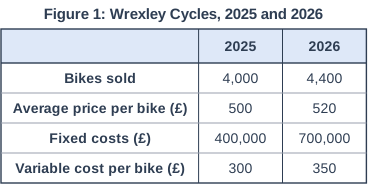
Wrexley Cycles makes bikes in a factory in Yorkshire. In 2026 it moved into a larger warehouse, and the cost of parts and energy rose. Figure 1 shows data for the business in 2025 and 2026. Wrexley's total revenue rose in 2026, but its profit fell.

Using Figure 1, analyse the possible reasons why Wrexley Cycles' profit fell even though its total revenue rose.

Figure 1: Wrexley Cycles, 2025 and 2026. Table with columns (row headings), "2025", "2026". Bikes sold; 2025: 4,000; 2026: 4,400 | Average price per bike (£); 2025: 500; 2026: 520 | Fixed costs (£); 2025: 400,000; 2026: 700,000 | Variable cost per bike (£); 2025: 300; 2026: 350.

Model answer

Wrexley's total revenue rose from £2.0 million (4,000 bikes × £500) to £2.288 million (4,400 × £520), an increase of 14.4%. But its total costs rose much faster, from £1.6 million (£400,000 fixed + 4,000 × £300) to £2.24 million (£700,000 + 4,400 × £350), an increase of 40%. As profit is total revenue minus total costs, profit fell from £400,000 to only £48,000.

The first reason is the rise in fixed costs. Moving into a larger warehouse raised fixed costs by £300,000, or 75%, through higher rent, rates and heating. These have to be paid however many bikes are sold, and an extra 400 bikes was not nearly enough to cover them.

The second reason is the rise in variable costs. Dearer parts and energy raised the variable cost of each bike from £300 to £350. At 4,400 bikes that adds £220,000 to costs. Together these changes raised the average cost of a bike from £400 to about £509.

Meanwhile Wrexley raised its price by only £20, from £500 to £520. It probably could not raise the price further because there are many rival bike makers, so demand for its bikes is likely to be price elastic and a larger price rise would have lost many sales. As a result, profit per bike fell from £100 to about £11. In the future, if sales grow to make full use of the larger warehouse, average fixed costs will fall and profit could recover.

Explanation

The best answers calculate total costs and profit for both years from Figure 1, then explain the chain: higher fixed costs and higher variable costs raised average cost far more than the small price rise raised average revenue. Recognising that revenue is not profit is central. Answers that make no use of the figures cannot score more than 4.

Mark scheme
  1. 6 marks

    Levels of response (6 marks).
    Level 3 (5-6 marks): A full analysis of the economic evidence, a well-developed and logical chain of reasoning.
    Level 2 (3-4 marks): An incomplete analysis of the economic evidence, starts to develop a chain of reasoning. Good application of knowledge and understanding of concepts/issues mostly relevant to the context.
    Level 1 (1-2 marks): Analysis of discrete points of the economic evidence with no chain of reasoning attempted. Basic application of knowledge and understanding of concepts/issues with limited relevance to the context.
    0 marks: Nothing written worthy of credit.

    Max 4 if the answer makes no use of the evidence or context given. Levels are a ladder, as AQA instructs: an answer reaches Level 3 only if it also applies knowledge to the context, as Level 2 requires. Indicative content (not exhaustive; credit other valid points): Use of data: total revenue rose from £2.0 million (4,000 × £500) to £2.288 million (4,400 × £520), up 14.4%. Total costs rose from £1.6 million (£400,000 + 4,000 × £300) to £2.24 million (£700,000 + 4,400 × £350), up 40%. Profit fell from £400,000 to £48,000. Fixed costs rose by 75% (the larger warehouse: rent, rates, heating). Variable cost per bike rose by £50 (16.7%) because of dearer parts and energy, adding £220,000 to costs at 4,400 bikes. Average cost per bike rose from £400 to about £509, while the price rose only £20 (4%), so profit per bike fell from £100 to about £11. Reasons the price rose so little: competition from rival bike makers / price elastic demand, so a bigger price rise could lose many sales. Possible further points: the warehouse is an investment for growth, so average fixed cost may fall as output rises in future; selling more is not the same as making more profit. Answers that only describe that 'costs rose' without using the data stay in Level 1 or low Level 2.

Ready to try the rest? Every answer you write is marked against the mark scheme, so you can see exactly where the marks are.

Study Helper Hints first, answers after you try

Stuck on this one? Ask for a hint and I’ll point you in the right direction, without giving the answer away. Once you’ve checked your answer, I’ll show you how the marks are awarded.