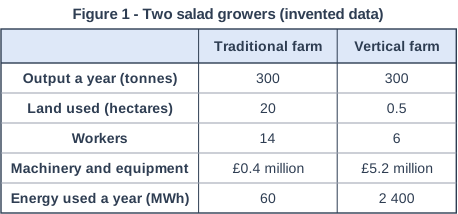
Figure 1 compares two businesses in Lincolnshire that each grow 300 tonnes of salad leaves a year. One is a traditional farm that grows the crop in fields. The other is a vertical farm that grows the crop indoors in stacked trays under LED lights, using robots to move the trays (the businesses and figures are invented).
Using Figure 1, analyse why a business might choose to use more capital and less land and labour, as the vertical farm has done.
Model answer
Figure 1 shows that the vertical farm uses a very different combination of factors of production. It uses only 0.5 hectares of land compared with 20 hectares for the traditional farm, and 6 workers instead of 14, but it has spent £5.2 million on machinery and equipment compared with £0.4 million.
One reason to use less land is that land is scarce and expensive, especially near towns and cities. Because the vertical farm stacks its crops, it needs 40 times less land, so it pays much less rent and can be located close to supermarkets, reducing transport costs.
A second reason is to use less labour. Farms often find it hard to recruit pickers, and wages are a large cost. By using robots and LED lights, the vertical farm needs only 6 workers, so its wage bill is lower and it is less exposed to labour shortages. Growing indoors also means output does not depend on the weather, so the business can supply salad all year round at a consistent quality, which makes it easier to win contracts with supermarkets.
However, using more capital brings its own costs. The £5.2 million of equipment has to be paid for, often by borrowing, so the reward paid to capital (interest) rises and the business takes on more risk. The vertical farm also uses 2,400 MWh of energy a year compared with 60 MWh, so if energy prices rise, the savings on land and labour could be wiped out. A business would therefore choose more capital only if the savings in rent and wages, and the benefit of reliable output, are greater than these extra costs.
Explanation
A Level 3 answer uses the data (for example 0.5 v 20 hectares, 6 v 14 workers, £5.2 million v £0.4 million) and builds chains of reasoning about why replacing land and labour with capital can cut costs or improve reliability, and what it costs in interest, risk and energy. Answers that only compare the numbers, or list factors of production, stay in Level 1.