Level:
Correct: 0
Incorrect: 0
Marks: 0/0
Exam Practice
Course:
Topics:
AQA GCSE Economics (Paper 1) Smart practice A mixed round aimed at your weak spots
Unit 1
Economic foundations
Economic activity
Economic activity
The factors of production
Unit 2
Resource allocation
Markets and allocation of resources
Markets and the allocation of resources
Economic sectors
Economic sectors
Specialisation, division of labour, and exchange
Specialisation, division of labour and exchange
Unit 3
How prices are determined
Demand for goods and services
Supply for goods and services
Supply of goods and services
Equilibrium price
Equilibrium price
Intermarket relationships
Price elasticity of demand
Price elasticity of supply
Unit 4
Production, costs, revenue and profit
The importance of cost, revenue and profit for producers
Cost, revenue and profit for producers
Production and productivity
Economies of scale
Economies of scale
Unit 5
Competitive and concentrated markets
The importance of market structures on producers and consumers
Market structures
Competitive markets
Competitive markets
The labour market
The labour market
Unit 6
Market failure
Avg
score:
–
Topics
done:
0/21

Production and productivity

Practise 15 exam-style questions on Production and productivity for AQA GCSE Economics (Paper 1). Write your answer as you would in the exam and get it marked in seconds against the mark scheme, point by point, with the Study Helper on hand if you get stuck.

  • 15 questions
  • 1–15 marks each
  • Instant marking
  • No sign-up needed
15 questions, marked as you go

Sample questions with model answers

Here are 4 of the questions in this topic, each with a model answer, an explanation of why it earns the marks and the mark scheme an examiner would use.

Question 1

1 mark

A factory makes 7,200 units a week. It employs 40 workers, who each work 36 hours a week.

What is the factory's labour productivity, in units per worker per hour?

Choose your answer.

  • A 0.2
  • B 5
  • C 180
  • D 200

Model answer

B 5

Explanation

Total hours worked = 40 × 36 = 1,440 hours, so output per worker per hour = 7,200 ÷ 1,440 = 5 units. 180 is output per worker per week (7,200 ÷ 40), 200 is output per hour for the whole factory (7,200 ÷ 36), and 0.2 is the calculation upside down (hours per unit).

Mark scheme
  1. 1 mark

    B / 5

    accept the letter or the option text. If more than one option is given, 0 marks.

Question 2

2 marks

A car-wash team of 4 workers washes 52 cars in a 7.5-hour day.

Calculate the number of cars washed per worker per hour. Give your answer to two decimal places.

Model answer

Total worker-hours = 4 × 7.5 = 30
Cars per worker per hour = 52 ÷ 30 = 1.7333... = 1.73 (to 2 decimal places)

Explanation

Labour productivity per worker per hour = total output ÷ total hours worked by all the workers. Dividing only by the number of workers gives output per worker per day (13), and dividing only by the hours gives the team's output per hour (6.93): both are productivity measures, but not the one asked for. Read the rounding instruction carefully.

Mark scheme
  1. 1 mark

    Correct method, e.g. total worker-hours = 4 × 7.5 = 30, then 52 ÷ 30; or 52 ÷ 4 = 13 cars per worker per day, then 13 ÷ 7.5; or a correct final answer of 1.73 with no working

    An answer of 1.73 with no working scores 2 marks. Answer not to two decimal places but otherwise correct (e.g. 1.7, 1.733): 1 mark. A correct intermediate value (13 cars per worker per day, 6.93 cars per hour for the team, or 30 worker-hours) scores 1. The calculation upside down (30 ÷ 52 = 0.58) scores 0.

  2. 1 mark

    1.73 cars per worker per hour

    The unrounded value is 1.7333... Accept 1.73 with or without units.

Question 3

3 marks

In 2025 a factory produced 48,000 units with 60 workers. In 2026 it produced 52,800 units with 56 workers.

Calculate the percentage change in the factory's labour productivity (output per worker) between 2025 and 2026. Give your answer to one decimal place.

Model answer

Productivity in 2025 = 48,000 ÷ 60 = 800 units per worker
Productivity in 2026 = 52,800 ÷ 56 = 942.86 units per worker
% change = (942.86 - 800) ÷ 800 × 100 = 17.86% = +17.9% (to 1 decimal place)

Explanation

First find productivity (output per worker) in each year, then the percentage change from the original 2025 value. Production rose by only 10%, but productivity rose by much more because the factory also used fewer workers. A common error is to work out the change in output instead of the change in output per worker.

Mark scheme
  1. 1 mark

    One productivity figure correct: 2025 = 48,000 ÷ 60 = 800 units per worker, or 2026 = 52,800 ÷ 56 = 942.86 units per worker (accept 942.9 or 943); or a correct final answer of +17.9% with no working

    An answer of 17.9% (an increase) with no working scores 3 marks. Answer not to one decimal place but otherwise correct (e.g. 17.86% or 18%): 2 marks. The % change in output (10%) scores 0. Using the 2026 figure as the base (15.2%) scores 1 for the productivity figures.

  2. 1 mark

    Correct method: (942.86 - 800) ÷ 800 × 100 with both productivity figures correct (implied by a correct final answer)

    Allow a follow-through of the method from one incorrect productivity figure.

  3. 1 mark

    +17.9% (an increase of 17.9%)

    Accept 17.9% with or without the + or % sign, provided it is not described as a fall.

Question 4

9 marks

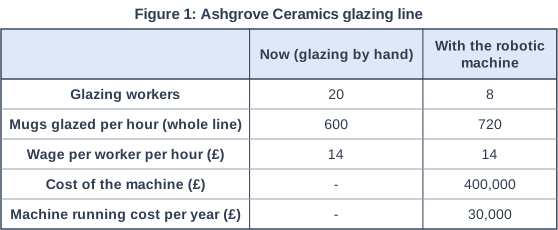
Ashgrove Ceramics makes mugs in Stoke-on-Trent. At present 20 workers glaze the mugs by hand. The company is considering buying a robotic glazing machine. With the machine, only 8 workers would be needed on the glazing line, and the other 12 would lose their jobs. The glazing line runs for 2,000 hours a year. Ashgrove sells mainly to supermarkets and gift shops and faces strong competition from cheaper imported mugs, although some customers like the fact that its mugs are glazed by hand. Figure 1 shows the company's estimates.

Using Figure 1, assess whether Ashgrove Ceramics should buy the robotic glazing machine.

Figure 1: Ashgrove Ceramics glazing line. Table with columns (row headings), "Now (glazing by hand)", "With the robotic machine". Glazing workers; Now (glazing by hand): 20; With the robotic machine: 8 | Mugs glazed per hour (whole line); Now (glazing by hand): 600; With the robotic machine: 720 | Wage per worker per hour (£); Now (glazing by hand): 14; With the robotic machine: 14 | Cost of the machine (£); Now (glazing by hand): -; With the robotic machine: 400,000 | Machine running cost per year (£); Now (glazing by hand): -; With the robotic machine: 30,000.

Model answer

The machine would raise labour productivity on the glazing line enormously. At present 20 workers glaze 600 mugs an hour, or 30 mugs per worker per hour. With the machine, 8 workers would glaze 720 mugs an hour, or 90 per worker per hour, a 200% rise, and total output would rise by 20%. This cuts the labour cost of glazing each mug from about 47p (£280 an hour ÷ 600 mugs) to about 16p (£112 ÷ 720). Over 2,000 hours a year, the wage bill for glazing would fall from £560,000 to £224,000, a saving of £336,000, or £306,000 after the machine's £30,000 running cost. The £400,000 machine would therefore pay for itself in about 1.3 years. Lower average costs would let Ashgrove either increase its profit or cut its prices, making it more competitive against cheaper imported mugs.

However, there are important costs. £400,000 is a large sum to pay up front; if Ashgrove borrows it, it pays interest, and the money cannot be used for anything else. Twelve workers would lose their jobs, which brings redundancy costs, and it may damage the morale and productivity of the workers who stay and the firm's reputation in the local community. If the machine breaks down, the whole glazing line stops. Also, the extra 20% output is only useful if Ashgrove can sell it; otherwise it would simply produce the same number of mugs with fewer workers. Finally, if customers value hand-glazed mugs, the brand could lose some of its appeal.

Overall, I think Ashgrove should buy the machine, because the cost savings are very large and the payback period of little more than a year is short, which matters in a competitive industry. However, this depends on the estimates being accurate and on whether its mugs sell on price rather than on being hand-made. To reduce the human cost, it should try to retrain some of the 12 workers for other jobs in the factory, such as packing the extra output or quality control.

Explanation

Level 3 answers use Figure 1 to calculate the change in productivity and the cost savings (and ideally the payback period), then weigh these against the up-front cost, job losses, risks and the importance of demand. The judgement should say what it depends on. Answers that consider only the benefits, or make no use of the data, cannot score more than 6.

Mark scheme
  1. 9 marks

    Levels of response (9 marks).
    Level 3 (7-9 marks): A fully justified conclusion with sustained evaluation, which is coherent and relevant, with judgements supported by evidence. A full analysis of the economic evidence, a well-developed and logical chain of reasoning. Comprehensive application of knowledge and understanding of pertinent concepts/issues relevant to the context; specialist language used throughout.
    Level 2 (4-6 marks): A partially justified conclusion with an evaluation, which is mostly coherent and relevant; judgements may not be fully supported by evidence. An incomplete analysis of the economic evidence; starts to develop a chain of reasoning. Good application of knowledge and understanding of concepts/issues mostly relevant to the context; specialist language used mostly appropriately.
    Level 1 (1-3 marks): A basic conclusion or assertion may be present based on evaluative judgements supported by little or no evidence. Analysis of discrete points of the economic evidence with no chain of reasoning attempted. Basic application of knowledge and understanding of concepts/issues with limited relevance to the context; may use non-specialist language.
    0 marks: Nothing written worthy of credit.

    Max 6 if the answer considers only one side or gives no judgement. Max 6 if the answer makes no use of the figure/data given. Indicative content (not exhaustive; credit other valid points). Arguments for buying: labour productivity rises from 30 mugs per worker per hour (600 ÷ 20) to 90 (720 ÷ 8), a 200% rise; output rises 20% (600 to 720 mugs an hour); labour cost per mug falls from about 47p (£280 ÷ 600) to about 16p (£112 ÷ 720); yearly labour cost falls from £560,000 (20 × £14 × 2,000) to £224,000, a saving of £336,000, or £306,000 after the £30,000 running cost, so the £400,000 machine pays for itself in about 1.3 years; lower average costs mean higher profit or lower prices and greater competitiveness against cheaper imported mugs; consistent quality. Arguments against: £400,000 up-front cost (borrowing, interest, opportunity cost); 12 workers lose their jobs (redundancy costs, ethical concerns, damage to the morale and productivity of remaining staff and to the firm's local reputation); breakdowns can stop the whole line; remaining staff need training; hand-glazed mugs may be a selling point, so a premium brand could lose sales; extra output is only worth producing if it can be sold. Evaluation: depends on demand for the extra 20% output, the reliability of the estimates, whether the brand depends on being hand-made, and whether workers could be retrained for other jobs rather than made redundant. Overall: credit any supported judgement.

Ready to try the rest? Every answer you write is marked against the mark scheme, so you can see exactly where the marks are.

Study Helper Hints first, answers after you try

Stuck on this one? Ask for a hint and I’ll point you in the right direction, without giving the answer away. Once you’ve checked your answer, I’ll show you how the marks are awarded.