Level:
Correct: 0
Incorrect: 0
Marks: 0/0
Exam Practice
Course:
Topics:
AQA GCSE Economics (Paper 1) Smart practice A mixed round aimed at your weak spots
Unit 1
Economic foundations
Economic activity
Economic activity
The factors of production
Unit 2
Resource allocation
Markets and allocation of resources
Markets and the allocation of resources
Economic sectors
Economic sectors
Specialisation, division of labour, and exchange
Specialisation, division of labour and exchange
Unit 3
How prices are determined
Demand for goods and services
Supply for goods and services
Supply of goods and services
Equilibrium price
Equilibrium price
Intermarket relationships
Price elasticity of demand
Price elasticity of supply
Unit 4
Production, costs, revenue and profit
The importance of cost, revenue and profit for producers
Cost, revenue and profit for producers
Production and productivity
Economies of scale
Economies of scale
Unit 5
Competitive and concentrated markets
The importance of market structures on producers and consumers
Market structures
Competitive markets
Competitive markets
The labour market
The labour market
Unit 6
Market failure
Avg
score:
–
Topics
done:
0/21

Competitive markets

Practise 14 exam-style questions on Competitive markets for AQA GCSE Economics (Paper 1). Write your answer as you would in the exam and get it marked in seconds against the mark scheme, point by point, with the Study Helper on hand if you get stuck.

  • 14 questions
  • 1–15 marks each
  • Instant marking
  • No sign-up needed
14 questions, marked as you go

Sample questions with model answers

Here are 4 of the questions in this topic, each with a model answer, an explanation of why it earns the marks and the mark scheme an examiner would use.

Question 1

1 mark

Hollin Farm is one of hundreds of farms selling plums to wholesalers at the market price. The farm decides to charge 10% more than the market price.

What is most likely to happen?

Choose your answer.

  • A Hollin Farm sells very few plums, because wholesalers buy from other farms.
  • B Hollin Farm's revenue rises by about 10%, because it sells the same quantity at a higher price.
  • C The market price of plums rises by 10%.
  • D The other farms also raise their prices by 10%.

Model answer

A Hollin Farm sells very few plums, because wholesalers buy from other farms.

In a competitive market the farm is a price taker: buyers can get identical plums from hundreds of other farms at the market price, so they switch away.

Explanation

One small seller in a competitive market cannot change the market price. If it charges more than everyone else, buyers simply buy elsewhere, so demand for its own product is extremely price elastic. Options B, C and D describe a firm with market power, which Hollin Farm does not have.

Mark scheme
  1. 1 mark

    A / Hollin Farm sells very few plums, because wholesalers buy from other farms.

    accept the letter or the option text. If more than one option is given, 0 marks.

Question 2

2 marks

Explain what is meant by a competitive market.

Model answer

A competitive market is one with many buyers and sellers of similar products and low barriers to entry, so no single firm can influence the market price: each firm is a price taker.

Explanation

The first mark is for the idea of many firms competing; the second needs a key feature that makes the market competitive, such as low barriers to entry or firms being price takers. An example of a competitive market on its own is not a definition.

Mark scheme
  1. 1 mark

    A market with many firms (sellers) competing for customers.

    Partial definition: the core idea of many firms competing. 2-mark answer, e.g.: 'A market with many buyers and sellers, where no single firm can influence the price because consumers can easily switch to a rival.' / 'A market with many firms, low barriers to entry and similar products, so firms are price takers.' 1-mark answer, e.g.: 'A market where firms compete with each other' / 'a market with lots of sellers'. 0 marks: an example alone (e.g. 'a farmers' market'), or 'a market where prices are low'.

  2. 1 mark

    Completes it with a key feature or consequence: no single firm can influence the market price / firms are price takers / low (or no) barriers to entry / similar or identical products / consumers can easily switch between sellers.

    Award only if the first mark is awarded.

Question 3

2 marks

Explain one reason why a firm in a highly competitive market has a strong incentive to keep its costs of production low.

Model answer

A firm in a highly competitive market is a price taker: it must charge about the same as its many rivals, or customers will switch to them. This means it cannot pass higher costs on through higher prices. If its costs rise above its rivals', its small profit margin disappears and it may make a loss and be forced to close, so it has a strong incentive to find the cheapest and most efficient ways to produce.

Explanation

This is about how producers operate in a competitive market: as price takers, firms can only protect their profit, or survive, by keeping costs down. The first mark is for a valid reason (price taker, rivals undercutting, thin margins); the second explains the link to profit or survival. Benefits to consumers do not answer the question.

Mark scheme
  1. 1 mark

    Identifies a valid reason, e.g. it is a price taker, so it cannot pass higher costs on in higher prices / rivals with lower costs can charge less and take its customers / profit margins are small, so higher costs quickly lead to a loss / only the most efficient firms survive

    2 marks = reason explained; 1 mark = reason identified; 0 = nothing worthy of credit. This indicative content is not exhaustive: credit any valid reason, not only those listed. Possible answers: it is a price taker, so it cannot pass higher costs on in higher prices / rivals with lower costs can charge less and take its customers / profit margins are small, so higher costs quickly lead to a loss / only the most efficient firms survive.

  2. 1 mark

    Explains it: develops the reason with a linked reason or consequence, e.g. because there are many rivals selling similar products, the firm must charge about the market price; if its costs are higher than its rivals', its small profit margin disappears and it may make a loss and be forced out of the market, so it keeps looking for cheaper, more efficient ways to produce

    Award only if the first mark is awarded. The explanation must say why or how (a linked step), not just repeat or reword the point identified.

Question 4

9 marks

Figure 1 - Kerr's Cycles

Kerr's Cycles is a bike repair shop in Ashworth, a city (invented). For years it was one of only four bike repair businesses in the city. Since 2021, seven more have opened, including two mobile mechanics who repair bikes at customers' homes. To keep its customers, Kerr's has cut the price of a standard service, started online booking and begun selling refurbished bikes. The owner says: 'We are busier than ever, but we have to work harder for every pound.'

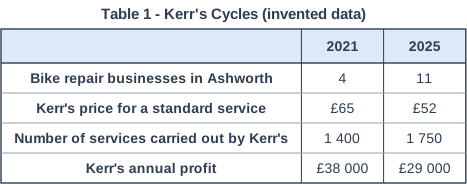
Table 1 shows data for Kerr's Cycles in 2021 and 2025.

Using Figure 1 and Table 1, assess whether increased competition has been harmful to a business such as Kerr's Cycles.

Table 1 - Kerr's Cycles (invented data). Table with columns (row headings), "2021", "2025". Bike repair businesses in Ashworth; 2021: 4; 2025: 11 | Kerr's price for a standard service; 2021: £65; 2025: £52 | Number of services carried out by Kerr's; 2021: 1 400; 2025: 1 750 | Kerr's annual profit; 2021: £38 000; 2025: £29 000.

Model answer

Increased competition appears to have harmed Kerr's Cycles' profits. The number of bike repair businesses in Ashworth rose from 4 to 11, so customers can now easily switch to a rival, including mobile mechanics who come to their homes. To keep customers, Kerr's had to cut the price of a standard service from £65 to £52, a fall of 20%. Its revenue from services has not changed at all: £65 × 1,400 = £91 000 in 2021 and £52 × 1,750 = £91 000 in 2025. Yet doing 350 more services needs more staff time and parts, so costs have risen and profit has fallen from £38 000 to £29 000, about 24% lower. This is what the owner means by working harder for every pound. Lower profit leaves less money to invest in new equipment and makes the business more vulnerable if costs rise further.

On the other hand, competition has not been wholly harmful. Kerr's is busier than ever, carrying out 25% more services, which shows that it has kept its customers and attracted new ones despite seven new rivals. Competition has forced it to innovate: online booking makes it more convenient, and selling refurbished bikes gives it a new source of revenue that is not included in the service figures, so its total revenue may actually have risen. The growth in the number of repair firms may also reflect more people cycling, a growing market that Kerr's can benefit from. The business is still making a profit of £29 000.

Overall, I think competition has harmed Kerr's Cycles in the short run, because its prices and profits have been driven down, just as theory predicts for a firm in an increasingly competitive market. However, the harm is not as serious as it first looks, because the business has responded by becoming more efficient and diversifying. Whether competition is harmful in the long run depends on whether refurbished bike sales grow, whether even more firms enter the market, and whether £29 000 is enough profit for the owner to keep the business going.

Explanation

A Level 3 answer uses the data (price -20%, profit about -24%, services +25%, unchanged service revenue of £91 000) on both sides, explains why competition drives prices and profits down, and also why it can make a firm more efficient and innovative. The judgement should say whether the harm is short or long term and what it depends on. One-sided answers, or answers that ignore the table, are capped at 6 marks.

Mark scheme
  1. 9 marks

    Levels of response (9 marks).
    Level 3 (7-9 marks): A fully justified conclusion with sustained evaluation, which is coherent and relevant, with judgements supported by evidence. A full analysis of the economic evidence, a well-developed and logical chain of reasoning. Comprehensive application of knowledge and understanding of pertinent concepts/issues relevant to the context; specialist language used throughout.
    Level 2 (4-6 marks): A partially justified conclusion with an evaluation, which is mostly coherent and relevant; judgements may not be fully supported by evidence. An incomplete analysis of the economic evidence; starts to develop a chain of reasoning. Good application of knowledge and understanding of concepts/issues mostly relevant to the context; specialist language used mostly appropriately.
    Level 1 (1-3 marks): A basic conclusion or assertion may be present based on evaluative judgements supported by little or no evidence. Analysis of discrete points of the economic evidence with no chain of reasoning attempted. Basic application of knowledge and understanding of concepts/issues with limited relevance to the context; may use non-specialist language.
    0 marks: Nothing written worthy of credit.

    Max 6 if the answer considers only one side or gives no judgement. Max 6 if the answer makes no use of the figure/data given. Indicative content (not exhaustive; credit other valid points). Harmful: more rivals (4 to 11 businesses) mean Kerr's is a price taker for standard services - it cut its price from £65 to £52 (-20%); profit fell from £38 000 to £29 000 (about -24%); revenue from services is unchanged (£65 × 1,400 = £91 000 and £52 × 1,750 = £91 000), but doing 25% more services raises costs (staff time, parts), so profit falls - 'work harder for every pound'; lower profit leaves less to invest and makes the firm more vulnerable to closure; mobile mechanics offer convenience Kerr's may struggle to match. Not harmful / beneficial: Kerr's is busier (1,400 to 1,750 services, +25%), so it has kept and won customers; competition has pushed it to innovate (online booking) and diversify (refurbished bikes, a new source of revenue not shown in the table); it may have become more efficient, cutting waste; a growing number of repair firms may reflect growing demand for cycling, which benefits all firms; still profitable (£29 000). Use of data: percentage changes, revenue calculations. Overall: e.g. competition has harmed Kerr's profits in the short run, but the firm has adapted and may be stronger in the long run; depends on whether refurbished bike sales grow, whether more firms enter, how its costs change, and whether £29 000 is enough for the owner to stay in business.

Ready to try the rest? Every answer you write is marked against the mark scheme, so you can see exactly where the marks are.

Study Helper Hints first, answers after you try

Stuck on this one? Ask for a hint and I’ll point you in the right direction, without giving the answer away. Once you’ve checked your answer, I’ll show you how the marks are awarded.