Level:
Correct: 0
Incorrect: 0
Marks: 0/0
Exam Practice
Course:
Topics:
AQA GCSE Economics (Paper 1) Smart practice A mixed round aimed at your weak spots
Unit 1
Economic foundations
Economic activity
Economic activity
The factors of production
Unit 2
Resource allocation
Markets and allocation of resources
Markets and the allocation of resources
Economic sectors
Economic sectors
Specialisation, division of labour, and exchange
Specialisation, division of labour and exchange
Unit 3
How prices are determined
Demand for goods and services
Supply for goods and services
Supply of goods and services
Equilibrium price
Equilibrium price
Intermarket relationships
Price elasticity of demand
Price elasticity of supply
Unit 4
Production, costs, revenue and profit
The importance of cost, revenue and profit for producers
Cost, revenue and profit for producers
Production and productivity
Economies of scale
Economies of scale
Unit 5
Competitive and concentrated markets
The importance of market structures on producers and consumers
Market structures
Competitive markets
Competitive markets
The labour market
The labour market
Unit 6
Market failure
Avg
score:
–
Topics
done:
0/21

Economies of scale

Practise 15 exam-style questions on Economies of scale for AQA GCSE Economics (Paper 1). Write your answer as you would in the exam and get it marked in seconds against the mark scheme, point by point, with the Study Helper on hand if you get stuck.

  • 15 questions
  • 1–15 marks each
  • Instant marking
  • No sign-up needed
15 questions, marked as you go

Sample questions with model answers

Here are 4 of the questions in this topic, each with a model answer, an explanation of why it earns the marks and the mark scheme an examiner would use.

Question 1

1 mark

A large food company sells more than 300 different products in 40 countries. A fall in the sales of one product, or in one country, has little effect on the company as a whole.

This is an example of

Choose your answer.

  • A financial economies of scale.
  • B managerial economies of scale.
  • C purchasing economies of scale.
  • D risk-bearing economies of scale.

Model answer

D risk-bearing economies of scale.

Explanation

Risk-bearing economies of scale come from spreading risk across many products and markets (diversification), so a problem in one area does not threaten the whole firm. Financial economies are cheaper borrowing, managerial economies come from employing specialist managers, and purchasing economies come from buying inputs in bulk at lower prices.

Mark scheme
  1. 1 mark

    D / risk-bearing economies of scale.

    accept the letter or the option text. If more than one option is given, 0 marks.

Question 2

2 marks

Explain one financial economy of scale that a large firm may benefit from.

Model answer

A large firm can usually borrow money at a lower rate of interest than a small firm. Banks see a large firm, with more assets and steadier revenues, as less likely to fail, so they charge it less interest. Paying less for each pound borrowed lowers its costs, so its average cost of production falls.

Explanation

Financial economies of scale are about the cost of raising money: larger firms are seen as lower risk, so they borrow more cheaply and have more ways to raise finance. The second mark needs the reason (lower risk to lenders) or the effect (lower average costs). Describing bulk buying is a purchasing economy, not a financial one.

Mark scheme
  1. 1 mark

    Identifies a valid financial economy of scale, e.g. large firms can borrow at lower interest rates / can borrow larger amounts more easily / have more ways to raise finance, such as selling shares

    2 = financial economy of scale explained, 1 = financial economy of scale identified, 0 = nothing worthy of credit. Possible answers: lower interest rates; easier access to large loans; ability to issue shares or bonds; better terms from lenders. Other types of economy of scale (bulk buying, specialist managers) score 0. This indicative content is not exhaustive: credit any other valid point.

  2. 1 mark

    Explains it: develops the point with a linked reason / consequence, e.g. because lenders see a large firm, with more assets and steadier revenue, as less risky, so the cost of borrowing per £ is lower, which reduces the firm's average costs

    Example of a 2-mark answer: 'A large firm can borrow at a lower interest rate (1) because banks see it as less likely to fail, so it pays less interest on each £ borrowed and its average costs are lower (1).'

Question 3

3 marks

A firm's total costs are £40,000 when it produces 5,000 units a month. After it expands, its total costs are £56,000 when it produces 8,000 units a month.

Calculate the percentage change in the firm's average cost. Give your answer to one decimal place.

Model answer

Average cost before = £40,000 ÷ 5,000 = £8 per unit
Average cost after = £56,000 ÷ 8,000 = £7 per unit
% change = (7 - 8) ÷ 8 × 100 = -12.5% (average cost falls by 12.5%)

Explanation

Find average cost (total cost ÷ output) at each output, then the percentage change from the original value. Total costs rose by 40%, but output rose by 60%, so average cost fell: the firm is benefiting from economies of scale. Common errors are working out the change in total cost and dropping the minus sign.

Mark scheme
  1. 1 mark

    One average cost correct: £40,000 ÷ 5,000 = £8 or £56,000 ÷ 8,000 = £7; or a correct final answer of -12.5% with no working

    An answer of -12.5% (or 'a fall of 12.5%') with no working scores 3 marks. 12.5% with no minus sign and no statement that it is a fall: 2 marks. The percentage change in total costs (+40%) scores 0. Using the new average cost as the base (-14.3%) scores 1 for the average costs.

  2. 1 mark

    Correct method: (£7 - £8) ÷ £8 × 100 with both average costs correct (implied by a correct final answer)

    Allow a follow-through of the method from one incorrect average cost.

  3. 1 mark

    -12.5% (a fall of 12.5%)

    Accept -12.5 with or without the % sign. The answer is exact, so -12.50% is also correct.

Question 4

9 marks

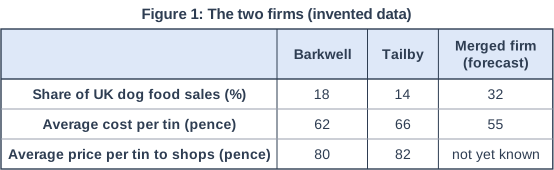
Barkwell Foods and Tailby Petcare are two UK makers of tinned dog food. They plan to merge. They say the merged firm will gain economies of scale by buying meat and tins in bulk, closing the smaller of their two factories and running one advertising campaign instead of two. However, the two firms use different suppliers, recipes and computer systems, about 300 staff would have to move to the remaining factory or leave, and the merger may be investigated by the Competition and Markets Authority (CMA), which can investigate a merger that creates a firm with 25% or more of the supply of a product. Figure 1 shows data about the two firms (invented data).

Using Figure 1, assess whether the merger is likely to benefit Barkwell Foods and Tailby Petcare.

Figure 1: The two firms (invented data). Table with columns (row headings), "Barkwell", "Tailby", "Merged firm (forecast)". Share of UK dog food sales (%); Barkwell: 18; Tailby: 14; Merged firm (forecast): 32 | Average cost per tin (pence); Barkwell: 62; Tailby: 66; Merged firm (forecast): 55 | Average price per tin to shops (pence); Barkwell: 80; Tailby: 82; Merged firm (forecast): not yet known.

Model answer

The merger could bring large benefits to the two firms. Figure 1 forecasts that the merged firm's average cost will be 55p a tin, compared with 62p at Barkwell and 66p at Tailby, falls of about 11% and 17%. These savings come from economies of scale. Buying meat and tins in much larger quantities gives the merged firm more bargaining power with suppliers, so it pays less for each unit (purchasing economies). Closing the smaller factory means the remaining factory runs at a higher output, spreading its fixed costs over more tins (technical economies), and one advertising campaign costs less per tin than two (marketing economies). If prices to shops stayed at around 80p, the profit on each tin would rise from 18p at Barkwell and 16p at Tailby to about 25p. With 32% of UK dog food sales, the merged firm would also be the largest seller, giving it more power when it negotiates with supermarkets.

However, these benefits are not certain. The 55p figure is the firms' own forecast and may be optimistic. Combining two businesses with different suppliers, recipes and computer systems can cause diseconomies of scale: communication and coordination become harder, and the 300 staff who must move or leave may be less motivated, so costs may not fall as much as hoped. Closing a factory also brings one-off costs, such as redundancy pay. Finally, a 32% share is above the 25% level at which the CMA can investigate. The CMA could delay or block the merger, or require the firms to sell a brand or a factory, which would reduce the economies of scale.

Overall, I think the merger is likely to benefit the two firms, because the forecast fall in average cost is large and comes from several different economies of scale, so even part of it would raise their profit per tin. However, the size of the benefit depends on how well the two businesses are combined, on whether the forecast savings are realistic, and on the CMA's decision: if the firms had to sell one of the brands, much of the gain could be lost.

Explanation

Level 3 answers use Figure 1 to measure the forecast cost savings and the rise in profit per tin, explain the economies of scale behind them, and weigh these against diseconomies of scale, one-off costs and the risk of a CMA investigation (32% is above the 25% test). The best judgement says what the outcome depends on. Answers that consider only the benefits, or ignore the data, cannot score more than 6.

Mark scheme
  1. 9 marks

    Levels of response (9 marks).
    Level 3 (7-9 marks): A fully justified conclusion with sustained evaluation, which is coherent and relevant, with judgements supported by evidence. A full analysis of the economic evidence, a well-developed and logical chain of reasoning. Comprehensive application of knowledge and understanding of pertinent concepts/issues relevant to the context; specialist language used throughout.
    Level 2 (4-6 marks): A partially justified conclusion with an evaluation, which is mostly coherent and relevant; judgements may not be fully supported by evidence. An incomplete analysis of the economic evidence; starts to develop a chain of reasoning. Good application of knowledge and understanding of concepts/issues mostly relevant to the context; specialist language used mostly appropriately.
    Level 1 (1-3 marks): A basic conclusion or assertion may be present based on evaluative judgements supported by little or no evidence. Analysis of discrete points of the economic evidence with no chain of reasoning attempted. Basic application of knowledge and understanding of concepts/issues with limited relevance to the context; may use non-specialist language.
    0 marks: Nothing written worthy of credit.

    Max 6 if the answer considers only one side or gives no judgement. Max 6 if the answer makes no use of the figure/data given. Indicative content (not exhaustive; credit other valid points). Benefits to the firms: forecast average cost falls from 62p (Barkwell) and 66p (Tailby) to 55p per tin, falls of about 11% and 17%, from purchasing economies (bulk meat and tins, more bargaining power with suppliers), technical economies (one larger, fuller factory spreading its fixed costs over more tins), marketing economies (one campaign spread over more tins) and managerial economies (one head office, specialist managers); at current prices the profit per tin would rise from 18p (80p - 62p) and 16p (82p - 66p) to about 25p-27p, or the firm could cut its price to win sales and still earn a bigger margin; with 32% of sales it becomes the largest seller, with more power when selling to supermarkets and pet shops and less competition; greater size to compete with the largest rivals and supermarkets' own-label dog food. Costs and risks: diseconomies of scale - combining two workforces with different suppliers, recipes and computer systems causes communication and coordination problems, and the 300 staff who must move or leave may lose motivation, so the forecast savings may not happen; one-off costs of closing a factory (redundancy pay) and merging systems; the 55p is the firms' own forecast and may be optimistic; with 32% of sales (above 25%) the CMA may investigate and could delay or block the merger or require a brand or factory to be sold, which would cut the economies of scale; loyal customers may switch if a recipe changes or a brand is dropped; rivals may respond with price cuts or more advertising. Use of data: % falls in average cost; profit per tin now and after; combined share 32% against the CMA's 25% test. Evaluation: depends on whether the forecast savings are achieved, how well the two businesses are combined, how the CMA responds, and how customers and rivals react. Overall: credit any well-supported judgement.

Ready to try the rest? Every answer you write is marked against the mark scheme, so you can see exactly where the marks are.

Study Helper Hints first, answers after you try

Stuck on this one? Ask for a hint and I’ll point you in the right direction, without giving the answer away. Once you’ve checked your answer, I’ll show you how the marks are awarded.