Level:
Correct: 0
Incorrect: 0
Marks: 0/0
Exam Practice
Course:
Topics:
AQA GCSE Economics (Paper 1) Smart practice A mixed round aimed at your weak spots
Unit 1
Economic foundations
Economic activity
Economic activity
The factors of production
Unit 2
Resource allocation
Markets and allocation of resources
Markets and the allocation of resources
Economic sectors
Economic sectors
Specialisation, division of labour, and exchange
Specialisation, division of labour and exchange
Unit 3
How prices are determined
Demand for goods and services
Supply for goods and services
Supply of goods and services
Equilibrium price
Equilibrium price
Intermarket relationships
Price elasticity of demand
Price elasticity of supply
Unit 4
Production, costs, revenue and profit
The importance of cost, revenue and profit for producers
Cost, revenue and profit for producers
Production and productivity
Economies of scale
Economies of scale
Unit 5
Competitive and concentrated markets
The importance of market structures on producers and consumers
Market structures
Competitive markets
Competitive markets
The labour market
The labour market
Unit 6
Market failure
Avg
score:
–
Topics
done:
0/21

Specialisation, division of labour and exchange

Practise 14 exam-style questions on Specialisation, division of labour and exchange for AQA GCSE Economics (Paper 1). Write your answer as you would in the exam and get it marked in seconds against the mark scheme, point by point, with the Study Helper on hand if you get stuck.

  • 14 questions
  • 1–15 marks each
  • Instant marking
  • No sign-up needed
14 questions, marked as you go

Sample questions with model answers

Here are 4 of the questions in this topic, each with a model answer, an explanation of why it earns the marks and the mark scheme an examiner would use.

Question 1

1 mark

Which of the following is most likely to be a benefit of specialisation for an individual worker?

Choose your answer.

  • A Becoming an expert in one area, so they can earn higher pay
  • B Doing a wider variety of tasks each day
  • C Lower average costs of production
  • D Being able to cover the job of any colleague who is absent

Model answer

A Becoming an expert in one area, so they can earn higher pay

Explanation

A specialist concentrates on one job or task, becomes very skilled at it and can often command higher pay or be in demand by employers. Specialists usually do a narrower, not wider, range of tasks, so options B and D describe a generalist. Lower average costs are a benefit of specialisation to the firm rather than to the worker.

Mark scheme
  1. 1 mark

    A / Becoming an expert in one area, so they can earn higher pay

    accept the letter or the option text; award 0 if more than one option is given. B and D describe the opposite of specialisation (doing many different tasks). C is a benefit to the firm, not to the individual worker.

Question 2

2 marks

Explain one benefit of the division of labour to a firm.

Model answer

With the division of labour, each worker repeats the same task and quickly becomes very good at it, and no time is wasted moving between tasks. The firm can therefore produce more output with the same number of workers, so the average cost of making each unit falls. This means the firm can charge lower prices than its rivals or make a higher profit.

Explanation

The main benefits to a firm are faster, more skilled workers, more output and lower costs per unit. The second mark is for showing the effect on the firm, such as lower average costs or higher profit. Make sure the benefit is to the firm, not to the worker.

Mark scheme
  1. 1 mark

    Identifies a valid benefit, e.g. workers become faster and more skilled at their one task (practice makes perfect); higher output per worker / more output from the same workers; lower average cost per unit; less time wasted moving between tasks; shorter and cheaper training for each task; easier to use specialist machinery; easier to recruit because each job needs fewer skills

    1 = identified. Possible answers (this indicative content is not exhaustive; credit any valid point). A benefit to the worker (e.g. higher pay) does not answer this question.

  2. 1 mark

    Explains it: develops the point with a linked consequence for the firm, e.g. because each worker repeats the same task, they become quicker at it, so the firm makes more output with the same number of workers and its average cost per unit falls, allowing lower prices or higher profit

    2 = explained. The explanation must show the consequence for the firm (output, costs, prices, profit, competitiveness). Two different benefits that are each only identified score 1 mark. No productivity calculation is required.

Question 3

2 marks

Explain one risk to a worker of becoming highly specialised.

Model answer

A highly specialised worker relies on one narrow skill. If new technology, such as a machine or software, is introduced to do that task, demand for their skill may disappear. Because they have few transferable skills, they may find it hard to get another job, so they could face a long period of unemployment or have to accept lower pay while they retrain.

Explanation

Specialisation can bring higher pay, but it also brings risk: a narrow skill can become out of date, or the industry that uses it can decline. The second mark needs the consequence for the worker, such as unemployment or having to retrain. Boredom is a cost, but the question asks about risk, so a point about job security is usually stronger.

Mark scheme
  1. 1 mark

    Identifies a valid risk, e.g. their skill may become out of date because of new technology or automation; demand for their specialism may fall (e.g. an industry declines); they have few transferable skills, so it is harder to change jobs; they depend on one employer or industry; repetitive work may cause boredom or injury

    1 = identified. Possible answers (this indicative content is not exhaustive; credit any valid point).

  2. 1 mark

    Explains it: develops the point with a linked consequence for the worker, e.g. if a machine is introduced that does their one task, they may lose their job, and because their skills are narrow they may struggle to find another job, leading to a long spell of unemployment and lower income

    2 = explained. The explanation must show the consequence for the worker (job loss, unemployment, lower pay, difficulty retraining). Two different risks that are each only identified score 1 mark.

Question 4

9 marks

Porthaven is a seaside town in Cornwall. Over many years, the town has specialised in tourism: its beaches, harbour and coastal paths attract visitors, and most of its businesses are hotels, holiday lets, cafés, surf schools and gift shops. The town buys most of the goods it needs, such as food, fuel and building materials, from other parts of the UK. In 2020, when holidays were stopped for several months, many businesses in the town struggled to survive.

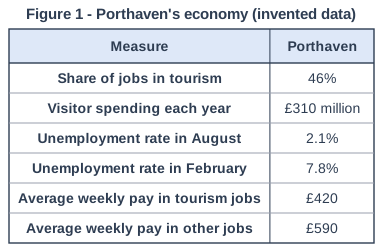
Figure 1 shows some data about Porthaven's economy (the town and the data are invented).

Using Figure 1, assess whether specialising in tourism has been good for Porthaven's economy.

Figure 1 - Porthaven's economy (invented data). Table with columns "Measure", "Porthaven". Measure: Share of jobs in tourism; Porthaven: 46% | Measure: Visitor spending each year; Porthaven: £310 million | Measure: Unemployment rate in August; Porthaven: 2.1% | Measure: Unemployment rate in February; Porthaven: 7.8% | Measure: Average weekly pay in tourism jobs; Porthaven: £420 | Measure: Average weekly pay in other jobs; Porthaven: £590.

Model answer

Specialising in tourism makes sense for Porthaven because its natural resources, its beaches, harbour and coastal paths, give it an advantage that inland towns do not have. Figure 1 shows that visitors spend £310 million a year in the town and that 46% of jobs are in tourism, so the industry provides a large share of local work and income. Through exchange, the town uses the money it earns from visitors to buy the food, fuel and materials it needs from other parts of the UK, which it could not produce as cheaply itself. In the summer, unemployment is only 2.1%, showing how much work tourism creates at its peak.

However, specialisation also brings costs. Because nearly half of all jobs depend on one industry, the town is very exposed when demand falls: the case shows that when holidays stopped in 2020, many businesses struggled to survive. Tourism is also seasonal, so unemployment rises from 2.1% in August to 7.8% in February, meaning many workers have no income for part of the year. Tourism jobs pay an average of £420 a week compared with £590 in other jobs, so incomes in the town are lower than they would be with a wider range of industries, and young people looking for better-paid careers may move away. The town also depends on other places for essentials, so it is hit by rises in their prices.

Overall, I think specialising in tourism has been good for Porthaven, because it uses the town's natural advantage and brings in £310 million a year that it could not earn from other industries. But the high winter unemployment and low pay show that relying so heavily on one industry has real costs, so the town would benefit from some diversification, such as attracting remote workers or year-round events. The judgement depends on how stable demand for UK holidays remains: if another shock like 2020 happened, the costs of over-specialisation would outweigh the benefits.

Explanation

A Level 3 answer explains specialisation and exchange in Porthaven's case, uses the data on both sides (£310 million and 46% of jobs against 7.8% winter unemployment and £420 v £590 pay) and reaches a judgement that explains what it depends on. Answers that ignore the figure, or only list advantages, are capped at 6.

Mark scheme
  1. 9 marks

    Levels of response (9 marks).
    Level 3 (7-9 marks): A fully justified conclusion with sustained evaluation, which is coherent and relevant, with judgements supported by evidence. A full analysis of the economic evidence, a well-developed and logical chain of reasoning. Comprehensive application of knowledge and understanding of pertinent concepts/issues relevant to the context; specialist language used throughout.
    Level 2 (4-6 marks): A partially justified conclusion with an evaluation, which is mostly coherent and relevant; judgements may not be fully supported by evidence. An incomplete analysis of the economic evidence; starts to develop a chain of reasoning. Good application of knowledge and understanding of concepts/issues mostly relevant to the context; specialist language used mostly appropriately.
    Level 1 (1-3 marks): A basic conclusion or assertion may be present based on evaluative judgements supported by little or no evidence. Analysis of discrete points of the economic evidence with no chain of reasoning attempted. Basic application of knowledge and understanding of concepts/issues with limited relevance to the context; may use non-specialist language.
    0 marks: Nothing written worthy of credit.

    Max 6 if the answer considers only one side or gives no judgement. Max 6 if the answer makes no use of the data in Figure 1. Indicative content (not exhaustive; credit other valid points). Benefits: the town specialises in what its natural resources (beaches, harbour, scenery) make it best at, so it can attract visitors that inland towns cannot; visitor spending of £310 million a year brings income into the town, which it exchanges for the goods it needs from elsewhere (specialisation and exchange); 46% of jobs are in tourism, so many people have work; businesses develop specialist skills (surf schools, hospitality) and the town builds a strong reputation; summer unemployment is very low (2.1%). Costs: dependence on one industry - when tourism stopped in 2020 many businesses struggled, showing the risk of specialisation; seasonal unemployment: 7.8% in February compared with 2.1% in August; lower pay in tourism (£420 a week) than in other jobs (£590), so incomes in the town are lower; few other career options, so young people may leave; the town depends on others for food, fuel and materials, so it is affected by their prices and supplies; vulnerable to bad weather, rising costs of living elsewhere (fewer holidays) or changing fashions. Use of data: 46%; £310 million; 2.1% v 7.8%; £420 v £590. Overall: a supported judgement, e.g. specialisation has been good overall because the town has a clear advantage and earns large visitor spending, but the town would benefit from diversifying (e.g. remote working, year-round events) to reduce seasonal unemployment and the risk shown in 2020; depends on the stability of demand for UK holidays and on whether other industries could realistically grow there.

Ready to try the rest? Every answer you write is marked against the mark scheme, so you can see exactly where the marks are.

Study Helper Hints first, answers after you try

Stuck on this one? Ask for a hint and I’ll point you in the right direction, without giving the answer away. Once you’ve checked your answer, I’ll show you how the marks are awarded.