Level:
Correct: 0
Incorrect: 0
Marks: 0/0
Practice
Course:
Topics:
Year 4 Maths Smart practice A mixed round aimed at your weak spots
Unit 1
Place value
Unit 2
Addition and subtraction
Column addition
Quick practice5 skills
Column subtraction
Quick practice5 skills
Estimating and checking answers
Quick practice5 skills
Two-step word problems
Quick practice5 skills
Unit 3
Multiplication and division
Unit 4
Fractions
Unit 5
Decimals
Unit 6
Measurement
Measurement
Converting units of measure
Quick practice6 skills
Perimeter
Quick practice5 skills
Area
Quick practice5 skills
Time
Quick practice7 skills
Unit 7
Shape
Unit 8
Position and direction
Geometry: position and direction
Coordinates
Quick practice5 skills
Translations
Quick practice4 skills
Unit 9
Statistics
Avg
score:
–
Topics
done:
0/34

Triangles and quadrilaterals

Practise 20 questions on Triangles and quadrilaterals for Year 4 Maths. Tap your answer and find out straight away if you are right, with the Study Helper on hand if you get stuck.

  • 20 questions
  • 1–5 marks each
  • Instant marking
  • No sign-up needed
20 questions, marked as you go

Sample questions with model answers

Here are 4 of the questions in this topic, each with a model answer, an explanation of why it earns the marks and the mark scheme.

Question 1

1 mark

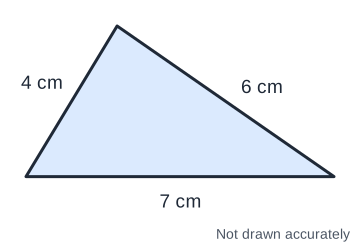
The diagram shows a triangle.

What type of triangle is it? Choose from equilateral, isosceles or scalene.

A shaded triangle with its longest side along the bottom. The bottom side is labelled 7 cm, the left side is labelled 4 cm and the right side is labelled 6 cm.

Model answer

The sides are 4 cm, 6 cm and 7 cm. No two sides are the same length, so it is a scalene triangle.

Explanation

Look at the lengths of the sides: 4 cm, 6 cm and 7 cm are all different. A triangle with no equal sides is called scalene. If two sides were the same it would be isosceles, and if all three were the same it would be equilateral.

Mark scheme
  1. 1 mark

    scalene

    Do not accept isosceles or equilateral.

Question 2

2 marks

Tom makes a triangle with three sticks. The sticks are 5 cm, 8 cm and 5 cm long.

What type of triangle has Tom made? How do you know?

Model answer

Isosceles. Two of the sides are the same length: they are both 5 cm.

Explanation

An isosceles triangle has two sides that are the same length. Tom's triangle has two sides of 5 cm and one side of 8 cm, so it is isosceles. It is not equilateral, because the 8 cm side is different. A common mistake is to say scalene, but a scalene triangle has no equal sides.

Mark scheme
  1. 1 mark

    isosceles

  2. 1 mark

    A correct reason: it has two sides the same length (the two 5 cm sides)

    Accept 'two sides are equal' or 'two sides are 5 cm'. 'Because of the sides' alone scores 0 for this mark.

Question 3

2 marks

An isosceles triangle has two sides that are each 7 cm long.

Its perimeter is 20 cm.

How long is its third side?

Model answer

\(7 + 7 = 14\) cm
\(20 - 14 = 6\) cm
The third side is 6 cm.

Explanation

The perimeter is all three sides added together. The two equal sides make \(7 + 7 = 14\) cm, so the third side is what is left of the 20 cm: \(20 - 14 = 6\) cm. A common mistake is to take away only one 7 cm side and get 13 cm.

Mark scheme
  1. 1 mark

    The two equal sides add up to 14 cm (\(7 + 7\)); or the correct answer 6 cm with no working

  2. 1 mark

    6 cm

    Accept 6. Do not accept 13 (20 - 7) or 7. A correct answer with no working scores full marks.

Question 4

4 marks

Jake has two equilateral triangles. Each side of each triangle is 5 cm long.

He puts them together along one side to make a quadrilateral.

What is the name of the quadrilateral? Use the name that tells you the most about it.

What is its perimeter?

How many pairs of parallel sides does it have?

Model answer

The two joined sides are inside the shape, so the quadrilateral has 4 outside sides, each 5 cm.
All 4 sides are equal and it has no right angles: a rhombus.
Perimeter = \(4 \times 5 = 20\) cm
A rhombus has 2 pairs of parallel sides.

Explanation

When the triangles are joined, the two sides that touch end up inside the shape, so only 4 sides are left on the outside, each 5 cm long. A quadrilateral with four equal sides and no right angles is a rhombus, and its perimeter is \(4 \times 5 = 20\) cm. A rhombus has two pairs of parallel sides. A common mistake is to add all six sides of the two triangles and get 30 cm.

Mark scheme
  1. 1 mark

    rhombus

    Do not accept diamond, square, kite or parallelogram (a rhombus is a special parallelogram, but rhombus is the name that tells you the most: all 4 sides are equal).

  2. 1 mark

    The quadrilateral has 4 sides that are each 5 cm (e.g. \(5 + 5 + 5 + 5\) or \(4 \times 5\)); or the correct perimeter 20 cm with no working

  3. 1 mark

    Perimeter = 20 cm

    Accept 20. Do not accept 30 (all six sides of the two triangles added, including the two joined sides).

  4. 1 mark

    2 pairs

    Accept 2.

Ready to try the rest? Tap your answers and see straight away how you did.

Topic notes

Triangles and quadrilaterals

The big idea

A triangle has 3 straight sides. A quadrilateral has 4 straight sides. To give a shape its exact name, look at its properties: how long its sides are, what its angles are like and whether any of its sides are parallel.

Words to know

  • A right angle is a square corner, like the corner of a page. A small square drawn in a corner shows a right angle.
  • Equal sides are the same length. Small dashes show equal sides: sides with the same number of dashes are equal.
  • Parallel sides stay the same distance apart all the way along, so they would never cross even if you made them longer. Think of the two rails of a train track. Arrows show parallel sides.
  • Turning a shape round does not change its name.

Types of triangle

TriangleWhat it has
equilateral3 equal sides
isosceles2 equal sides
scaleneno equal sides
right-angled1 right angle
Four triangles, labelled. Equilateral: all 3 sides marked equal. Isosceles: 2 sides marked equal. Scalene: no equal sides. Right-angled: a small square marks its right angle.
Dashes show the equal sides. The small square shows the right angle.

A triangle can need two words. A right-angled triangle is also isosceles or scalene, depending on its sides.

Mo makes a table to sort triangles. Can he find a triangle for every box?

Has a right angleHas no right angle
Isoscelesbox 1box 2
Scalenebox 3box 4
  • Box 1: fold a square piece of paper in half, so that one corner lands on the opposite corner. The folded triangle has a right angle and 2 equal sides.
  • Box 2: the isosceles triangle in the picture.
  • Box 3: the right-angled triangle in the picture. Its sides are all different lengths.
  • Box 4: the scalene triangle in the picture.

So every box can be filled. An equilateral triangle fits neither row, because all 3 of its sides are equal. It never has a right angle: its 3 angles are the same size, and each one is smaller than a right angle.

Types of quadrilateral

QuadrilateralSidesRight anglesPairs of parallel sides
square4 equal sides42
rectangleopposite sides equal42
rhombus4 equal sidesnone2
parallelogramopposite sides equalnone2
trapeziumany lengthssome have themexactly 1
kite2 pairs of equal sides, each pair meeting at a cornersome have themnone
Six quadrilaterals, labelled. Square: 4 equal sides and 4 right angles. Rectangle: opposite sides equal and 4 right angles. Rhombus: 4 equal sides and 2 pairs of parallel sides. Parallelogram: opposite sides equal and 2 pairs of parallel sides. Trapezium: 1 pair of parallel sides. Kite: 2 short equal sides and 2 long equal sides.
Dashes show equal sides, arrows show parallel sides and small squares show right angles.

A rectangle that is not a square is sometimes called an oblong.

Some shapes fit more than one name. A square is also a rectangle (it has 4 right angles) and also a rhombus (it has 4 equal sides). But square is the name that tells you the most about it, so that is the name to use. Always use the name that tells you the most.

Ruby says, "My shape has 4 equal sides, so it must be a square." Is she right?

Not always. A square needs 4 equal sides and 4 right angles.

A rhombus has 4 equal sides as well, but none of its corners is a right angle. Two corners are narrower than a right angle and two are wider.

So Ruby is not right. Her shape is a square only if its corners are right angles. If they are not, it is a rhombus.

You can also sort shapes in a Venn diagram. A shape that fits both labels goes where the circles overlap. A shape that fits neither label goes outside the circles.

Sort these shapes by how many pairs of parallel sides they have: kite, rectangle, trapezium, rhombus, square, parallelogram.

Look at each pair of opposite sides and ask: are they parallel, like train rails?

No pairs1 pair2 pairs
kitetrapeziumrectangle, rhombus, square, parallelogram

Check your answer: there are 6 shapes, and each one is in exactly one column.

Remember

  • Equilateral: 3 equal sides. Isosceles: 2 equal sides. Scalene: no equal sides.
  • A right-angled triangle has 1 right angle.
  • Square, rectangle, rhombus and parallelogram have 2 pairs of parallel sides.
  • A trapezium has exactly 1 pair of parallel sides. A kite has none.
  • Use the name that tells you the most.

Common mistakes

  • Calling a rhombus a square. A square must have 4 right angles too.
  • Calling a triangle with 2 equal sides scalene. Scalene means no equal sides, so this triangle is isosceles.
  • Counting the sides instead of the pairs. A parallelogram has 4 sides but 2 pairs of parallel sides.
  • Calling a kite a rhombus. A rhombus has all 4 sides equal. A kite has 2 short equal sides and 2 long equal sides.
  • Thinking a shape changes when it is turned. A square standing on one corner is still a square.

Top tip

Check the marks before you name a shape: dashes for equal sides, arrows for parallel sides and small squares for right angles. Then go through the table one property at a time.

Study Helper Hints first, answers after you try

Stuck on this one? Ask for a hint and I’ll point you in the right direction, without giving the answer away. Once you’ve checked your answer, I’ll show you how the marks are awarded.