Level:
Correct: 0
Incorrect: 0
Marks: 0/0
Practice
Course:
Topics:
Year 4 Maths Smart practice A mixed round aimed at your weak spots
Unit 1
Place value
Unit 2
Addition and subtraction
Column addition
Quick practice5 skills
Column subtraction
Quick practice5 skills
Estimating and checking answers
Quick practice5 skills
Two-step word problems
Quick practice5 skills
Unit 3
Multiplication and division
Unit 4
Fractions
Unit 5
Decimals
Unit 6
Measurement
Measurement
Converting units of measure
Quick practice6 skills
Perimeter
Quick practice5 skills
Area
Quick practice5 skills
Time
Quick practice7 skills
Unit 7
Shape
Unit 8
Position and direction
Geometry: position and direction
Coordinates
Quick practice5 skills
Translations
Quick practice4 skills
Unit 9
Statistics
Avg
score:
–
Topics
done:
0/34

Lines of symmetry

Practise 20 questions on Lines of symmetry for Year 4 Maths. Tap your answer and find out straight away if you are right, with the Study Helper on hand if you get stuck.

  • 20 questions
  • 1–5 marks each
  • Instant marking
  • No sign-up needed
20 questions, marked as you go

Sample questions with model answers

Here are 4 of the questions in this topic, each with a model answer, an explanation of why it earns the marks and the mark scheme.

Question 1

1 mark

The diagram shows four capital letters.

Which of these letters has a line of symmetry?

Four capital letters drawn with thick lines, in a row: F, T, N and Z.

Model answer

T. A line straight down the middle of the T splits it into two matching halves.

Explanation

Imagine a mirror line straight down the middle of each letter. T matches on both sides, so it has a line of symmetry. F has its arms on one side only, and N and Z look the same if you turn them half way round, but no fold line makes their two halves match. A common mistake is to think N or Z is symmetrical because they look balanced.

Mark scheme
  1. 1 mark

    T

    Do not accept F, N or Z. If more than one letter is given, award 0.

Question 2

2 marks

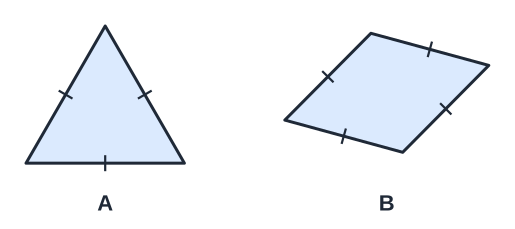
The diagram shows two shapes, A and B. Sides with the same marks are the same length.

How many lines of symmetry does shape A have?

How many lines of symmetry does shape B have?

Two shaded shapes labelled A and B. A is a triangle with one small dash on each of its three sides. B is a four-sided shape, turned so that it slopes, with one small dash on each of its four sides and no right angles.

Model answer

A is an equilateral triangle: 3 lines, one from each corner to the middle of the opposite side.
B is a rhombus: 2 lines, along its two diagonals.

Explanation

Shape A has three equal sides, so it is an equilateral triangle, and it has 3 lines of symmetry, one through each corner. Shape B has four equal sides but no right angles, so it is a rhombus. A rhombus folds exactly along both of its diagonals, so it has 2 lines of symmetry, even though it is turned. A common mistake is to give the rhombus 4 lines, like a square.

Mark scheme
  1. 1 mark

    Shape A: 3

  2. 1 mark

    Shape B: 2

    Do not accept 4 or 0 for shape B.

Question 3

2 marks

Which of these quadrilaterals has exactly 2 lines of symmetry?

Which of these quadrilaterals has no lines of symmetry?

Model answer

2 lines of symmetry: rectangle
No lines of symmetry: parallelogram

Explanation

A rectangle that is not a square has 2 lines of symmetry, through the middles of opposite sides, and a rhombus has 2 along its diagonals. A parallelogram with no right angles and sides of two different lengths has no lines of symmetry: no fold makes its halves match. A common mistake is to think a parallelogram folds along a diagonal like a rhombus.

Mark scheme
  1. 1 mark

    Exactly 2 lines: rectangle or rhombus

    Accept oblong. Do not accept square (4 lines) or kite (1 line).

  2. 1 mark

    No lines: parallelogram

    Also accept an irregular quadrilateral, or a trapezium described as having no equal sides or a right angle. Do not accept 'trapezium' on its own (some trapeziums have a line of symmetry), square, rectangle, rhombus or kite.

Question 4

4 marks

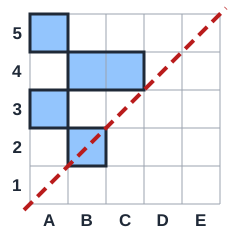
The diagram shows a pattern on a grid. The dashed mirror line goes diagonally from one corner of the grid to the opposite corner. Each square is named by its column letter and row number, like B2.

Tap all the squares that must be shaded to make the pattern symmetrical in the mirror line.

A grid of squares with columns labelled A to E and rows labelled 1 to 5, with row 1 at the bottom. A dashed mirror line goes diagonally from the bottom left corner of the grid to the top right corner, passing through squares A1, B2, C3, D4 and E5. Shaded squares: A5, B4, C4, A3 and B2.

Model answer

The mirror line swaps the column and the row.
A3 (column 1, row 3) goes to column 3, row 1: C1.
B4 goes to D2.
C4 goes to D3.
A5 goes to E1.
B2 is on the line, so it stays where it is.
C1, D2, D3, E1

Explanation

With a diagonal mirror line, each square's reflection is the same distance from the line on the other side, which makes the column and the row swap over: A3 (column A is the 1st column, row 3) reflects to the 3rd column, row 1, which is C1. In the same way B4 goes to D2, C4 goes to D3 and A5 goes to E1. B2 sits on the mirror line, so it is its own reflection. A common mistake is to reflect the squares straight down or straight across, as if the mirror line were upright.

Mark scheme
  1. 1 mark

    C1

  2. 1 mark

    D2

  3. 1 mark

    D3

  4. 1 mark

    E1

    Award one mark for each correct square, in any order, then take off 1 mark for each wrong square (the total cannot go below 0). Ignore squares that are already shaded (A3, A5, B4, C4 and B2; B2 is on the mirror line, so it is its own reflection).

Ready to try the rest? Tap your answers and see straight away how you did.

Topic notes

Lines of symmetry

The big idea

A line of symmetry cuts a shape into two halves that match exactly. Fold the shape along the line and one half lands exactly on the other half. Each half is the mirror image of the other half, so a line of symmetry is also called a mirror line. A shape with a line of symmetry is symmetrical.

Finding lines of symmetry

To test a line, imagine folding the shape along it. You can also stand a small mirror on the line: one half and its reflection should make the whole shape.

  • Lines of symmetry can go up and down, across, or on a slant.
  • Two equal pieces are not enough: when you fold, the pieces must match exactly.
  • If you turn a shape, its lines of symmetry turn with it, so it keeps the same number.
ShapeLines of symmetry
square4
equilateral triangle3
rectangle that is not a square2
rhombus that is not a square2
kite1
isosceles triangle1
scalene triangle0
parallelogram that is not a rhombus or a rectangle0
Three shapes with their lines of symmetry dashed: a square standing on one corner with 4 lines, a rectangle with 2 lines, and a kite with 1 line from its top corner to its bottom corner.
The dashed lines are the lines of symmetry. The square is standing on one corner.

Jo draws a square standing on one of its corners. She says, "It looks like a diamond now, so it has only 2 lines of symmetry." Is she right?

Turning a shape does not change it. Jo's shape is still a square, so it still has 4 lines of symmetry:

  • one up and down, from the top corner to the bottom corner
  • one across, from the left corner to the right corner
  • two on a slant, each through the middle of a pair of opposite sides.

So Jo is not right. Look at the square in the picture: each of the 4 dashed lines folds it exactly in half.

Letters

Capital letters can be symmetrical too, when they are written as plain block letters.

Lines of symmetryLetters
1, going up and downA, M, T, U, V, W, Y
1, going acrossB, C, D, E, K
2H, I, O, X
0F, G, J, L, N, P, Q, R, S, Z

Completing a symmetrical pattern

Squares on a grid have names: the column letter comes first, then the row number, as in B2. To complete a pattern in a mirror line, every shaded square needs a partner on the other side of the line. For a mirror line that goes up and down, the partner is:

  • in the same row
  • the same number of squares away from the mirror line.

Always start counting at the mirror line, never at the side of the grid. When the mirror line goes across instead, a partner stays in its column and moves to the other side of the line, so the pattern flips upside down.

A grid with columns A to F and rows 1 to 4, and a dashed mirror line between columns C and D. The shaded squares are B1, C1, D1 and E1 in row 1, C2, D2 and E2 in row 2, and C3 in row 3.
Ben's pattern. The dashed mirror line is between columns C and D.

Ben coloured the left half of his pattern first. Then he tried to copy it on the right of the mirror line, but he coloured one square in the wrong place. Which square is wrong? Which square should he have coloured instead?

For each square on the left, find its partner: same row, equally far from the mirror line.

  • B1 is the 2nd square from the line. Partner: E1, the 2nd square on the other side, which is coloured.
  • C1 touches the line. Partner: D1, which is coloured.
  • C2 touches the line. Partner: D2, which is coloured.
  • C3 touches the line. Partner: D3, which is not coloured.

On the right, E2 is coloured, but its partner on the left, B2, is not.

So E2 is the wrong square. Ben should have coloured D3 instead.

Remember

  • A line of symmetry folds a shape into two halves that match exactly.
  • Square: 4 lines. Equilateral triangle: 3. Rectangle: 2. Kite: 1.
  • A turned shape keeps all its lines of symmetry.
  • Count from the mirror line to find a partner square.

Common mistakes

  • Giving a rectangle 4 lines of symmetry, like a square. Its corner-to-corner lines are not lines of symmetry: the corners do not meet when you fold.
  • Only looking for lines that go straight up and down. Lines of symmetry can go across or on a slant.
  • Counting squares from the side of the grid. Count from the mirror line: a square touching the line has a partner touching the line.
  • Thinking the letter N has a line of symmetry because it looks the same upside down. No fold makes its two halves match.

Top tip

Not sure? Trace the shape and fold the tracing along the line. If every corner lands on a corner, the fold is a line of symmetry.

Study Helper Hints first, answers after you try

Stuck on this one? Ask for a hint and I’ll point you in the right direction, without giving the answer away. Once you’ve checked your answer, I’ll show you how the marks are awarded.