Level:
Correct: 0
Incorrect: 0
Marks: 0/0
Practice
Course:
Topics:
Year 4 Maths Smart practice A mixed round aimed at your weak spots
Unit 1
Place value
Unit 2
Addition and subtraction
Column addition
Quick practice5 skills
Column subtraction
Quick practice5 skills
Estimating and checking answers
Quick practice5 skills
Two-step word problems
Quick practice5 skills
Unit 3
Multiplication and division
Unit 4
Fractions
Unit 5
Decimals
Unit 6
Measurement
Unit 7
Shape
Geometry: properties of shapes
Triangles and quadrilaterals
Quick practice5 skills
Angles
Quick practice5 skills
Lines of symmetry
Quick practice5 skills
Unit 8
Position and direction
Geometry: position and direction
Coordinates
Quick practice5 skills
Translations
Quick practice4 skills
Unit 9
Statistics
Avg
score:
–
Topics
done:
0/34

Perimeter

Practise 20 questions on Perimeter for Year 4 Maths. Tap your answer and find out straight away if you are right, with the Study Helper on hand if you get stuck.

  • 20 questions
  • 1–4 marks each
  • Instant marking
  • No sign-up needed
20 questions, marked as you go

Sample questions with model answers

Here are 4 of the questions in this topic, each with a model answer, an explanation of why it earns the marks and the mark scheme.

Question 1

1 mark

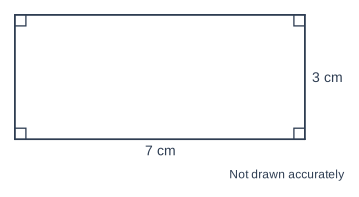
The diagram shows a rectangular photo.

What is the perimeter of the photo?

Geometry diagram, marked "Not drawn accurately". A rectangle (its vertices are not labelled). The unlabelled side going to the right is labelled 7 cm. The unlabelled side going upwards is labelled 3 cm. The angle at an unlabelled point is marked as a right angle (90°). The angle at an unlabelled point is marked as a right angle (90°). The angle at an unlabelled point is marked as a right angle (90°). The angle at an unlabelled point is marked as a right angle (90°).

Model answer

\(7 + 3 + 7 + 3 = 20\)
The perimeter is 20 cm.

Explanation

A rectangle has two long sides and two short sides. The opposite sides are the same length, so the sides are 7 cm, 3 cm, 7 cm and 3 cm. Add all four: \(7 + 3 + 7 + 3 = 20\) cm. A common mistake is to add only the two lengths written on the diagram and get 10 cm.

Mark scheme
  1. 1 mark

    20 cm

    Accept 20 with or without the unit. Do not accept 10 (two sides only) or 21 (7 times 3, the area).

Question 2

2 marks

Mr Ali's garden is a rectangle. It is 8 m long and 5 m wide.

He puts a fence all the way round the edge of the garden.

How many metres of fence does he need?

Model answer

\(8 + 5 + 8 + 5 = 26\)
He needs 26 m of fence.

Explanation

A fence all the way round the edge is the perimeter. The garden has two sides of 8 m and two sides of 5 m, so add them all: \(8 + 5 + 8 + 5 = 26\) m. A common mistake is to multiply 8 by 5, which gives the area (the space inside), not the distance round.

Mark scheme
  1. 1 mark

    A correct method, e.g. \(8 + 5 + 8 + 5\), or \(8 + 5 = 13\) then doubled; or the correct answer 26 m with no working

  2. 1 mark

    26 m

    Accept 26 with or without the unit. Do not accept 13 (half way round) or 40 (8 times 5). A correct answer with no working scores full marks.

Question 3

2 marks

A picture is a rectangle 30 cm long and 20 cm wide. Lou wants to put ribbon all the way round the edge of the picture.

Lou has 1 m of ribbon.

Does Lou have enough ribbon?

Model answer

\(30 + 20 + 30 + 20 = 100\), so the perimeter is 100 cm.
1 m = 100 cm
Yes. The ribbon is exactly long enough.

Explanation

The ribbon must go all the way round, so find the perimeter: \(30 + 20 + 30 + 20 = 100\) cm. There are 100 cm in 1 m, so Lou has exactly the right amount of ribbon, with none left over. A common mistake is to compare 1 with 100 and think 1 m is too short.

Mark scheme
  1. 1 mark

    The perimeter is 100 cm (\(30 + 20 + 30 + 20\))

  2. 1 mark

    Yes, because 1 m = 100 cm, which is exactly enough

    Follow through: a correct decision from a wrong perimeter compared with 100 cm. "Yes" with no working scores 0.

Question 4

4 marks

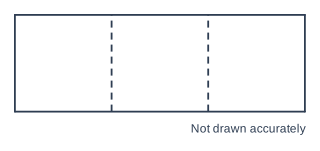
Three square stickers are put in a row, side by side, with no gaps. The diagram shows the rectangle they make.

The perimeter of the rectangle is 48 cm.

How long is each side of one sticker? What is the perimeter of one sticker?

Geometry diagram, marked "Not drawn accurately". A rectangle of three squares (its vertices are not labelled). A dashed vertical line with no labelled ends is drawn. A dashed vertical line with no labelled ends is drawn.

Model answer

Round the rectangle there are 3 sticker sides along the top, 3 along the bottom and 1 at each end: 8 sides.
\(48 \div 8 = 6\), so each side is 6 cm.
One sticker: \(4 \times 6 = 24\), so its perimeter is 24 cm.

Explanation

Count how many sticker sides make the outside of the rectangle: 3 along the top, 3 along the bottom and 1 at each end, which is 8 sides. The sides where the stickers touch are inside, so they are not part of the perimeter. So 8 sides make 48 cm, and each side is \(48 \div 8 = 6\) cm. One sticker has 4 sides of 6 cm, so its perimeter is 24 cm. A common mistake is to divide 48 by 3 or by 4.

Mark scheme
  1. 1 mark

    Sees that the perimeter of the rectangle is made of 8 sides of a sticker (3 along the top, 3 along the bottom and 1 at each end); or the correct answers (6 cm and 24 cm) with no working

  2. 1 mark

    \(48 \div 8\)

    Or any correct method using the 8 sides, e.g. trying a side length and checking it.

  3. 1 mark

    Each side is 6 cm

    Do not accept 16 cm (48 divided by 3) or 12 cm (48 divided by 4).

  4. 1 mark

    Perimeter of one sticker is 24 cm

    Follow through: 4 times the pupil's side length. A correct answer with no working scores full marks.

Ready to try the rest? Tap your answers and see straight away how you did.

Topic notes

Perimeter

The big idea

The perimeter of a flat shape is the distance all the way round its edge. Imagine an ant walking round the outside of a shape until it gets back to where it started. The distance the ant walks is the perimeter. Perimeter is a length, so we measure it in units of length such as centimetres (cm) and metres (m).

Adding up the sides

To find a perimeter, add the lengths of all the sides. Start at one corner and go round the shape. Tick each side as you add it, so you do not miss one or count one twice.

Geometry diagram, drawn accurately to scale. A house-shaped sign (its vertices are not labelled) (shaded). The unlabelled side going to the right is labelled 6 cm. The unlabelled side going upwards is labelled 4 cm. The unlabelled side going up and to the left is labelled 5 cm. The unlabelled side going down and to the left is labelled 5 cm. The unlabelled side going downwards is labelled 4 cm. The angle at an unlabelled point is marked as a right angle (90°). The angle at an unlabelled point is marked as a right angle (90°).
A sign shaped like a house. It has 5 sides: 6 cm along the bottom, 4 cm up each wall and 5 cm along each side of the roof.

Find the perimeter of the house-shaped sign.

Start at the bottom left corner and go round the shape: bottom, right wall, roof, roof, left wall.

\(6 + 4 + 5 + 5 + 4 = 24\)

The perimeter is 24 cm.

Check your answer: the shape has 5 sides, and 5 lengths were added.

Rectangles and squares

A rectangle has 4 sides and 4 right angles (square corners). Its opposite sides are the same length. So you only need two of its sides: the length, which is the long side, and the width, which is the short side.

\[\text{perimeter of a rectangle} = \text{length} + \text{width} + \text{length} + \text{width}\]

You can also add the length and the width, then double the answer.

A square is a rectangle with 4 equal sides, so its perimeter is 4 times one side. A square with sides of 8 cm has a perimeter of \(4 \times 8 = 32\) cm.

Mia lays lolly sticks end to end to make the outline of a rectangle. It is 6 sticks long and 3 sticks wide. Each stick is 10 cm long. What is the perimeter of her rectangle?

Count the sticks all the way round: \(6 + 3 + 6 + 3 = 18\) sticks.

Each stick is 10 cm, so \(18 \times 10 = 180\).

The perimeter is 180 cm, which is 1 m 80 cm.

Check your answer: the long sides are 60 cm and the short sides are 30 cm, and \(60 + 30 + 60 + 30 = 180\).

Finding a missing side

Half the perimeter of a rectangle is one length plus one width. So if you know the perimeter and one side, halve the perimeter, then take away the side you know.

Ben bends a piece of wire 30 cm long into a rectangle. He says, "My rectangle is 9 cm long and 7 cm wide." Can he be right? If it is 9 cm long, how wide must it be?

A 9 cm by 7 cm rectangle has a perimeter of \(9 + 7 + 9 + 7 = 32\) cm. Ben has only 30 cm of wire, so he cannot be right.

Half of 30 cm is 15 cm. That is one length and one width together.

\(15 - 9 = 6\), so the rectangle is 6 cm wide.

Check your answer: \(9 + 6 + 9 + 6 = 30\)

Shapes on a squared grid

On a grid of centimetre squares, each square has sides 1 cm long. To find the perimeter, count the edges of the squares all the way round the outside of the shape. Do not count the squares inside.

A rectilinear shape has straight sides that all meet at right angles, like the T-shape below.

A sketch on a pair of axes (Each square is 1 cm wide across, Each square is 1 cm tall up) with no scale marked. A shaded octagon with vertices (4, 1), (6, 1), (6, 4), (8, 4), (8, 6), (2, 6), (2, 4) and (4, 4). (Octagon; area 18 square units.)
A T-shape on a centimetre grid. Going round from the bottom: 2 + 3 + 2 + 2 + 6 + 2 + 2 + 3 = 22, so the perimeter is 22 cm.

Perimeter in real life

We use perimeter to find how much fence goes round a field, or how much ribbon goes round a card.

Ms Green puts fairy lights all the way round a shop window. The window is a rectangle 5 m wide and 3 m tall. The lights come on strings 6 m long. How many strings does she need?

Perimeter of the window: \(5 + 3 + 5 + 3 = 16\) m.

2 strings make 12 m. That is not enough.

3 strings make 18 m. That is enough, with 2 m spare.

Ms Green needs 3 strings.

Remember

  • Perimeter is the distance all the way round a shape.
  • Add up the lengths of all the sides.
  • Rectangle: length + width + length + width.
  • Square: 4 times one side.
  • On a grid, count the edges round the outside.

Common mistakes

  • Adding only the two sides that have lengths written on them. A rectangle 9 cm by 4 cm has a perimeter of 26 cm, not 13 cm.
  • Counting the squares inside a shape instead of the edges round the outside.
  • Missing a short side on an L-shape or a T-shape. Tick each side as you add it.
  • Multiplying the length by the width. That does not give the perimeter.

Top tip

Before you add, count how many sides the shape has. Then check that you have added that many lengths.

Study Helper Hints first, answers after you try

Stuck on this one? Ask for a hint and I’ll point you in the right direction, without giving the answer away. Once you’ve checked your answer, I’ll show you how the marks are awarded.