Practise 19 questions on Coordinates for Year 4 Maths. Tap your answer and find out straight away if you are right, with the Study Helper on hand if you get stuck.
19 questions
1–4 marks each
Instant marking
No sign-up needed
19 questions, marked as you go
Sample questions with model answers
Here are 4 of the questions in this topic, each with a model answer, an explanation of why it earns the marks and the mark scheme.
Question 1
1 mark
Ruby wants to mark the point \((5, 2)\) on a grid. She starts at the origin.
What should she do?
Model answer
Go 5 across, then 2 up
Explanation
In coordinates, the first number is always how far across and the second number is how far up. So \((5, 2)\) means go 5 across along the x-axis, then 2 up. A good way to remember is 'along the corridor, then up the stairs'. A common mistake is to go up first.
Mark scheme
1 mark
Go 5 across, then 2 up
Accept a clear equivalent, such as '5 right and 2 up' or 'the first one'. Do not accept either of the other two choices: both of them reach (2, 5).
Question 2
2 marks
The picture shows a map of a park on a grid. P is the pond, S is the swings, C is the café and G is the gate.
What are the coordinates of the pond and the café?
Model answer
Pond: 2 across, 4 up, so \((2, 4)\) Café: 6 across, 1 up, so \((6, 1)\)
Explanation
For each place, count across from the origin first, then count up. The pond is 2 across and 4 up, and the café is 6 across and 1 up. Always write the number across first. A common mistake is to swap the numbers, giving \((4, 2)\) for the pond.
Mark scheme
1 mark
Pond: \((2, 4)\)
Accept 2, 4 without the brackets. Do not accept (4, 2).
1 mark
Café: \((6, 1)\)
Accept 6, 1 without the brackets. Do not accept (1, 6). Each answer must be clearly linked to its place, or given in the order asked (pond first).
Question 3
2 marks
Here are four points on a grid.
P \((3, 6)\) Q \((6, 3)\) R \((4, 4)\) S \((1, 5)\)
Which point is the highest up the grid? Which point is the furthest to the right?
Model answer
The second number tells you how high. P has the biggest second number, 6, so P is the highest. The first number tells you how far across. Q has the biggest first number, 6, so Q is the furthest right.
Explanation
To compare heights, look at the second numbers: 6, 3, 4 and 5. The biggest is 6, so P is the highest. To compare how far right, look at the first numbers: 3, 6, 4 and 1, so Q is the furthest right. A common mistake is to use the first number for height.
Mark scheme
1 mark
Highest: P
Do not accept Q: its second number is only 3.
1 mark
Furthest to the right: Q
Do not accept P. Each answer must be clearly linked to its question, or given in the order asked.
Question 4
4 marks
Leah marks some points on a grid. For every point, the two numbers add up to 4.
For example, she marks \((1, 3)\) because \(1 + 3 = 4\).
The numbers are whole numbers, and they can be 0.
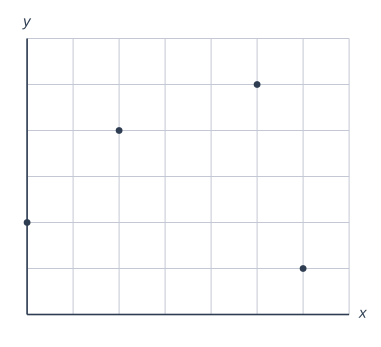
Find all the points that Leah can mark. Mark them on the grid.
Model answer
First number 0: \(0 + 4 = 4\), so \((0, 4)\) First number 1: \((1, 3)\) First number 2: \((2, 2)\) First number 3: \((3, 1)\) First number 4: \((4, 0)\) There are 5 points.
Explanation
Work in order so you do not miss any: start with the first number 0, then 1, 2, 3 and 4. For each one, find the number that makes 4. Remember that \((1, 3)\) and \((3, 1)\) are different points, and that 0 is allowed, so \((0, 4)\) and \((4, 0)\) count. A common mistake is to forget the points with a 0.
Mark scheme
1 mark
Two correct points other than \((1, 3)\), from \((0, 4)\), \((2, 2)\), \((3, 1)\) and \((4, 0)\)
1 mark
Four correct points
(1, 3) counts as listed even if the pupil leaves it out because the question gives it.
1 mark
All five points: \((0, 4)\), \((1, 3)\), \((2, 2)\), \((3, 1)\) and \((4, 0)\)
Any order. (1, 3) counts as listed even if the pupil leaves it out because the question gives it.
1 mark
No wrong points in the list
There are exactly 5 points. A list with a wrong extra point, such as (2, 3), (4, 4) or (5, 1), loses this mark only.
Ready to try the rest? Tap your answers and see straight away how you did.
Ctrl + Enter to check
Study HelperHints first, answers after you try
Stuck on this one? Ask for a hint and I’ll point you in the right direction, without giving the answer away. Once you’ve checked your answer, I’ll show you how the marks are awarded.