Level:
Correct: 0
Incorrect: 0
Marks: 0/0
Practice
Course:
Topics:
Year 4 Maths Smart practice A mixed round aimed at your weak spots
Unit 1
Place value
Unit 2
Addition and subtraction
Column addition
Quick practice5 skills
Column subtraction
Quick practice5 skills
Estimating and checking answers
Quick practice5 skills
Two-step word problems
Quick practice5 skills
Unit 3
Multiplication and division
Unit 4
Fractions
Unit 5
Decimals
Unit 6
Measurement
Measurement
Converting units of measure
Quick practice6 skills
Perimeter
Quick practice5 skills
Area
Quick practice5 skills
Time
Quick practice7 skills
Unit 7
Shape
Geometry: properties of shapes
Triangles and quadrilaterals
Quick practice5 skills
Angles
Quick practice5 skills
Lines of symmetry
Quick practice5 skills
Unit 8
Position and direction
Geometry: position and direction
Coordinates
Quick practice5 skills
Translations
Quick practice4 skills
Unit 9
Statistics
Avg
score:
–
Topics
done:
0/34

Dividing by 10 and 100

Practise 18 questions on Dividing by 10 and 100 for Year 4 Maths. Tap your answer and find out straight away if you are right, with the Study Helper on hand if you get stuck.

  • 18 questions
  • 1–4 marks each
  • Instant marking
  • No sign-up needed
18 questions, marked as you go

Sample questions with model answers

Here are 4 of the questions in this topic, each with a model answer, an explanation of why it earns the marks and the mark scheme.

Question 1

1 mark

Work out \(47 \div 10\)

Model answer

4 tens become 4 ones. 7 ones become 7 tenths.

4.7

Explanation

Dividing by 10 moves each digit one place to the right. The 4 tens become 4 ones and the 7 ones become 7 tenths, so the answer is 4.7. A common mistake is to write 0.47, which is dividing by 100.

Mark scheme
  1. 1 mark

    4.7

    Accept \(4\dfrac{7}{10}\). Do not accept 0.47 or 470.

Question 2

2 marks

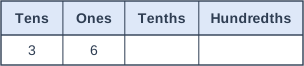
The place-value grid shows the number 36.

Sam divides 36 by 10.

What is Sam's answer? Which column is the digit 6 in now?

Table with columns "Tens", "Ones", "Tenths", "Hundredths". Tens: 3; Ones: 6; Tenths: (blank); Hundredths: (blank).

Model answer

Each digit moves one place to the right.
3 tens become 3 ones. 6 ones become 6 tenths.

3.6; the 6 is in the tenths column.

Explanation

Dividing by 10 moves every digit one place to the right in the place-value grid. The 3 moves from tens to ones, and the 6 moves from ones to tenths. So \(36 \div 10 = 3.6\) and the 6 is now worth 6 tenths. A common mistake is to think the digits stay still and only the decimal point appears.

Mark scheme
  1. 1 mark

    3.6

    Do not accept 0.36 or 360.

  2. 1 mark

    Tenths (column)

    Accept "the tenths", "tenths place" or "6 tenths". Do not accept ones or hundredths. Award this mark on its own even if the first answer is wrong.

Question 3

2 marks

10 copies of the same book weigh 9 kg altogether.

How much does one book weigh?

Model answer

\(9 \div 10 = 0.9\)

0.9 kg

Explanation

The 9 kg is shared equally between 10 books, so divide by 10. The 9 moves one place to the right, from ones to tenths, giving 0.9 kg. That is a bit less than 1 kg, which makes sense for a big book. A common mistake is to multiply by 10 and get 90 kg.

Mark scheme
  1. 1 mark

    \(9 \div 10\) seen; or the correct answer 0.9 kg with no working

  2. 1 mark

    0.9 kg

    Accept 0.9 without the unit, or 900 g. Do not accept 0.09 kg or 90 kg. A correct answer with no working scores full marks.

Question 4

4 marks

Jess has a ribbon that is 7 m long. She cuts it into 10 equal pieces.

Then she takes one of the pieces and cuts it into 10 equal bits.

How long is each bit, in metres?

There are 100 cm in 1 m. How long is each bit, in centimetres?

Model answer

Each piece: \(7 \div 10 = 0.7\) m
Each bit: \(0.7 \div 10 = 0.07\) m
0.07 m is 7 hundredths of a metre, and 1 hundredth of a metre is 1 cm.

0.07 m; 7 cm

Explanation

Cutting into 10 equal pieces means dividing by 10: \(7 \div 10 = 0.7\) m. Cutting one piece into 10 again divides by 10 again: 0.07 m. Dividing by 10 twice is the same as dividing by 100. Each centimetre is one hundredth of a metre, so 7 hundredths of a metre is 7 cm. A common mistake is to divide by 10 only once.

Mark scheme
  1. 1 mark

    Each piece is 0.7 m (\(7 \div 10\)); or the correct answer 0.07 m with no working

  2. 1 mark

    Each bit is 0.07 m (\(0.7 \div 10\), or \(7 \div 100\))

    Accept 0.07 without the unit. Do not accept 0.7 m or 0.007 m.

  3. 1 mark

    A correct method for centimetres, e.g. 7 m = 700 cm and \(700 \div 100 = 7\); or 0.07 m is 7 hundredths of a metre and 1 hundredth of a metre is 1 cm; or 0.7 m = 70 cm and \(70 \div 10 = 7\); or the correct answer 7 cm with no working

  4. 1 mark

    7 cm

    Accept 7 without the unit. ft their length in metres changed to centimetres correctly. A correct answer with no working scores full marks.

Ready to try the rest? Tap your answers and see straight away how you did.

Topic notes

Dividing by 10 and 100

The big idea

When you divide a number by 10, it becomes 10 times smaller. Every digit moves one place to the right on a place-value grid. When you divide by 100, the number becomes 100 times smaller, and every digit moves two places to the right. Digits that move past the ones place go after the decimal point, so they become tenths and hundredths.

The place-value grid

A place-value grid has a column for each place. Here is what happens to 35 and to 7:

TensOnesTenthsHundredths
3535
\(35 \div 10\)35
\(35 \div 100\)035
77
\(7 \div 10\)07
\(7 \div 100\)007

So \(35 \div 10 = 3.5\), \(35 \div 100 = 0.35\), \(7 \div 10 = 0.7\) and \(7 \div 100 = 0.07\).

  • The digits move. The decimal point stays where it is, straight after the ones.
  • If the ones place is empty, write a 0 there: 0.35, not .35.
  • If there is a gap between the decimal point and a digit, fill it with a 0. This 0 is a place holder: \(7 \div 100 = 0.07\).

The value of each digit

After you divide, say what each digit is worth now.

  • In \(35 \div 10 = 3.5\), the 3 was 3 tens and is now 3 ones. The 5 was 5 ones and is now 5 tenths.
  • In \(35 \div 100 = 0.35\), the 3 is now 3 tenths and the 5 is now 5 hundredths.

Dividing by 10 twice

Dividing by 100 is the same as dividing by 10 and then by 10 again. This is where hundredths come from: one tenth divided by 10 is one hundredth.

Flow chart of 3 boxes joined by arrows, read from left to right. The first box is "9", which leads (along an arrow labelled "÷ 10") to "0.9", which leads (along an arrow labelled "÷ 10") to "0.09".
9 divided by 10 is 0.9 (9 tenths). Dividing by 10 again gives 0.09 (9 hundredths). So \(9 \div 100 = 0.09\).

A ladybird is 4 mm long. A beetle is 34 mm long. There are 10 mm in 1 cm. How long is each one in centimetres?

10 mm make 1 cm, so to change millimetres into centimetres, divide by 10.

Ladybird: \(4 \div 10\). The 4 ones move one place right and become 4 tenths, so the ladybird is 0.4 cm long.

Beetle: \(34 \div 10\). The 3 tens become 3 ones and the 4 ones become 4 tenths, so the beetle is 3.4 cm long.

Check your answer: 30 mm is 3 cm, and the beetle is a bit longer than that, so 3.4 cm makes sense.

Sam has a toy blue whale. Every length on the toy is the real length divided by 100. A real blue whale can be 25 m long. How long is the toy?

Divide the real length by 100: \(25 \div 100\).

Each digit moves two places right. The 2 tens become 2 tenths and the 5 ones become 5 hundredths. The ones place is empty, so write a 0 there.

\(25 \div 100 = 0.25\), so the toy is 0.25 m long. The 2 is worth 2 tenths and the 5 is worth 5 hundredths.

What number goes in the box? \(52 \div \square = 0.52\)

Look at the 5. In 52 it is 5 tens. In 0.52 it is 5 tenths.

Tens to ones is one place, and ones to tenths is another, so the 5 has moved 2 places to the right. Moving 2 places means dividing by 100.

Check your answer with the 2: it has moved from the ones to the hundredths, which is also 2 places. So \(52 \div 100 = 0.52\).

If the missing number is the one you start with, use the same idea: look at where each digit is now, and work out where it must have come from.

Remember

  • Divide by 10: every digit moves 1 place to the right.
  • Divide by 100: every digit moves 2 places to the right.
  • Fill empty places before the digits with 0, like 0.07.

Common mistakes

  • Moving the digits the wrong number of places. \(5 \div 10\) is 0.5, not 0.05 (that is \(5 \div 100\)).
  • Leaving out the place holder. \(1 \div 100\) is 0.01, not 0.1.
  • Moving the digits to the left. Dividing makes the number smaller, so \(6 \div 10\) is 0.6, not 60.
  • Just crossing off a 0. That is only right for numbers that end in 0: \(20 \div 10 = 2\), but \(2 \div 10 = 0.2\).
  • Dividing a 2-digit number by 100 and only moving one place. \(48 \div 100\) is 0.48, not 4.8.

Top tip

Count the zeros. 10 has one zero, so the digits move 1 place. 100 has two zeros, so they move 2 places. Then check your answer: it should be smaller than the number you started with.

Study Helper Hints first, answers after you try

Stuck on this one? Ask for a hint and I’ll point you in the right direction, without giving the answer away. Once you’ve checked your answer, I’ll show you how the marks are awarded.