Practise 23 questions on Short multiplication for Year 4 Maths. Tap your answer and find out straight away if you are right, with the Study Helper on hand if you get stuck.
23 questions
1–4 marks each
Instant marking
No sign-up needed
20 questions, marked as you go
Sample questions with model answers
Here are 4 of the questions in this topic, each with a model answer, an explanation of why it earns the marks and the mark scheme.
Question 1
1 mark
Ellie uses the grid method to work out \(63 \times 4\)
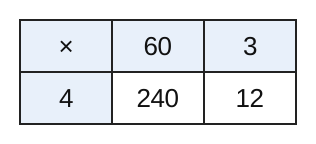
The diagram shows her grid.
What is \(63 \times 4\)?
Model answer
\(240 + 12 = 252\) \(63 \times 4 = 252\)
Explanation
The grid splits 63 into 60 and 3 and multiplies each part by 4: \(60 \times 4 = 240\) and \(3 \times 4 = 12\). Add the parts to get the answer: \(240 + 12 = 252\). A common mistake is to write the two parts side by side as 24012.
Mark scheme
1 mark
252
Do not accept 240 + 12 written without the total, or 2,412. A correct answer with no working scores full marks.
Question 2
2 marks
Work out \(427 \times 6\)
Model answer
Ones: \(7 \times 6 = 42\). Write 2, carry 4. Tens: \(2 \times 6 = 12\), add 4 to get 16. Write 6, carry 1. Hundreds: \(4 \times 6 = 24\), add 1 to get 25. Answer: 2,562
Explanation
Work from the ones to the hundreds, carrying each time a product is 10 or more. The hundreds give \(24 + 1 = 25\) hundreds, which is 2 thousands and 5 hundreds, so the answer has four digits: 2,562. Check: \(400 \times 6 = 2{,}400\), so an answer a little more than 2,400 makes sense. A common mistake is to forget to add a carried digit.
Mark scheme
1 mark
A correct method (short multiplication, a grid or partitioning method such as \(400 \times 6 = 2{,}400\), \(20 \times 6 = 120\), \(7 \times 6 = 42\)) with no more than one arithmetic error; or the correct answer 2,562 with no working
Pupils type their working as lines, not in columns: accept any clear record of the method, such as the parts or the carried digits. Short multiplication steps on single digits, such as 'Tens: \(2 \times 6 = 12\), add the carried 4 to get 16, write 6, carry 1', are correct. A place-value slip in a partitioning method, such as \(400 \times 6 = 240\), is a method error and does not score.
1 mark
2,562
Accept 2562. A correct answer with no working scores full marks.
Question 3
2 marks
Three children work out \(198 \times 6\)
Amir gets 1,188. Bea gets 708. Cal gets 11,808.
Use an estimate to decide which answer could be right. How do you know?
Model answer
198 rounds to 200. \(200 \times 6 = 1{,}200\) 1,188 is close to 1,200, so Amir's answer could be right. 708 is much too small and 11,808 is much too big.
Explanation
Round 198 to 200, because 200 is easy to multiply: \(200 \times 6 = 1{,}200\). The real answer must be close to 1,200, and only Amir's 1,188 is. Bea's answer is about half as big and Cal's is about ten times too big. An estimate cannot prove an answer is exactly right, but it quickly shows when an answer is wrong.
Mark scheme
1 mark
Amir, with a relevant but incomplete reason, e.g. 'it is the closest' or 'the others are too big or too small' with no estimate given
'Amir' on its own scores 0. Choosing Bea or Cal scores 0.
1 mark
Amir, with a complete reason: 198 is about 200, and \(200 \times 6 = 1{,}200\), which is close to 1,188 (708 is much too small and 11,808 is much too big)
A complete correct reason on its own scores both marks. An exact calculation \(198 \times 6 = 1{,}188\) instead of an estimate also scores both marks.
Question 4
4 marks
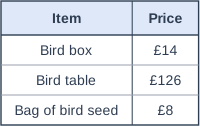
The table shows the prices at a garden centre.
The school wildlife club buys 3 bird tables and 7 bird boxes.
The club has £500 to spend.
Does it have enough money?
Model answer
Bird tables: \(126 \times 3 = 378\) Bird boxes: \(14 \times 7 = 98\) Total: \(378 + 98 = 476\) Yes. £476 is less than £500, so they have £24 left.
Explanation
Find the cost of each item first: 3 bird tables cost \(126 \times 3 = 378\) pounds and 7 bird boxes cost \(14 \times 7 = 98\) pounds. Add them to get £476, then compare with £500. The bird seed is not needed, so ignore it. A common mistake is to add £126 and £14 and forget to multiply.
Mark scheme
1 mark
£378 (3 bird tables)
Accept 378.
1 mark
£98 (7 bird boxes)
Accept 98.
1 mark
£476 (total cost)
Follow through: their two costs added correctly.
1 mark
Yes, because £476 is less than £500 (with £24 left over)
Follow through: a correct yes or no from their total compared with £500. 'Yes' with no total shown scores 0, because the question asks them to show how they know. 'Yes' with the correct total £476 compared with £500 scores full marks, even if the two costs are not written separately.
Ready to try the rest? Tap your answers and see straight away how you did.
Ctrl + Enter to check
Study HelperHints first, answers after you try
Stuck on this one? Ask for a hint and I’ll point you in the right direction, without giving the answer away. Once you’ve checked your answer, I’ll show you how the marks are awarded.