Level:
Correct: 0
Incorrect: 0
Marks: 0/0
Practice
Course:
Topics:
Year 4 Maths Smart practice A mixed round aimed at your weak spots
Unit 1
Place value
Unit 2
Addition and subtraction
Column addition
Quick practice5 skills
Column subtraction
Quick practice5 skills
Estimating and checking answers
Quick practice5 skills
Two-step word problems
Quick practice5 skills
Unit 3
Multiplication and division
Unit 4
Fractions
Unit 5
Decimals
Unit 6
Measurement
Measurement
Converting units of measure
Quick practice6 skills
Perimeter
Quick practice5 skills
Area
Quick practice5 skills
Time
Quick practice7 skills
Unit 7
Shape
Geometry: properties of shapes
Triangles and quadrilaterals
Quick practice5 skills
Angles
Quick practice5 skills
Lines of symmetry
Quick practice5 skills
Unit 8
Position and direction
Geometry: position and direction
Coordinates
Quick practice5 skills
Translations
Quick practice4 skills
Unit 9
Statistics
Avg
score:
–
Topics
done:
0/34

Tenths and hundredths

Practise 23 questions on Tenths and hundredths for Year 4 Maths. Tap your answer and find out straight away if you are right, with the Study Helper on hand if you get stuck.

  • 23 questions
  • 1–4 marks each
  • Instant marking
  • No sign-up needed
20 questions, marked as you go

Sample questions with model answers

Here are 4 of the questions in this topic, each with a model answer, an explanation of why it earns the marks and the mark scheme.

Question 1

1 mark

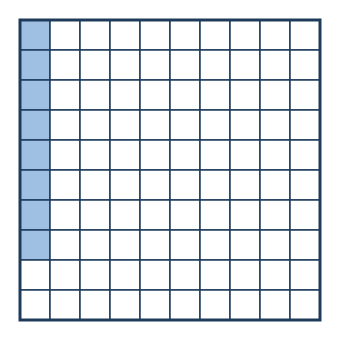
The diagram shows a grid of 100 equal squares. Some of the squares are shaded.

What is the shaded part of the grid as a decimal?

A large square split into 10 rows and 10 columns of equal small squares. In the left-hand column, the top 8 small squares are shaded. All the other squares are white.

Model answer

8 of the 100 squares are shaded: \(\dfrac{8}{100}\)

0.08

Explanation

Each small square is one hundredth of the grid, and 8 squares are shaded, so that is 8 hundredths. There are no whole columns shaded, so there are 0 tenths. 0 tenths and 8 hundredths is written 0.08. A common mistake is to write 0.8, which would be 8 whole columns.

Mark scheme
  1. 1 mark

    0.08

    Accept .08. Do not accept 0.8 or 8 or 0.008. A fraction (8/100) on its own does not score, as the question asks for a decimal.

Question 2

2 marks

A chocolate bar is split into 10 equal pieces.

Ali takes one piece and cuts it into 10 equal bits.

What fraction of the whole bar is one bit? Give it as a fraction and as a decimal.

Model answer

One piece is \(\dfrac{1}{10}\) of the bar.
One tenth split into 10 is one hundredth.

\(\dfrac{1}{100}\) and 0.01

Explanation

Each piece is one tenth of the bar. Splitting a tenth into 10 equal bits makes bits that are one hundredth of the whole bar, because the bar would hold \(10 \times 10 = 100\) of them. One hundredth is written 0.01. A common mistake is to say \(\dfrac{1}{10}\), which is a bit of the piece, not of the whole bar.

Mark scheme
  1. 1 mark

    \(\dfrac{1}{100}\)

    Accept one hundredth in words. Do not accept 1/10 or 1/20.

  2. 1 mark

    0.01

    Accept .01. Do not accept 0.1 or 0.100. Award this mark on its own for 0.01, even if the fraction is wrong.

Question 3

2 marks

There are 100 centimetres in 1 metre, so 1 cm is one hundredth of a metre.

A worm is 7 cm long. A pencil is 15 cm long.

What is each length in metres, as a decimal?

Model answer

7 cm = 7 hundredths of a metre = 0.07 m
15 cm = 15 hundredths of a metre = 0.15 m

Explanation

Each centimetre is one hundredth of a metre. 7 cm is 7 hundredths of a metre, which is 0.07 m, with 0 tenths. 15 cm is 15 hundredths, which is 1 tenth and 5 hundredths: 0.15 m. A common mistake is to write the worm as 0.7 m, which would be 70 cm.

Mark scheme
  1. 1 mark

    Worm: 0.07 m

    The unit is not needed. Do not accept 0.7 m.

  2. 1 mark

    Pencil: 0.15 m

    The unit is not needed. Do not accept 1.5 m or 0.015 m.

Question 4

4 marks

The number line goes from 0.3 to 0.4. It is split into hundredths.

What numbers do arrows A and B point to?

Kim says, "B is 5 tenths more than A."

Is Kim right? How do you know?

A horizontal scale from 0.3 to 0.4, with a long mark at each end, split into 10 small divisions by short marks. Every long mark is numbered (0.3 and 0.4). An arrow labelled A points to a mark on the scale. An arrow labelled B points to a mark on the scale.

Model answer

Each small step is 0.01.
A = 0.32 and B = 0.37

No. B is 5 steps after A, and each step is one hundredth. So B is 5 hundredths more than A, not 5 tenths. The whole line is only 1 tenth long.

Explanation

The line from 0.3 to 0.4 is split into 10 equal steps, so each step is one hundredth. A is 2 steps after 0.3, so it is 0.32, and B is 7 steps after 0.3, so it is 0.37. B is 5 hundredths more than A. Kim has mixed up tenths and hundredths: 5 tenths more than 0.32 would be 0.82.

Mark scheme
  1. 1 mark

    A = 0.32

    Do not accept 0.302 or 3.2.

  2. 1 mark

    B = 0.37

    Do not accept 0.307 or 3.7.

  3. 1 mark

    No, with a relevant but incomplete reason, e.g. "it is 5 hundredths" with no more detail, or "5 tenths is too much"

    "No" on its own scores 0. "Yes" scores 0 for this mark and the next.

  4. 1 mark

    A complete correct reason, e.g. B is 5 small steps after A and each step is one hundredth, so B is 5 hundredths (0.05) more; or 5 tenths more than 0.32 would be 0.82, which is not on this line; or the whole line is only 1 tenth long

    A complete correct reason on its own scores both of the last two marks.

Ready to try the rest? Tap your answers and see straight away how you did.

Topic notes

Tenths and hundredths

The big idea

Split one whole into 10 equal parts and each part is one tenth. Split one whole into 100 equal parts and each part is one hundredth. You can write tenths and hundredths as fractions, like \(\dfrac{7}{10}\), or as decimals, like 0.7. A decimal has a decimal point: a dot that comes straight after the ones. The digits after the point are worth less than 1.

Tenths

\[ \dfrac{1}{10} = 0.1 \qquad \dfrac{7}{10} = 0.7 \]

The first digit after the decimal point shows the tenths. 0.7 means 0 ones and 7 tenths.

A horizontal scale from 0 to 1, divided into 10 equal parts by long marks. Every long mark is numbered (0, 0.1, 0.2, 0.3, 0.4, 0.5, 0.6, 0.7, 0.8, 0.9 and 1). Long marks are every 0.1. Arrow 7/10 points to 0.7.
A number line from 0 to 1, split into tenths. The arrow shows \(\dfrac{7}{10}\), which is 0.7.

Counting in tenths adds or takes away 0.1 each time. Ten tenths make one whole, so after 0.9 comes 1, not 0.10. Counting on past 1 goes 1.1, 1.2, 1.3. Counting back goes 2.2, 2.1, 2, 1.9.

Hundredths

Now split each tenth into 10 equal parts. The whole is now split into \(10 \times 10 = 100\) equal parts, so each part is a hundredth. Dividing one whole by 100, or dividing one tenth by 10, gives a hundredth.

\[ \dfrac{1}{100} = 0.01 \qquad \dfrac{23}{100} = 0.23 \]

The second digit after the decimal point shows the hundredths.

A hundred square is a big square split into 100 small squares. Each small square is one hundredth. Each column of 10 small squares is one tenth.

A hundred square: 10 rows of 10 small squares. 23 squares are shaded: 2 full columns of 10 and 3 more squares.
A hundred square with 23 small squares shaded: 2 full columns (2 tenths) and 3 more squares (3 hundredths). That is \(\dfrac{23}{100}\), or 0.23.

The place-value grid

A place-value grid shows what each digit is worth.

NumberOnesTenthsHundredths
0.23023
4.05405

In 4.05, the 0 is a place holder. It shows there are no tenths and keeps the 5 in the hundredths place. Without it you would write 4.5, which is 4 ones and 5 tenths.

10 hundredths make 1 tenth

Just as 10 ones make 1 ten, 10 hundredths make 1 tenth and 10 tenths make 1 whole. On the hundred square, 10 small squares fill one column. So 0.8 is the same as 80 hundredths, 0.80.

You can see this when you count in hundredths: 0.07, 0.08, 0.09, 0.1, 0.11. After 9 hundredths, one more makes 10 hundredths, which is 1 tenth. Counting back goes 0.62, 0.61, 0.6, 0.59.

A box holds 10 eggs. 3 of the eggs are brown and the rest are white. Write the brown eggs and the white eggs as fractions and as decimals of the box.

Each egg is 1 of 10 equal parts, so each egg is one tenth of the box.

Brown: 3 tenths, which is \(\dfrac{3}{10}\) or 0.3.

White: \(10 - 3 = 7\) eggs, which is \(\dfrac{7}{10}\) or 0.7.

Check your answer: 3 tenths and 7 tenths make 10 tenths, the whole box.

Maya has 100 stickers. She sticks 95 of them in her book. What fraction of the stickers has she used, and what fraction is left? Give each answer as a fraction and a decimal.

Each sticker is 1 of 100, so each sticker is one hundredth of all the stickers.

Used: 95 stickers, which is \(\dfrac{95}{100}\). That is 9 tenths and 5 hundredths, so it is 0.95.

Left: \(100 - 95 = 5\) stickers, which is \(\dfrac{5}{100}\). There are no tenths, so put a 0 in the tenths place: 0.05.

Check your answer: 95 hundredths and 5 hundredths make 100 hundredths, all of the stickers.

Write 0.52 in tenths and hundredths in three different ways.

The usual way: 5 tenths and 2 hundredths.

Swap one of the tenths for 10 hundredths: 4 tenths and 12 hundredths.

Swap all 5 tenths for 50 hundredths: 52 hundredths, which is \(\dfrac{52}{100}\).

All three are worth the same: 0.52.

Remember

  • The first place after the decimal point is tenths. The second place is hundredths.
  • 10 hundredths = 1 tenth. 10 tenths = 1 whole.
  • Use a 0 as a place holder when there are no tenths: 0.06 is 6 hundredths.

Common mistakes

  • Mixing up tenths and hundredths. 0.9 is 9 tenths, but 9 hundredths is 0.09.
  • Putting the digits in the wrong places. \(\dfrac{61}{100}\) is 0.61, not 6.1.
  • Writing 0.10 after 0.9 when counting in tenths. The next number is 1.
  • Writing 0.210 after 0.29 when counting in hundredths. The next number is 0.3 (or 0.30).

Top tip

Look at where the last digit is. If it is in the hundredths place, the fraction is out of 100: 0.36 is 36 hundredths, \(\dfrac{36}{100}\). When you type a fraction, use a slash: 36/100.

Study Helper Hints first, answers after you try

Stuck on this one? Ask for a hint and I’ll point you in the right direction, without giving the answer away. Once you’ve checked your answer, I’ll show you how the marks are awarded.