Level:
Correct: 0
Incorrect: 0
Marks: 0/0
Practice
Course:
Topics:
Year 4 Maths Smart practice A mixed round aimed at your weak spots
Unit 1
Place value
Unit 2
Addition and subtraction
Column addition
Quick practice5 skills
Column subtraction
Quick practice5 skills
Estimating and checking answers
Quick practice5 skills
Two-step word problems
Quick practice5 skills
Unit 3
Multiplication and division
Unit 4
Fractions
Unit 5
Decimals
Unit 6
Measurement
Measurement
Converting units of measure
Quick practice6 skills
Perimeter
Quick practice5 skills
Area
Quick practice5 skills
Time
Quick practice7 skills
Unit 7
Shape
Geometry: properties of shapes
Triangles and quadrilaterals
Quick practice5 skills
Angles
Quick practice5 skills
Lines of symmetry
Quick practice5 skills
Unit 8
Position and direction
Geometry: position and direction
Coordinates
Quick practice5 skills
Translations
Quick practice4 skills
Unit 9
Statistics
Avg
score:
–
Topics
done:
0/34

Negative numbers

Practise 16 questions on Negative numbers for Year 4 Maths. Tap your answer and find out straight away if you are right, with the Study Helper on hand if you get stuck.

  • 16 questions
  • 1–5 marks each
  • Instant marking
  • No sign-up needed
16 questions, marked as you go

Sample questions with model answers

Here are 4 of the questions in this topic, each with a model answer, an explanation of why it earns the marks and the mark scheme.

Question 1

1 mark

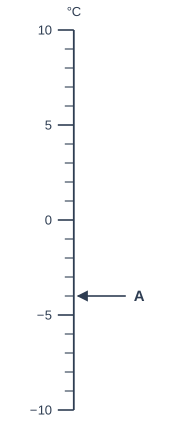
Kai looks at the thermometer outside his window on a cold night. Arrow A shows the temperature.

What is the temperature?

A vertical scale from −10 to 10 °C, divided into 4 equal parts by long marks, each split into 5 small divisions by short marks. Every long mark is numbered (−10, −5, 0, 5 and 10). An arrow labelled A points to a mark on the scale.

Model answer

Each small step is 1 degree.
Arrow A is 4 steps below 0.
\(-4^\circ\text{C}\)

Explanation

The numbers on the thermometer go up in 5s, and there are 5 small steps between them, so each small step is 1 degree. Arrow A is 4 steps below 0, so the temperature is \(-4^\circ\text{C}\). A common mistake is to count the wrong way from \(-5\) and say \(-6^\circ\text{C}\).

Mark scheme
  1. 1 mark

    \(-4^\circ\text{C}\)

    Accept -4, minus 4, negative 4 or 4 degrees below zero; the unit is not needed. Do not accept 4, -6 or -3.

Question 2

2 marks

Put these numbers in order, starting with the smallest.

Model answer

On a number line, \(-4\) is furthest to the left.
\(-4, \; -1, \; 0, \; 2, \; 3\)

Explanation

Picture a number line. Negative numbers are to the left of 0, and the further left a number is, the smaller it is. \(-4\) is further left than \(-1\), so it is smaller. Then come 0, 2 and 3. A common mistake is to think \(-1\) is smaller than \(-4\) because 1 is smaller than 4.

Mark scheme
  1. 1 mark

    The numbers in order with one mistake (one number in the wrong place, or two numbers next to each other swapped); or the correct order

    For example, -1, -4, 0, 2, 3 scores this mark.

  2. 1 mark

    \(-4, \; -1, \; 0, \; 2, \; 3\)

    The correct order on its own scores both marks.

Question 3

3 marks

At 4 pm the temperature is \(3^\circ\text{C}\). It falls by 1 degree every hour.

What is the temperature at 7 pm?

What is the temperature at 9 pm?

At what time will the temperature be \(-3^\circ\text{C}\)?

Model answer

4 pm: \(3^\circ\text{C}\)
5 pm: \(2^\circ\text{C}\)
6 pm: \(1^\circ\text{C}\)
7 pm: \(0^\circ\text{C}\)
8 pm: \(-1^\circ\text{C}\)
9 pm: \(-2^\circ\text{C}\)
10 pm: \(-3^\circ\text{C}\)

Explanation

Make a list, one hour at a time, counting back 1 degree for each hour. After 3 hours, at 7 pm, the temperature reaches 0. Then it goes below zero: \(-1^\circ\text{C}\) at 8 pm, \(-2^\circ\text{C}\) at 9 pm and \(-3^\circ\text{C}\) at 10 pm. A common mistake is to skip 0 when counting below zero.

Mark scheme
  1. 1 mark

    At 7 pm: \(0^\circ\text{C}\)

    Accept 0 or zero.

  2. 1 mark

    At 9 pm: \(-2^\circ\text{C}\)

    Accept -2 or minus 2; the unit is not needed. Do not accept 2 or -1.

  3. 1 mark

    10 pm

    Accept 10 o'clock or 22:00. Do not accept 9 pm or 11 pm. A correct answer with no working scores full marks.

Question 4

4 marks

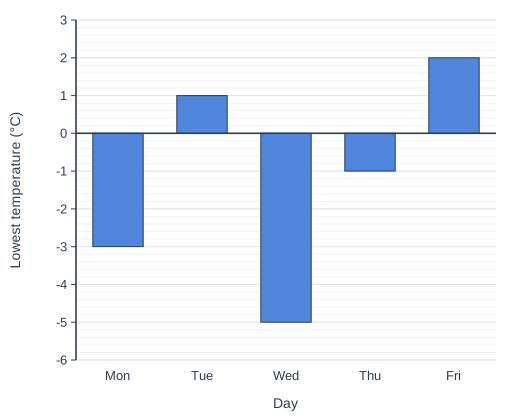
The bar chart shows the lowest temperature in a town on five days.

On how many of the days was the lowest temperature below zero?

Which day was the coldest?

Put the five days in order of their temperatures, starting with the coldest.

Bar chart of lowest temperature (°C) for each day: Mon -3, Tue 1, Wed -5, Thu -1, Fri 2.

Model answer

Monday \(-3^\circ\text{C}\), Tuesday \(1^\circ\text{C}\), Wednesday \(-5^\circ\text{C}\), Thursday \(-1^\circ\text{C}\), Friday \(2^\circ\text{C}\)
Below zero: Monday, Wednesday and Thursday, so 3 days.
Coldest: Wednesday.
\(-5, \; -3, \; -1, \; 1, \; 2\)

Explanation

Bars that go down from 0 show temperatures below zero: Monday, Wednesday and Thursday. Wednesday's bar goes down furthest, to \(-5^\circ\text{C}\), so it was the coldest. To put them in order, start with the lowest: \(-5\), \(-3\), \(-1\), then 1 and 2. A common mistake is to think \(-1\) is colder than \(-3\).

Mark scheme
  1. 1 mark

    3 days

    Accept the three days named: Monday, Wednesday and Thursday.

  2. 1 mark

    Wednesday

    Accept Wed or -5 degrees.

  3. 1 mark

    The temperatures in order with one mistake (one temperature in the wrong place, or two next to each other swapped); or the correct order

    For example, -3, -5, -1, 1, 2 scores this mark. The order -1, -3, -5, 1, 2 (the negative numbers reversed) does not.

  4. 1 mark

    \(-5, \; -3, \; -1, \; 1, \; 2\)

    Accept with or without °C. Accept the days in this order: Wednesday, Monday, Thursday, Tuesday, Friday. The correct order on its own scores both of these marks.

Ready to try the rest? Tap your answers and see straight away how you did.

Topic notes

Negative numbers

The big idea

Numbers less than zero are called negative numbers. They have a minus sign in front: −3 is read "negative three" or "minus three". Numbers greater than zero, like 3, are positive numbers. Zero is not positive or negative. You meet negative numbers on very cold days, when the temperature drops below zero.

Counting back through zero

On a number line, numbers get bigger as you go right and smaller as you go left. Negative numbers sit on the left of 0.

A horizontal scale from −5 to 5, divided into 10 equal parts by long marks. Every long mark is numbered (−5, −4, −3, −2, −1, 0, 1, 2, 3, 4 and 5). Long marks are every 1.
Negative numbers are on the left of 0. Each step to the left is 1 less.

Counting back does not stop at 0. Keep going past it: 3, 2, 1, 0, −1, −2, −3. Zero is a number too, so never skip it.

You can count back through zero in bigger steps as well. Counting back in 5s from 15 goes 10, 5, 0, −5, −10. Counting on means moving right: count on in ones from −4 and you say −3, −2, −1, 0, 1.

Thermometers

A thermometer measures temperature: how hot or cold something is. We measure temperature in degrees Celsius, written °C. Water freezes at 0 °C, so on a frosty morning the temperature can be below zero, such as −2 °C.

A thermometer works like an upright number line. Higher up is warmer, and lower down is colder.

A vertical scale from −10 to 10 °C, divided into 4 equal parts by long marks, each split into 5 small divisions by short marks. Every long mark is numbered (−10, −5, 0, 5 and 10). Long marks are every 5 °C and each small division is 1 °C. Arrow A points to −7 °C. Arrow B points to 2 °C.
Each small step is 1 degree. Arrow B points to 2 °C, two steps above 0. Arrow A points to −7 °C, seven steps below 0. B is higher up, so it is warmer.

To read a thermometer, first work out what each small step is worth. Then count the steps up or down from 0.

Ordering negative numbers

The further below zero you go, the smaller the number. So −6 is smaller than −2, even though 6 is bigger than 2. On a number line, −6 is further to the left. On a thermometer, −6 °C is lower down, so it is colder than −2 °C.

To order numbers from smallest to largest, start with the negative number that is furthest from zero: −6, −2, 0, 1, 4.

Count back in 5s from 23. What is the first negative number you say?

Take away 5 each time: 23, 18, 13, 8, 3.

From 3, count back 5 more. Three steps take you to 0, and two more steps take you to −2.

The first negative number you say is −2.

Ben counts back in 2s from 5. He writes 5, 3, 1, 0, −2, −4. What has he done wrong?

Check each gap. 5 to 3 is 2, and 3 to 1 is 2. But 1 to 0 is only 1.

Counting back 2 from 1 takes one step to 0 and one more step to −1. So the number after 1 is −1, not 0.

The correct pattern is 5, 3, 1, −1, −3, −5. Counting back in 2s from an odd number jumps right over zero.

A snow machine on a ski slope only works when it is −2 °C or colder. Which of these temperatures could it work at? 1 °C, −3 °C, −2 °C, 0 °C, −6 °C

Colder means lower down the thermometer, further below zero.

  • −3 °C and −6 °C are lower than −2 °C, so they are cold enough.
  • −2 °C itself is fine, because the machine works at "−2 °C or colder".
  • 0 °C and 1 °C are higher than −2 °C, so they are too warm.

The machine could work at −3 °C, −2 °C and −6 °C.

Remember

  • Negative numbers are less than zero and have a minus sign: −1, −2, −3.
  • On a number line they sit left of 0. On a thermometer they are below 0.
  • The further a number is below zero, the smaller (and colder) it is.

Common mistakes

  • Forgetting the minus sign. 4 degrees below zero is −4 °C, not 4 °C.
  • Thinking −6 is bigger than −2 because 6 is bigger than 2. −6 is further below zero, so it is smaller.
  • Skipping zero when counting back: 2, 1, 0, −1, not 2, 1, −1.
  • Counting the wrong way below zero. On a thermometer, the mark just below −5 is −6, and the mark just above it is −4.

Top tip

Draw a quick number line with 0 in the middle, and point to each number as you count. Moving left, or down a thermometer, is counting back.

Study Helper Hints first, answers after you try

Stuck on this one? Ask for a hint and I’ll point you in the right direction, without giving the answer away. Once you’ve checked your answer, I’ll show you how the marks are awarded.