Level:
Correct: 0
Incorrect: 0
Marks: 0/0
Practice
Course:
Topics:
Year 4 Maths Smart practice A mixed round aimed at your weak spots
Unit 1
Place value
Unit 2
Addition and subtraction
Column addition
Quick practice5 skills
Column subtraction
Quick practice5 skills
Estimating and checking answers
Quick practice5 skills
Two-step word problems
Quick practice5 skills
Unit 3
Multiplication and division
Unit 4
Fractions
Unit 5
Decimals
Unit 6
Measurement
Measurement
Converting units of measure
Quick practice6 skills
Perimeter
Quick practice5 skills
Area
Quick practice5 skills
Time
Quick practice7 skills
Unit 7
Shape
Geometry: properties of shapes
Triangles and quadrilaterals
Quick practice5 skills
Angles
Quick practice5 skills
Lines of symmetry
Quick practice5 skills
Unit 8
Position and direction
Geometry: position and direction
Coordinates
Quick practice5 skills
Translations
Quick practice4 skills
Unit 9
Statistics
Avg
score:
–
Topics
done:
0/34

Roman numerals

Practise 16 questions on Roman numerals for Year 4 Maths. Tap your answer and find out straight away if you are right, with the Study Helper on hand if you get stuck.

  • 16 questions
  • 1–5 marks each
  • Instant marking
  • No sign-up needed
16 questions, marked as you go

Sample questions with model answers

Here are 4 of the questions in this topic, each with a model answer, an explanation of why it earns the marks and the mark scheme.

Question 1

1 mark

What number is XLVI?

Model answer

XL = 40
VI = 6
\(40 + 6 = 46\)

Explanation

Split the numeral into parts. XL is X before L, so it is 10 less than 50, which is 40. VI is \(5 + 1 = 6\). So XLVI is \(40 + 6 = 46\). A common mistake is to read XL as 60: when the smaller letter comes first, you take it away.

Mark scheme
  1. 1 mark

    46

    Do not accept 66 (reading XL as 60) or 64.

Question 2

2 marks

In a museum, the rooms are numbered with Roman numerals.

What are the numbers of these two rooms in figures?

Room XXXVIII   Room LIX

Model answer

XXXVIII: XXX = 30 and VIII = 8, so 38
LIX: L = 50 and IX = 9, so 59

Explanation

Split each numeral into tens and ones. XXX is three 10s, 30, and VIII is \(5 + 3 = 8\), so XXXVIII is 38. In LIX, L is 50 and IX is 1 before 10, which is 9, so LIX is 59. A common mistake is to read LIX as \(50 + 1 + 10 = 61\), but an I before an X takes 1 away from the X.

Mark scheme
  1. 1 mark

    XXXVIII = 38

    Do not accept 33 or 308.

  2. 1 mark

    LIX = 59

    Do not accept 61 (adding the I) or 51. If the answers are not labelled, take them in order.

Question 3

3 marks

This pattern counts up in 5s.

XXX   XXXV   \(\square\)   XLV   \(\square\)   \(\square\)

What are the three missing Roman numerals?

Model answer

XXX = 30, XXXV = 35, then 40, 45, 50, 55
40 = XL
50 = L
55 = LV
XL, L, LV

Explanation

Change the numerals you know into numbers: XXX is 30, XXXV is 35 and XLV is 45. Counting in 5s, the missing numbers are 40, 50 and 55. 40 is 10 less than 50, so it is XL; 50 is L; and 55 is \(50 + 5\), so it is LV. A common mistake is to write 40 as XXXX.

Mark scheme
  1. 1 mark

    First missing numeral: XL (40)

    Do not accept XXXX or LX.

  2. 1 mark

    Second missing numeral: L (50)

    Do not accept XXXXX or LL.

  3. 1 mark

    Third missing numeral: LV (55)

    Accept lower case. If the answers are not labelled, take them in order. Numbers in figures only (40, 50, 55) score 1 mark in total.

Question 4

4 marks

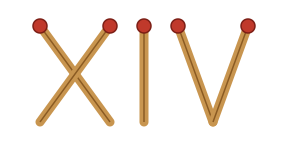
Ravi makes Roman numerals with sticks. I uses 1 stick. V and X each use 2 sticks.

The picture shows XIV made with 5 sticks.

How many sticks does Ravi need to make XXVII?

Which number from 1 to 20 needs the most sticks? What is its Roman numeral, and how many sticks does it need?

Sticks arranged to make the Roman numeral XIV: two crossed sticks make the X, one upright stick makes the I, and two sticks meeting at the bottom make the V.

Model answer

XXVII: \(2 + 2 + 2 + 1 + 1 = 8\) sticks
XVII: \(2 + 2 + 1 + 1 = 6\) sticks
XVIII: \(2 + 2 + 1 + 1 + 1 = 7\) sticks
XVIII (18) needs the most: 7 sticks.

Explanation

Count 2 sticks for every X or V and 1 stick for every I. Numbers with lots of letters need lots of sticks, so look at numerals such as VIII, XIII, XVII and XVIII. XVIII has an X, a V and three Is, so it needs \(2 + 2 + 3 = 7\) sticks, more than any other number up to 20. A common mistake is to count the letters instead of the sticks.

Mark scheme
  1. 1 mark

    8 sticks

    X, X and V use 2 sticks each and I, I use 1 each: \(2 + 2 + 2 + 1 + 1 = 8\). Do not accept 5 (counting letters).

  2. 1 mark

    A correct method for the second part, for example counting the sticks for several numerals such as XVII (6) and XVIII (7); or the correct answer XVIII with no working

  3. 1 mark

    XVIII (18)

    Accept 18 written in figures as well as, or instead of, the numeral. Do not accept XVII or XIII.

  4. 1 mark

    7 sticks

    Follow through: the number of sticks in the pupil's numeral, counted correctly. A correct answer with no working scores full marks.

Ready to try the rest? Tap your answers and see straight away how you did.

Topic notes

Roman numerals

The big idea

Long ago, the Romans wrote numbers using letters. We call these Roman numerals. You can still see them on clock faces and old buildings. This topic covers Roman numerals from 1 to 100.

The five symbols

A symbol is a letter or sign that stands for something. You need five symbols:

SymbolIVXLC
Value151050100

Usually the symbols go from biggest to smallest, and you add them: XVI is \(10 + 5 + 1 = 16\), and LXX is \(50 + 10 + 10 = 70\).

I and X can be used up to three times in a row: III is 3 and XXX is 30. Never write the same symbol four times in a row. V and L are only used once in a number.

The subtraction rule

When a smaller symbol comes just before a bigger one, you take it away. Up to 100, there are only four of these pairs:

IVIXXLXC
494090
1 before 51 before 1010 before 5010 before 100

Only I is ever taken from V or X, and only X is taken from L or C.

Roman numerals on clocks

Many clocks use Roman numerals for the hours, from I to XII. Some clocks show 4 as IIII, but when you write it yourself, always use IV.

A clock face with the Roman numerals XII, I, II, III, IV, V, VI, VII, VIII, IX, X and XI going clockwise round the edge, starting at the top. I, V and X are in bold.
A clock face with Roman numerals. I, V and X are in bold here because each one is a single symbol. Every other hour is made by joining them.

A clock has Roman numerals. Its short hour hand points to IX. Where will the hour hand point 2 hours later?

IX is 1 before 10, which is 9.

The hour hand moves on one number every hour, so 2 hours later it points to \(9 + 2 = 11\).

11 is 10 and 1 more, which is XI.

Writing and reading numbers to 100

To write a number, partition it (split it) into tens and ones. Write each part, then put the tens first. This table has every part you need:

DigitAs onesAs tens
1IX
2IIXX
3IIIXXX
4IVXL
5VL
6VILX
7VIILXX
8VIIILXXX
9IXXC

So 63 is 60 and 3, which is LXIII. There is no symbol for zero: if a number has no ones, just leave the ones out, so 80 is LXXX. And 100 is C.

To read a Roman numeral, split it into its tens part and its ones part, change each part into a number, then add.

In an old theatre, the seats are numbered in Roman numerals. Ana sits in seat XCVII. Her three friends sit in the next three seats. What are their seat numbers?

XCVII is XC and VII: 90 and 7, which is 97. So her friends are in seats 98, 99 and 100.

  • 98 is 90 and 8: XC and VIII, which is XCVIII.
  • 99 is 90 and 9: XC and IX, which is XCIX.
  • 100 is C.

I am a Roman numeral with exactly two symbols. I am more than 50 but less than 100. What number could I be?

To make more than 50 with just two symbols, you need an L or a C.

  • L with a smaller symbol after it: LI is 51, LV is 55 and LX is 60.
  • X before C: XC is 90.
  • XL is only 40, and C followed by anything is over 100. IL, IC, VL, VC, LC and LL are not allowed.

I could be 51, 55, 60 or 90 (LI, LV, LX or XC).

Zero and place value

The Romans had no symbol for zero, and they did not use place value. Our system uses the digits 0 to 9, and a digit's column tells you what it is worth. That makes our numbers easier to use:

  • In 77, the first 7 is worth 70 and the second 7 is worth 7. In 70, the 0 holds the empty ones column. The Romans needed different symbols: LXXVII and LXX.
  • Our numbers stay short: every number up to 99 has 1 or 2 digits. Roman numerals can get long: 83 is LXXXIII.
  • We can add and take away in columns.

Our digits, with a zero, were first used in India. They reached Europe through the Arab world hundreds of years ago, and slowly took over from Roman numerals.

Common mistakes

  • Mixing up IX and XI. IX is 9 (1 before 10), but XI is 11 (10 and 1 more).
  • Writing four of the same symbol: 40 is XL, not XXXX.
  • Taking away a symbol that is not allowed: 95 is XCV (90 and 5), not VC. V is never taken away.

Top tip

When you have written a Roman numeral, read it back part by part. XCIV reads back as 90 and 4, which makes 94, so it is right.

Study Helper Hints first, answers after you try

Stuck on this one? Ask for a hint and I’ll point you in the right direction, without giving the answer away. Once you’ve checked your answer, I’ll show you how the marks are awarded.