Practise 21 questions on Equivalent fractions for Year 4 Maths. Tap your answer and find out straight away if you are right, with the Study Helper on hand if you get stuck.
21 questions
1–4 marks each
Instant marking
No sign-up needed
20 questions, marked as you go
Sample questions with model answers
Here are 4 of the questions in this topic, each with a model answer, an explanation of why it earns the marks and the mark scheme.
Question 1
1 mark
What is the missing number?
\(\dfrac{1}{3} = \dfrac{\square}{6}\)
Model answer
\(3 \times 2 = 6\), so \(1 \times 2 = 2\)
\(\dfrac{1}{3} = \dfrac{2}{6}\)
2
Explanation
The denominator has doubled from 3 to 6, so each third has been split into 2 sixths. Double the numerator too: \(1 \times 2 = 2\). On a fraction wall, one third brick is the same length as two sixth bricks. A common mistake is to add 3 to the numerator because 3 was added to the denominator.
Mark scheme
1 mark
2
Accept the fraction written out, \(\dfrac{2}{6}\). Do not accept 4 (adding 3 to the numerator because 3 was added to the denominator).
Question 2
2 marks
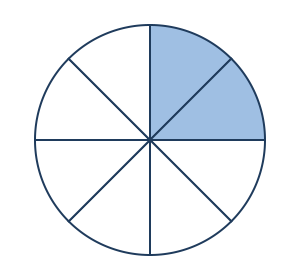
The picture shows a pizza cut into 8 equal slices. Jess eats the shaded slices.
What fraction of the pizza does Jess eat? Give it in eighths, and then in quarters.
Model answer
2 of the 8 equal slices are shaded: \(\dfrac{2}{8}\)
2 eighths make 1 quarter: \(\dfrac{1}{4}\)
Explanation
The pizza has 8 equal slices and Jess eats 2 of them, so she eats \(\dfrac{2}{8}\). If you cut the pizza into quarters instead, each quarter would be 2 slices, so 2 slices is 1 quarter. A common mistake is to write \(\dfrac{2}{4}\): that would be half of the pizza.
Mark scheme
1 mark
\(\dfrac{2}{8}\)
Accept two eighths in words. This mark needs eighths.
1 mark
\(\dfrac{1}{4}\)
Accept one quarter in words. This mark needs quarters. Do not accept 2/4 or 1/8.
Question 3
2 marks
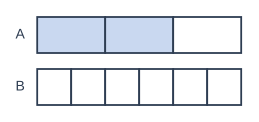
The diagram shows two bars, A and B. The bars are the same length.
Bar A is split into 3 equal parts, and 2 of them are shaded. Bar B is split into 6 equal parts.
How many parts of bar B must be shaded to show the same fraction as bar A? What fraction of bar B would be shaded, in sixths?
Model answer
Bar A has 2 of its 3 parts shaded: \(\dfrac{2}{3}\). Each part of A is the same length as 2 parts of B, so 2 parts of A match 4 parts of B.
4 parts, \(\dfrac{4}{6}\)
Explanation
Look at the lines in the two bars. Each third of bar A lines up with 2 sixths of bar B. Bar A has 2 thirds shaded, so bar B needs \(2 \times 2 = 4\) sixths shaded, and \(\dfrac{2}{3} = \dfrac{4}{6}\). A common mistake is to shade 2 parts of bar B, but those parts are smaller, so that is less of the bar.
Mark scheme
1 mark
4 (parts)
Do not accept 2 (the same number of parts as bar A).
1 mark
\(\dfrac{4}{6}\)
ft: their number of parts over 6, as long as it is not 2. This mark needs sixths, so 2/3 does not score it. Accept four sixths in words.
Question 4
4 marks
Ollie, Priya and Kai each run part of the way round the same track.
Ollie runs \(\dfrac{3}{4}\) of the way round. Priya runs \(\dfrac{6}{8}\) of the way round. Kai runs \(\dfrac{5}{8}\) of the way round.
Which two children run the same distance? How do you know?
Who runs the shortest distance? How do you know?
Model answer
\(\dfrac{3}{4} = \dfrac{6}{8}\), because each quarter is 2 eighths. So Ollie and Priya run the same distance.
Kai runs \(\dfrac{5}{8}\), which is 1 eighth less than \(\dfrac{6}{8}\). So Kai runs the shortest distance.
Explanation
To compare the fractions, write them all in eighths. Each quarter is the same as 2 eighths, so \(\dfrac{3}{4}\) is \(\dfrac{6}{8}\), and Ollie and Priya run the same distance. Now all three are in eighths, and 5 eighths is less than 6 eighths, so Kai runs the least. A common mistake is to think \(\dfrac{3}{4}\) is the smallest because 3 and 4 are the smallest numbers.
Mark scheme
1 mark
Ollie and Priya, with a relevant but incomplete reason, e.g. "their fractions are equal"
The two names with no reason score 0.
1 mark
A complete reason that \(\dfrac{3}{4} = \dfrac{6}{8}\), e.g. each quarter is 2 eighths, so 3 quarters is 6 eighths; or doubling 3 and 4 gives 6 and 8; or a fraction wall in which 3 quarter bricks line up with 6 eighth bricks
A complete correct reason (with Ollie and Priya) on its own scores both of these marks.
1 mark
Kai, with a relevant but incomplete reason, e.g. "his fraction is the smallest" or "because 5 is the smallest number"
Kai with no reason scores 0.
1 mark
A complete reason, e.g. \(\dfrac{5}{8}\) is less than \(\dfrac{6}{8}\), and \(\dfrac{6}{8}\) is the same as \(\dfrac{3}{4}\), so Kai runs less than both of the others; or Kai runs 1 eighth less than Priya and Ollie
A complete correct reason (with Kai) on its own scores both of these marks. The reason must compare Kai with Ollie as well as Priya; if the answer has already shown that 3/4 = 6/8, then "5/8 is less than 6/8" is complete.
Ready to try the rest? Tap your answers and see straight away how you did.
Ctrl + Enter to check
Study HelperHints first, answers after you try
Stuck on this one? Ask for a hint and I’ll point you in the right direction, without giving the answer away. Once you’ve checked your answer, I’ll show you how the marks are awarded.