Level:
Correct: 0
Incorrect: 0
Marks: 0/0
Practice
Course:
Topics:
Year 4 Maths Smart practice A mixed round aimed at your weak spots
Unit 1
Place value
Unit 2
Addition and subtraction
Column addition
Quick practice5 skills
Column subtraction
Quick practice5 skills
Estimating and checking answers
Quick practice5 skills
Two-step word problems
Quick practice5 skills
Unit 3
Multiplication and division
Unit 4
Fractions
Unit 5
Decimals
Unit 6
Measurement
Measurement
Converting units of measure
Quick practice6 skills
Perimeter
Quick practice5 skills
Area
Quick practice5 skills
Time
Quick practice7 skills
Unit 7
Shape
Unit 8
Position and direction
Geometry: position and direction
Coordinates
Quick practice5 skills
Translations
Quick practice4 skills
Unit 9
Statistics
Avg
score:
–
Topics
done:
0/34

Angles

Practise 20 questions on Angles for Year 4 Maths. Tap your answer and find out straight away if you are right, with the Study Helper on hand if you get stuck.

  • 20 questions
  • 1–5 marks each
  • Instant marking
  • No sign-up needed
20 questions, marked as you go

Sample questions with model answers

Here are 4 of the questions in this topic, each with a model answer, an explanation of why it earns the marks and the mark scheme.

Question 1

1 mark

Which word describes an angle that is bigger than a right angle but smaller than two right angles?

Model answer

obtuse

Explanation

An obtuse angle is bigger than a right angle but smaller than two right angles. Two right angles together make a straight line, so an obtuse angle is wider than a square corner but not yet flat. A common mistake is to choose acute, which is the word for angles smaller than a right angle.

Mark scheme
  1. 1 mark

    obtuse

    Do not accept acute (smaller than a right angle) or straight (exactly two right angles).

Question 2

2 marks

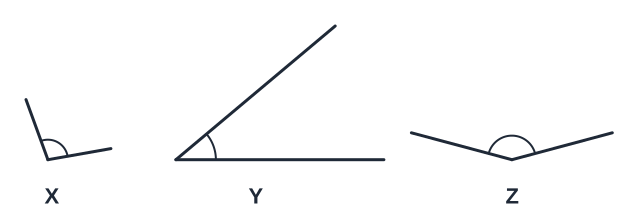
The diagram shows three angles, X, Y and Z. They are drawn accurately.

Put the angles in order of size. Start with the smallest.

Three angles labelled X, Y and Z underneath, each marked with an arc. X has very short arms: one goes right and slightly up, the other goes up and slightly to the left. Y has very long arms: one goes straight to the right, the other goes up to the right. Z has medium arms: one goes right and slightly up, the other goes left and slightly up.

Model answer

Y is smaller than a right angle.
X is a little bigger than a right angle.
Z is nearly flat, so it is the biggest.
Y, X, Z

Explanation

The size of an angle is how far one arm is turned from the other, not how long the arms are. Y has long arms, but it is only a small turn, so it is the smallest. X is a little more than a right angle, and Z is nearly a straight line, so it is the largest. A common mistake is to think Y is the biggest because its arms are the longest.

Mark scheme
  1. 1 mark

    Y identified as the smallest angle, or Z identified as the largest angle; or the correct order Y, X, Z with no working

    Also award this mark for the order Z, X, Y (largest first).

  2. 1 mark

    Y, X, Z

    Do not accept X, Y, Z or orders that put Y last (comparing the length of the arms). A correct answer with no working scores full marks.

Question 3

2 marks

How many right angles make a three-quarter turn?

How many right angles make a whole turn?

Model answer

A quarter turn is 1 right angle.
A three-quarter turn is 3 right angles.
A whole turn is 4 right angles.

Explanation

A quarter turn is one right angle, so a three-quarter turn is three right angles. A whole turn is four quarter turns, so it is four right angles, and you end up facing the way you started. A common mistake is to think a three-quarter turn is 4 right angles.

Mark scheme
  1. 1 mark

    Three-quarter turn: 3 right angles

  2. 1 mark

    Whole turn: 4 right angles

    The two answers must be clearly matched.

Question 4

4 marks

Kim says, "A three-quarter turn clockwise always ends facing the same way as a quarter turn anticlockwise."

Start facing north.
Which way do you face after a three-quarter turn clockwise?
Which way do you face after a quarter turn anticlockwise?

Is Kim right? Why?

Model answer

Three-quarter turn clockwise from north: east, south, west. I face west.
Quarter turn anticlockwise from north: west. I face west.
Yes, Kim is right. A whole turn is 4 quarter turns. If you turn 3 quarter turns one way, you are 1 quarter turn short of a whole turn, which is the same as turning 1 quarter turn back the other way.

Explanation

Try it from north: three quarter turns clockwise go to east, then south, then west, and one quarter turn anticlockwise goes straight to west. Both end facing west. This always happens, because a three-quarter turn and a quarter turn together make a whole turn, so going three quarters one way reaches the same place as going one quarter the other way. A common mistake is to check only one example and not explain why it always works.

Mark scheme
  1. 1 mark

    Three-quarter turn clockwise from north: west

  2. 1 mark

    Quarter turn anticlockwise from north: west

  3. 1 mark

    Yes, with a relevant but incomplete reason, e.g. 'both turns end facing west' with nothing more

    'Yes' alone scores 0 for this mark.

  4. 1 mark

    Yes, with a complete reason why it always works: a whole turn is 4 right angles (4 quarter turns), so turning 3 right angles one way ends in the same place as turning 1 right angle the other way

    A complete correct reason on its own scores this mark and the one before it. Accept 'three quarters and one quarter make a whole turn, so they meet at the same place'.

Ready to try the rest? Tap your answers and see straight away how you did.

Topic notes

Angles

The big idea

An angle measures how much turn there is between two straight lines that meet at a point. The two lines are called the arms of the angle. The more one arm is turned away from the other, the bigger the angle. How long the arms are does not matter.

Right angles

A right angle is a quarter of a whole turn. It is the square corner you see on a page, a door or a window. A small square in the corner of a drawing shows a right angle.

You can make a right-angle checker. Fold any piece of paper in half. Then fold it in half again, so the folded edge lies along itself. The corner you have made is a right angle. If you turn a right angle round, it is still a right angle.

Acute and obtuse angles

We name angles by checking them against a right angle.

AngleSize
acuteless than a right angle
right angleexactly a quarter turn
obtusemore than a right angle, but less than two right angles

A straight line is two right angles put side by side: a half turn.

Four drawings, labelled: an acute angle, a right angle marked with a small square, an obtuse angle, and a straight line with a line standing up from its middle, making two right angles.
An acute angle, a right angle and an obtuse angle. Two right angles side by side make a straight line.

To compare or order angles, look at how much one arm has turned away from the other. Ignore how long the arms are.

Max opens his laptop slowly. Name the angle between the screen and the keyboard at each stage. Then order the stages from the smallest angle to the largest.

  • Stage A: the screen stands straight up.
  • Stage B: the screen is open a little.
  • Stage C: the screen is tipped back past straight up, but it is not flat.

Stage A: straight up makes a square corner with the keyboard, so it is a right angle.

Stage B: the screen has turned less than a right angle, so the angle is acute.

Stage C: the screen has turned more than a right angle, so the angle is obtuse.

In order, from the smallest: B, A, C.

Check your answer: if the screen lay flat, the angle would be two right angles, a straight line. Stage C is less than that, so it really is obtuse.

Angles in shapes

Every corner of a shape has an angle. A square and a rectangle have 4 right angles. An equilateral triangle has 3 acute angles. A rhombus that is not a square has 2 acute angles and 2 obtuse angles. Check every corner, even the ones that point sideways or downwards.

Turns and compass directions

A turn can be clockwise, the same way as a clock's hands move, or anticlockwise, the opposite way.

TurnRight angles
quarter turn1
half turn2
three-quarter turn3
whole turn (you face the way you started)4

The four compass directions are north (N), east (E), south (S) and west (W). Turning clockwise, they go N, E, S, W and back to N. On a clock, the minute hand turns through 1 right angle every 15 minutes.

A compass cross with north at the top, east on the right, south at the bottom and west on the left. The right angle between north and east is marked and labelled a quarter turn.
The four compass directions. Turning from north to east is a quarter turn clockwise: 1 right angle.

Leo is facing west. He turns to face north. Describe his turn in two different ways.

Clockwise, the directions go N, E, S, W, then back to N. So from W, the very next direction clockwise is N.

Way 1: a quarter turn clockwise, which is 1 right angle.

Way 2: anticlockwise, Leo passes S and then E before he reaches N. That is a three-quarter turn anticlockwise, which is 3 right angles.

Check your answer: 1 right angle and 3 right angles make 4 right angles, a whole turn.

Remember

  • A right angle is a quarter turn: a square corner.
  • Acute: less than a right angle.
  • Obtuse: more than a right angle but less than two right angles.
  • Two right angles make a straight line. Four make a whole turn.
  • Clockwise goes N, E, S, W.

Common mistakes

  • Thinking longer arms make a bigger angle. An angle's size depends on the turn between the arms, not on their length.
  • Missing a right angle because it has been turned. Turn the page, or use your right-angle checker.
  • Calling a straight line obtuse. A straight line is two right angles, and an obtuse angle is less than that.
  • Mixing up clockwise and anticlockwise. Clockwise follows a clock's hands.

Top tip

Line up one edge of your right-angle checker with one arm of the angle. Then look at the other arm: inside the checker means acute, along the edge means a right angle, and outside means obtuse.

Study Helper Hints first, answers after you try

Stuck on this one? Ask for a hint and I’ll point you in the right direction, without giving the answer away. Once you’ve checked your answer, I’ll show you how the marks are awarded.