Level:
Correct: 0
Incorrect: 0
Marks: 0/0
Practice
Course:
Topics:
Year 4 Maths Smart practice A mixed round aimed at your weak spots
Unit 1
Place value
Unit 2
Addition and subtraction
Column addition
Quick practice5 skills
Column subtraction
Quick practice5 skills
Estimating and checking answers
Quick practice5 skills
Two-step word problems
Quick practice5 skills
Unit 3
Multiplication and division
Unit 4
Fractions
Unit 5
Decimals
Unit 6
Measurement
Unit 7
Shape
Geometry: properties of shapes
Triangles and quadrilaterals
Quick practice5 skills
Angles
Quick practice5 skills
Lines of symmetry
Quick practice5 skills
Unit 8
Position and direction
Geometry: position and direction
Coordinates
Quick practice5 skills
Translations
Quick practice4 skills
Unit 9
Statistics
Avg
score:
–
Topics
done:
0/34

Area

Practise 18 questions on Area for Year 4 Maths. Tap your answer and find out straight away if you are right, with the Study Helper on hand if you get stuck.

  • 18 questions
  • 1–5 marks each
  • Instant marking
  • No sign-up needed
18 questions, marked as you go

Sample questions with model answers

Here are 4 of the questions in this topic, each with a model answer, an explanation of why it earns the marks and the mark scheme.

Question 1

1 mark

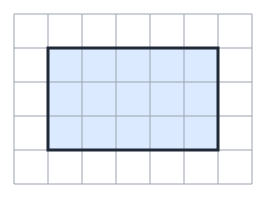
The diagram shows a rectangle drawn on a grid of centimetre squares.

What is the area of the rectangle?

A shaded rectangle on a grid of centimetre squares. The rectangle is 5 squares long and 3 squares tall.

Model answer

There are 3 rows of 5 squares.
\(5 + 5 + 5 = 15\)
The area is 15 squares.

Explanation

Count the squares inside the rectangle. A quick way is to count one row and then add the rows: there are 3 rows with 5 squares in each, and 5 + 5 + 5 = 15. A common mistake is to add the length and the width (5 + 3 = 8), but that does not count the squares inside.

Mark scheme
  1. 1 mark

    15 squares (15 cm²)

    Accept 15 with no unit, 15 squares, 15 cm² or 15 square centimetres. Do not accept 16 (the perimeter) or 8 (adding 5 and 3).

Question 2

2 marks

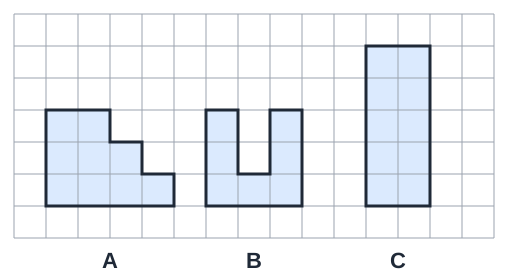
The diagram shows three shapes, A, B and C, on a grid of squares.

Put the shapes in order of area. Start with the smallest.

Three shaded shapes on a grid of squares, labelled A, B and C underneath. Shape A is a staircase shape: a bottom row of 4 squares, a row of 3 above it and a row of 2 at the top, all lined up on the left. Shape B is a U shape: a bottom row of 3 squares with a column of 2 squares going up from each end. Shape C is a tall rectangle, 2 squares wide and 5 squares tall.

Model answer

A = 4 + 3 + 2 = 9 squares
B = 3 + 2 + 2 = 7 squares
C = 2 + 2 + 2 + 2 + 2 = 10 squares
Smallest first: B, A, C

Explanation

Count the squares in each shape row by row. A has 9, B has 7 and C has 10, so from smallest to largest the order is B, A, C. Shape C is the tallest, but you still need to count: it is the largest here because it has the most squares. Read the question carefully: a common mistake is to start with the largest.

Mark scheme
  1. 1 mark

    At least two of the three areas correct: A = 9 squares, B = 7 squares, C = 10 squares; or the correct order B, A, C with no working

    Also award this mark for the order C, A, B (largest first).

  2. 1 mark

    B, A, C

    The order must start with the smallest. A correct answer with no working scores full marks.

Question 3

3 marks

Ruby draws a rectangle on a grid of centimetre squares.

Its area is 12 squares.
Its perimeter is 14 cm.

How long and how wide is Ruby's rectangle?

Model answer

Rectangles with an area of 12 squares:
12 by 1: perimeter \(12 + 1 + 12 + 1 = 26\) cm
6 by 2: perimeter \(6 + 2 + 6 + 2 = 16\) cm
4 by 3: perimeter \(4 + 3 + 4 + 3 = 14\) cm
Ruby's rectangle is 4 cm long and 3 cm wide.

Explanation

List the rectangles you can make from 12 squares: 12 by 1, 6 by 2 and 4 by 3. Then work out the perimeter of each one by adding all four sides. Only 4 by 3 has a perimeter of 14 cm. A common mistake is to stop at the first rectangle with an area of 12 without checking its perimeter.

Mark scheme
  1. 1 mark

    At least two different rectangles with an area of 12 squares written (12 by 1, 6 by 2, 4 by 3); or the correct answer 4 cm by 3 cm with no working

    Another correct method also scores this mark and the next one, e.g. 'the length and width add up to half of 14, which is 7; 4 + 3 = 7 and 4 rows of 3 squares make 12'.

  2. 1 mark

    The perimeter of at least one of these rectangles worked out correctly (12 by 1 is 26 cm, 6 by 2 is 16 cm, 4 by 3 is 14 cm)

  3. 1 mark

    4 cm long and 3 cm wide

    Accept 3 by 4, 4 and 3, 4 cm by 3 cm or 3 cm and 4 cm in either order, with or without units. Do not accept 6 by 2 (area 12 but perimeter 16 cm). A correct answer with no working scores full marks.

Question 4

4 marks

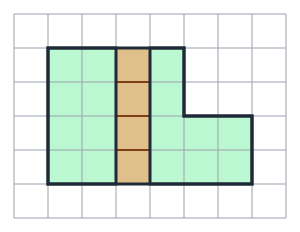
The diagram shows Grandad's vegetable patch on a grid of squares. The brown squares are a path. He plants seeds in all the green squares.

One packet of seeds is enough for 3 squares.

How many packets of seeds does he need?

A vegetable patch drawn on a grid of squares. The patch is 6 squares wide and 4 squares tall, but a piece 2 squares wide and 2 squares tall is missing from its top right corner. A brown path, 1 square wide, runs from the bottom to the top of the patch in the third column from the left. All the other squares of the patch are green.

Model answer

Green squares: \(20 - 4 = 16\)
Count in 3s: 3, 6, 9, 12, 15 is 5 packets.
5 packets plant 15 squares, so 1 square is left.
He needs 1 more packet for that square.
He needs 6 packets.

Explanation

First find the area that needs seeds: the patch has 20 squares and the path has 4, so 16 squares are green. Then count in 3s: 5 packets cover only 15 squares, and there is still 1 square left over. So Grandad must buy one more packet, 6 in all. A common mistake is to say 5 packets, forgetting the square that is left over.

Mark scheme
  1. 1 mark

    16 green squares found (or 20 squares in the patch and 4 on the path); or the correct answer 6 with no working

  2. 1 mark

    A method to find how many groups of 3 are in their number of green squares, e.g. counting in 3s (3, 6, 9, 12, 15) or \(16 \div 3\)

  3. 1 mark

    5 packets are not enough: 5 packets plant only 15 squares (or \(16 \div 3 = 5\) remainder 1)

  4. 1 mark

    6 packets

    Accept 6. Do not accept 5, 5 r 1 or 5 and a bit. Follow through from their number of green squares if it is not a multiple of 3 (round up). A correct answer with no working scores full marks.

Ready to try the rest? Tap your answers and see straight away how you did.

Topic notes

Area

The big idea

The area of a flat shape is the amount of surface it covers. To find it, we count the squares inside it. The more squares a shape covers, the bigger its area.

Counting squares

On squared paper, count every square inside the shape. Count one row at a time, then add the rows together. That way you do not miss a square or count one twice.

When each square is a centimetre square (its sides are 1 cm long), we can give the area in square centimetres. An area of 15 square centimetres is written 15 cm².

A car shape on a grid of centimetre squares: a bottom row of 6 squares, a middle row of 6 squares and a top row of 3 squares.
Asha's car, drawn on centimetre squares.

Asha draws a car on centimetre squared paper. What is the area of her car?

Count one row at a time, starting at the bottom.

  • Bottom row: 6 squares
  • Middle row: 6 squares
  • Top row: 3 squares

\(6 + 6 + 3 = 15\)

The area of the car is 15 squares, or 15 cm².

Check your answer: count again in columns, from left to right. \(2 + 2 + 3 + 3 + 3 + 2 = 15\)

Area and perimeter

Area is not the same as perimeter. Perimeter is the length of the outline of a shape: how far you go if you walk once round its edge.

AreaPerimeter
What it measuresthe surface inside the shapethe length of the outline
How to find it on a gridcount the squares insidecount the square edges along the outline
Unit on centimetre squarescm²cm

What is the perimeter of Asha's car? Is it the same number as its area?

Start at the bottom left corner. Walk once round the outline, counting the square edges: along the bottom 6, up the right side 2, along 1, up 1, along the roof 3, down 1, along 2, and down the left side 2.

\(6 + 2 + 1 + 1 + 3 + 1 + 2 + 2 = 18\)

So the perimeter is 18 cm, but the area is 15 cm². The numbers are different, because area and perimeter measure different things.

Comparing areas and making shapes

To compare two areas, count the squares in both shapes. A shape that is longer or taller does not always have a bigger area. The squares must be the same size, too: a few big squares can cover more than lots of tiny ones.

You can make lots of different shapes with the same area. Just use the same number of squares, joined along their sides.

Two shapes on a grid of squares. Shape A is a rectangle 5 squares long and 2 squares tall. Shape B has rows of 5, 3 and 2 squares from the bottom, lined up on the left.
Shape A is Jade's rectangle. Shape B is made from the same 10 tiles after she moved 2 of them.

Jade makes rectangle A with 10 square tiles: 2 rows of 5. Then she takes the 2 tiles at the right-hand end of the top row and puts them on top of the left-hand end, to make shape B. Has the area changed?

Jade did not add any tiles or take any away. She only moved them.

Shape A: \(5 + 5 = 10\) squares.

Shape B: \(5 + 3 + 2 = 10\) squares.

The area has not changed. Both shapes have an area of 10 squares, even though they look different.

Stretch: a quick way for rectangles

In a rectangle, all the rows are the same length. So instead of adding the rows, you can multiply: the number of rows × the number of squares in each row. This is the same as the length × the width.

A red rug is made of carpet squares. It is 5 squares long and 4 squares wide. A blue rug is 7 squares long and 3 squares wide. Which rug has the bigger area?

Red rug: 4 rows of 5 squares. \(4 \times 5 = 20\) squares.

Blue rug: 3 rows of 7 squares. \(3 \times 7 = 21\) squares.

21 is more than 20, so the blue rug has the bigger area, by 1 square.

Remember

  • Area tells you how many squares a shape covers.
  • Count one row at a time, then add the rows.
  • On centimetre squares, area is in cm² (square centimetres).
  • Perimeter measures the outline. Area measures the inside.
  • Moving squares around does not change the area.

Common mistakes

  • Counting the square edges along the outline. That gives the perimeter, not the area.
  • Counting a square twice where a row and a column meet. Mark each square as you count it.
  • Choosing the longest or tallest shape as the biggest without counting. Count the squares to be sure.
  • Adding the length and the width of a rectangle. A rectangle 6 squares long and 2 squares wide covers 12 squares, not 8.

Top tip

Count the squares one way, in rows. Then check by counting them another way, in columns. If you get the same number both times, you can be sure.

Study Helper Hints first, answers after you try

Stuck on this one? Ask for a hint and I’ll point you in the right direction, without giving the answer away. Once you’ve checked your answer, I’ll show you how the marks are awarded.