Practise 17 questions on Translations for Year 4 Maths. Tap your answer and find out straight away if you are right, with the Study Helper on hand if you get stuck.
17 questions
1–4 marks each
Instant marking
No sign-up needed
17 questions, marked as you go
Sample questions with model answers
Here are 4 of the questions in this topic, each with a model answer, an explanation of why it earns the marks and the mark scheme.
Question 1
1 mark
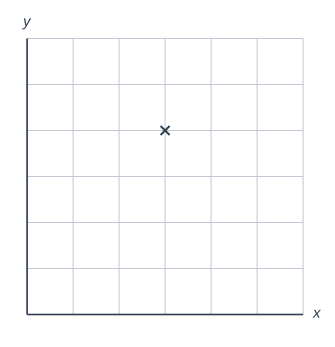
The diagram shows point P on a grid.
Point P moves 2 squares down.
What are the coordinates of the new position of P?
Model answer
P is at \((3, 4)\). Moving down takes 2 off the second number: \(4 - 2 = 2\). \((3, 2)\)
Explanation
P starts 3 across and 4 up. Moving down changes only the second number, the height, so take 2 away from 4. The first number stays the same. A common mistake is to change the first number instead.
Mark scheme
1 mark
\((3, 2)\)
Accept 3, 2 without the brackets. Do not accept (1, 4) (moved left instead) or (3, 6) (moved up).
Question 2
2 marks
A toy car is at \((1, 2)\) on a grid. It moves 3 squares up. Then it moves 2 squares to the right.
What are the coordinates of the place where it stops?
Model answer
Up 3: \(2 + 3 = 5\), so \((1, 5)\) Right 2: \(1 + 2 = 3\), so \((3, 5)\)
Explanation
Do one move at a time. Moving up changes the second number, so the car goes to \((1, 5)\). Moving right changes the first number, so it ends at \((3, 5)\). A common mistake is to add the 3 to the first number because it is the first move.
Mark scheme
1 mark
\((1, 5)\) after the first move, or one number of the final answer correct; or the correct answer \((3, 5)\) with no working
1 mark
\((3, 5)\)
Accept 3, 5 without the brackets. Do not accept (4, 4) (3 right and 2 up). A correct answer with no working scores full marks.
Question 3
3 marks
Point A is at \((2, 4)\).
A moves 3 squares right and 1 square down. Now it is at point B. Then B moves 2 squares left and 4 squares up. Now it is at point C.
What are the coordinates of B and C?
Model answer
B: \(2 + 3 = 5\) and \(4 - 1 = 3\), so \((5, 3)\) C: \(5 - 2 = 3\) and \(3 + 4 = 7\), so \((3, 7)\)
Explanation
Right and left change the first number; up and down change the second number. Right and up add, while left and down take away. Do the first move to find B, then start from B for the second move. A common mistake is to start the second move from A instead of B.
Mark scheme
1 mark
B: \((5, 3)\)
Accept 5, 3 without the brackets.
1 mark
A correct second move from their B: 2 taken away from the first number and 4 added to the second number; or the correct answer C \((3, 7)\) with no working
1 mark
C: \((3, 7)\)
Accept 3, 7 without the brackets. Do not accept (0, 8), which starts the second move from A instead of B. A correct answer with no working scores full marks.
Question 4
4 marks
A counter starts at \((1, 2)\).
First it moves 3 squares to the right. Then it makes a second move and lands on \((4, 6)\).
Describe the second move.
Then the counter goes back to where it started, \((1, 2)\). It moves left or right, then up or down. Describe how it gets back.
Model answer
After 3 right: \((4, 2)\) From \((4, 2)\) to \((4, 6)\): \(6 - 2 = 4\), so 4 squares up. Back from \((4, 6)\) to \((1, 2)\): \(4 - 1 = 3\) left and \(6 - 2 = 4\) down. 3 squares left and 4 squares down.
Explanation
Find where the counter is after the first move, then compare it with \((4, 6)\): only the second number changes, so the move is straight up. To go back, the counter undoes both moves by going the opposite way: left instead of right and down instead of up. A common mistake is to say 3 right and 4 up for the way back.
Mark scheme
1 mark
\((4, 2)\) found after the first move; or the correct second move with no working
1 mark
Second move: 4 squares up
Do not accept 6 squares up (the end number).
1 mark
Way back: 3 squares left
1 mark
and 4 squares down
Accept the two parts of the way back in either order. Do not accept right or up for the way back. A correct answer with no working scores full marks.
Ready to try the rest? Tap your answers and see straight away how you did.
Ctrl + Enter to check
Study HelperHints first, answers after you try
Stuck on this one? Ask for a hint and I’ll point you in the right direction, without giving the answer away. Once you’ve checked your answer, I’ll show you how the marks are awarded.