Level:
Correct: 0
Incorrect: 0
Marks: 0/0
Practice
Course:
Topics:
Year 4 Maths Smart practice A mixed round aimed at your weak spots
Unit 1
Place value
Unit 2
Addition and subtraction
Column addition
Quick practice5 skills
Column subtraction
Quick practice5 skills
Estimating and checking answers
Quick practice5 skills
Two-step word problems
Quick practice5 skills
Unit 3
Multiplication and division
Unit 4
Fractions
Unit 5
Decimals
Unit 6
Measurement
Measurement
Converting units of measure
Quick practice6 skills
Perimeter
Quick practice5 skills
Area
Quick practice5 skills
Time
Quick practice7 skills
Unit 7
Shape
Geometry: properties of shapes
Triangles and quadrilaterals
Quick practice5 skills
Angles
Quick practice5 skills
Lines of symmetry
Quick practice5 skills
Unit 8
Position and direction
Geometry: position and direction
Coordinates
Quick practice5 skills
Translations
Quick practice4 skills
Unit 9
Statistics
Avg
score:
–
Topics
done:
0/34

Numbers up to 10,000

Practise 25 questions on Numbers up to 10,000 for Year 4 Maths. Tap your answer and find out straight away if you are right, with the Study Helper on hand if you get stuck.

  • 25 questions
  • 1–5 marks each
  • Instant marking
  • No sign-up needed
20 questions, marked as you go

Sample questions with model answers

Here are 4 of the questions in this topic, each with a model answer, an explanation of why it earns the marks and the mark scheme.

Question 1

1 mark

Which sign, < or >, makes this correct?

\(643 \;\square\; 634\)

Model answer

Both numbers have 6 hundreds.
643 has 4 tens and 634 has 3 tens.
\(643 > 634\)

Explanation

Compare the digits from the left. Both numbers have 6 hundreds, so look at the tens: 4 tens is more than 3 tens, so 643 is greater. The sign opens towards the bigger number: \(643 > 634\). A common mistake is to compare the ones first, where 3 is less than 4.

Mark scheme
  1. 1 mark

    >

    Accept the statement written out (\(643 > 634\)) or the words 'greater than' or 'is bigger than'. Do not accept < or =.

Question 2

2 marks

What number is 100 more than 935?

What number is 100 less than 935?

Model answer

\(935 + 100 = 1{,}035\)
\(935 - 100 = 835\)

Explanation

Adding or taking away 100 changes the hundreds digit. 935 has 9 hundreds, and one more hundred makes 10 hundreds, which is 1 thousand: so 100 more is 1,035. For 100 less, the hundreds digit goes down from 9 to 8: 835. A common mistake is to change the tens digit instead and get 945 or 925.

Mark scheme
  1. 1 mark

    100 more: 1,035

    Accept 1035. Do not accept 945 (10 more) or 1,935.

  2. 1 mark

    100 less: 835

    Do not accept 925 (10 less) or 735. If the answers are not labelled, take them in the order the questions are asked.

Question 3

2 marks

The number line goes from 0 to 10,000.

Estimate the numbers that arrows A and B point to.

A number line labelled 0 at the left end and 10,000 at the right end. There are no marks in between. Arrow A points to a place nearer the 0 end. Arrow B points to a place nearer the 10,000 end.

Model answer

Halfway along the line is 5,000.
A is a little less than halfway from 0 to 5,000: about 2,000.
B is about halfway from 5,000 to 10,000: about 7,500.

Explanation

Start by finding the middle of the line, which is 5,000. Then compare each arrow with the middle and the ends. A is less than halfway to the middle, and halfway between 5,000 and 10,000 is 7,500, which is close to B. Any sensible estimate near the arrow is fine. A common mistake is to guess without using the middle of the line to help.

Mark scheme
  1. 1 mark

    A: any number from 1,500 to 2,500

    Arrow A is drawn at 2,000. Accept any value in the range, for example 2,000 or 1,800.

  2. 1 mark

    B: any number from 7,000 to 8,000

    Arrow B is drawn at 7,500. Accept any value in the range, for example 7,500 or 7,800.

Question 4

4 marks

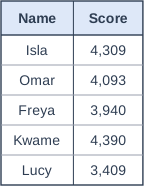
Five children play a computer game. The table shows their scores.

Which two children scored more than 4,300?

Whose score has a 0 in the hundreds column?

Theo scores 1,000 more than Lucy. What is Theo's score?

Who scored more, Theo or Omar?

Table with columns "Name", "Score". Name: Isla; Score: 4,309 | Name: Omar; Score: 4,093 | Name: Freya; Score: 3,940 | Name: Kwame; Score: 4,390 | Name: Lucy; Score: 3,409.

Model answer

4,309 and 4,390 are more than 4,300: Isla and Kwame.
4,093 has 0 hundreds: Omar.
\(3{,}409 + 1{,}000 = 4{,}409\)
4,409 is more than 4,093, so Theo scored more.

Explanation

To compare, look at the thousands first, then the hundreds. Isla and Kwame both have 4 thousands and 3 hundreds, so they are over 4,300, but Omar has 4 thousands and 0 hundreds. Adding 1,000 to Lucy's 3,409 changes only the thousands digit, giving 4,409. Theo and Omar both have 4 thousands, but Theo has 4 hundreds and Omar has none. A common mistake is to think 4,093 is more than 4,300 because it has a 9.

Mark scheme
  1. 1 mark

    Isla and Kwame

    Both names are needed, and no others. Accept their scores (4,309 and 4,390). Do not accept Omar (4,093).

  2. 1 mark

    Omar

    Accept 4,093.

  3. 1 mark

    4,409

    Accept 4409. Do not accept 3,509 (100 more) or 3,419 (10 more).

  4. 1 mark

    Theo

    Follow through: compare the pupil's score for Theo with Omar's 4,093. A correct answer with no working scores full marks.

Ready to try the rest? Tap your answers and see straight away how you did.

Topic notes

Numbers up to 10,000

The big idea

Every number is written with the ten digits from 0 to 9. What a digit is worth depends on where it sits in the number. This is called place value. This topic is about four-digit numbers and the number 10,000.

Thousands, hundreds, tens and ones

A four-digit number fills four columns: thousands (Th), hundreds (H), tens (T) and ones (O). Each column is worth 10 times the column on its right: ten hundreds make a thousand. Here is 2,764 in a place-value chart, a table with one column for each place:

ThHTO
2764

The 2 is worth 2,000, the 7 is worth 700, the 6 is worth 60 and the 4 is worth 4. Place-value counters show it too: two 1,000s, seven 100s, six 10s and four 1s.

Ten thousands make 10,000 (ten thousand), the first number with five digits.

If a column is empty, write a 0 in it. This 0 is a place holder: it keeps the other digits in the right columns. In 5,008 the zeros show that the hundreds and tens columns are empty. Without them, 5,008 would turn into 58.

Reading and writing numbers

Say the thousands first, then the rest.

In figuresIn words
2,764two thousand, seven hundred and sixty-four
5,008five thousand and eight

To write a number from words, put a 0 in any empty column. Three thousand and seventy needs zeros in the hundreds and ones columns: 3,070.

Partitioning

To partition a number means to split it into parts. The usual way uses the value of each digit:

\[2{,}764 = 2{,}000 + 700 + 60 + 4\]

You can split it in other ways too, such as \(2{,}000 + 764\), or 27 hundreds and 64 ones.

Comparing and ordering

To compare two numbers means to find out which is bigger.

  1. A number with more digits is bigger: 1,002 is bigger than 987.
  2. If they have the same number of digits, compare the thousands, then the hundreds, tens and ones.

The sign > means "is greater than" and < means "is less than". The open side faces the bigger number: \(5{,}217 > 5{,}172\). To order numbers, compare them like this, then list them from smallest to largest.

1, 10, 100 and 1,000 more or less

Adding or taking away 1,000 changes the thousands digit: 1,000 more than 4,537 is 5,537. Adding 100 changes the hundreds digit, and so on.

Take care with 9s and 0s. A 9 that goes up becomes 0, and the column on its left goes up: 1 more than 2,399 is 2,400. A 0 that goes down becomes 9, and the column on its left goes down: 10 less than 3,206 is 3,196.

Number lines

On a number line, numbers get bigger as you go right. First work out what each small gap is worth.

A horizontal scale from 4000 to 6000, divided into 2 equal parts by long marks, each split into 5 small divisions by short marks. The marks are not numbered. Long marks are every 1000 and each small division is 200. Words under the scale: "4,000" at 4000, "5,000" at 5000 and "6,000" at 6000. Arrow A points to 5400.
From 4,000 to 5,000 there are 5 small gaps. Five 200s make 1,000, so each gap is worth 200. Arrow A is 2 gaps after 5,000, so it points to 5,400.

With no small marks, estimate: make a sensible guess. Find the middle first. Halfway between 3,000 and 4,000 is 3,500, so 3,900 sits near the 4,000 end.

Which is bigger: three thousand and eighty-five, or three thousand, eight hundred?

Write both in figures first. Three thousand and eighty-five has no hundreds, so it needs a place holder: 3,085. Three thousand, eight hundred is 3,800.

The thousands match, so look at the hundreds next: 0 hundreds against 8 hundreds.

So three thousand, eight hundred is bigger: \(3{,}800 > 3{,}085\).

A step counter showed 6,472 steps at lunchtime and 7,472 steps at bedtime. How many steps were walked in between?

The hundreds, tens and ones are the same in both: 472.

Only the thousands digit has changed. It went up by 1, so 1,000 steps were walked.

A factory packs 4,630 pencils into boxes of 100. How many boxes can it fill?

Partition 4,630 into hundreds and ones. 4 thousands are 40 hundreds, and there are 6 more hundreds. So 4,630 is 46 hundreds and 30 ones.

Each full box holds 1 hundred, so the factory fills 46 boxes, with 30 pencils left over.

Common mistakes

  • Giving the digit, not its value. In 2,764 the 7 is worth 700, not 7.
  • Leaving out a place holder: five thousand and eight is 5,008, not 508 or 58.
  • Thinking the number with more 9s is bigger. 4,199 is less than 4,200, because 1 hundred is less than 2 hundreds.

Top tip

Write numbers in a place-value chart before you compare them. Lining up the digits stops you mixing up the columns.

Study Helper Hints first, answers after you try

Stuck on this one? Ask for a hint and I’ll point you in the right direction, without giving the answer away. Once you’ve checked your answer, I’ll show you how the marks are awarded.