
Level:
Correct: 0
Incorrect: 0
Marks: 0/0
Exam Practice
Course:
Topics:
OCR GCSE Physics (Paper 4) Smart practice A mixed round aimed at your weak spots
Unit 5
Waves in matter
Unit 6
Radioactivity
Unit 7
Energy
Unit 8
Global challenges
Unit 9
Practical skills
Avg
score:
–
Topics
done:
0/33

Waves for exploring the Earth's core and deep water

Practise 10 exam-style questions on Waves for exploring the Earth's core and deep water for OCR GCSE Physics (Paper 4). Write your answer as you would in the exam and get it marked in seconds against the mark scheme, point by point, with the Study Helper on hand if you get stuck.

  • 10 questions
  • 1–5 marks each
  • Instant marking
  • No sign-up needed
10 questions, marked as you go

Sample questions with model answers

Here are 4 of the questions in this topic, each with a model answer, an explanation of why it earns the marks and the mark scheme an examiner would use.

Question 1

1 mark

A survey ship uses sonar to study a flat area of seabed. The water is the same depth everywhere in this area. The echoes from one part of the area are much weaker than the echoes from the rest.

Which is the best explanation?

Choose your answer.

  • A Echoes from that part take longer to return to the ship, so they have become weaker.
  • B Sound changes its frequency when it reflects from that part.
  • C Sound travels faster through the water above that part.
  • D That part is covered with soft mud, which reflects less sound and absorbs more.

Model answer

D

Explanation

Sonar can show what the seabed is made of as well as how deep it is. The time an echo takes gives the depth; the strength of the echo depends on how much of the sound is reflected. Hard rock reflects strongly, while soft mud transmits and absorbs more of the sound, so it gives weak echoes. Surveyors use this to map areas of rock, sand and mud on the seabed.

Mark scheme
  1. 1 mark

    D / That part is covered with soft mud, which reflects less sound and absorbs more.

    The only correct answer is D: when the sound meets the seabed, part of it is reflected and the rest goes into the seabed and is absorbed; soft mud is more like water than rock or hard sand is, so it reflects a smaller fraction of the sound and absorbs more of it, giving weaker echoes. A is not correct because the water is the same depth everywhere, so all the echoes take the same time to return; B is not correct because reflection does not change the frequency of a wave; C is not correct because the sound travels through the same seawater everywhere, and a change of speed would change the time the echo takes, not its strength. ALLOW the letter or the option. If more than one option is given, do not award the mark.
Question 2

2 marks

A survey boat searches for a shipwreck on a flat, sandy seabed. Its sonar sends pulses of ultrasound sideways and downwards across the seabed, and a computer builds an image from the strength of the echoes.

In the image, the steel wreck appears as a very bright area. On the side of the wreck furthest from the boat there is a dark area, where almost no echoes are received.

Explain why the wreck appears bright and why there is a dark area beyond it.

Model answer

The steel wreck reflects much more of the ultrasound back towards the boat than the sand does, so the echoes from it are strong and it appears bright. The wreck also stops the ultrasound going any further, so no ultrasound reaches the seabed just behind it. No echoes come back from that part of the seabed, so it appears dark, like a shadow.

Explanation

Differences in reflection make objects stand out: hard steel reflects ultrasound much more strongly than sand. The dark area is an acoustic shadow, formed in the same way as a shadow in light, because the wreck blocks the pulses. Surveyors use the length of the shadow to estimate how far the wreck stands up from the seabed.

Mark scheme
  1. 1 mark

    the (steel) wreck reflects much more of the ultrasound (back to the boat) than the sandy seabed does / gives strong echoes

    ALLOW the wreck is a good reflector of sound. IGNORE the wreck is shiny.

  2. 1 mark

    the wreck blocks the ultrasound (reflects or absorbs it), so no ultrasound reaches the seabed behind it, so no echoes come back from there

    ALLOW the wreck casts an (acoustic) shadow. The idea that no ultrasound reaches the seabed behind the wreck is needed. DO NOT ALLOW the seabed behind the wreck absorbs all the ultrasound.

Question 3

3 marks

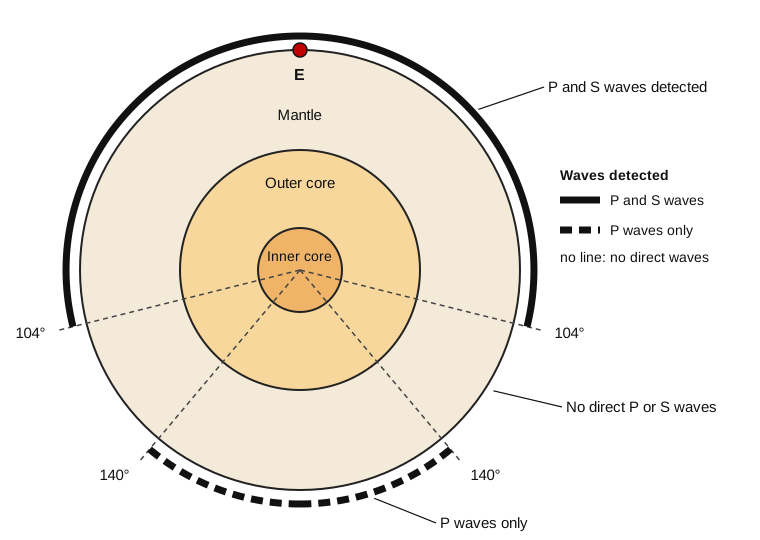
The diagram is a slice through the centre of the Earth. An earthquake happens at E, on the surface.

The diagram also shows the parts of the Earth's surface where seismometers detect P waves and S waves that have travelled directly through the Earth from E. The angles are measured at the centre of the Earth, from E.

Explain why no direct P waves are detected between 104° and 140° from E, and why no direct S waves are detected anywhere more than 104° from E.

A cross-section of the Earth showing the mantle, the outer core and the inner core. An earthquake is marked E at the top. Around the surface, lines show where P and S waves are detected, where only P waves are detected and where no direct waves are detected, with the angles 104° and 140° from E marked on both sides.

Model answer

P waves that just miss the core reach the surface at up to 104° from E. To reach the surface further from E, a wave must travel through the core. When P waves enter the liquid outer core they slow down, so they are refracted (bent towards the normal) at the boundary, and again when they leave it. This bends them so that they reach the surface beyond 140°, leaving a zone between 104° and 140° that no direct P waves reach.
S waves are transverse and cannot travel through a liquid. Any S wave reaching the surface more than 104° from E would have to pass through the liquid outer core, so no direct S waves are detected anywhere beyond 104°.

Explanation

The two shadow zones have different causes. The S-wave shadow zone is caused by the outer core not transmitting S waves at all, which is the evidence that the outer core is liquid. The P-wave shadow zone is caused by refraction: P waves slow down as they enter the outer core, so they bend and come out beyond 140°. Weaker answers say the P waves are blocked by the core, which does not explain why they are detected again beyond 140°.

Mark scheme
  1. 1 mark

    P waves that just miss the (outer) core reach the surface at up to 104° from E / waves that reach the surface more than 104° from E must have travelled through the core

    Max 3. Max 2 if only one of the two observations (P waves or S waves) is explained.

  2. 1 mark

    P waves change speed / slow down when they enter the (liquid) outer core

    ALLOW P waves travel more slowly in the outer core than in the mantle.

  3. 1 mark

    so P waves that enter the core are refracted / change direction (bend towards the normal) at the boundary, and reach the surface beyond 140°, so no P waves reach the surface between 104° and 140°

    ALLOW the core acts like a lens, bending the P waves so that they come out further round. ALLOW refraction when the waves leave the core as well. DO NOT ALLOW the P waves are reflected or absorbed by the core as the only reason.

  4. 1 mark

    S waves are transverse and cannot travel through the liquid outer core, so no S waves reach the surface more than 104° from E (where the waves would have to pass through the core)

    ALLOW the outer core is liquid and S waves do not travel through liquids. DO NOT ALLOW the whole core is liquid.

Question 4

4 marks

A seismometer is 300 km from a small earthquake. P waves from the earthquake reach the seismometer along two different paths:

• path A: straight through the crust, a distance of 300 km, at 6.0 km/s
• path B: down through the crust to the top of the mantle, along the top of the mantle, then back up through the crust: 100 km through the crust at 6.0 km/s and 220 km through the mantle at 8.0 km/s.

Calculate the time taken for the P waves to travel along each path.

Use your answers to explain how measurements like these give evidence for a boundary between the crust and the mantle, about 30 km below the surface.

Model answer

Path A: time = distance ÷ speed = 300 ÷ 6.0 = 50 s
Path B: time = 100 ÷ 6.0 + 220 ÷ 8.0 = 16.7 + 27.5 = 44 s
The P waves along path B arrive about 6 s before those along path A, even though path B is longer, because they spend most of their journey in the mantle, where P waves travel faster.
So the first waves to arrive at distant seismometers have travelled through faster rock below the crust. This shows that there is a boundary about 30 km down, below which the rock is different (the mantle) and P waves travel faster. Seismometers close to the earthquake receive the waves through the crust first; the distance at which the faster waves start to arrive first depends on the depth of the boundary.

Explanation

Each time is distance ÷ speed, and path B has two parts that must be added. The surprising result, that the longer path is quicker, can only be explained if the waves travel faster in a deeper layer. This kind of evidence, first noticed in the early 1900s, revealed the boundary between the crust and the mantle without anyone digging down to it.

Mark scheme
  1. 1 mark

    path A: time = 300 ÷ 6.0 = 50 (s); or a correct final answer of 50 s and 44 s with no working

    An answer of 50 s for path A and 44 s for path B with no working scores marking points 1 and 2. ALLOW recall of distance = speed × time. ALLOW 50 s alone with no working for marking point 1.

  2. 1 mark

    path B: time = 100 ÷ 6.0 + 220 ÷ 8.0 = 16.7 + 27.5 = 44 (s)

    ALLOW 44.2 s. ALLOW ECF for one incorrect part of the calculation.

  3. 1 mark

    the waves along path B arrive first, even though path B is longer, because P waves travel faster in the mantle than in the crust

    ALLOW ECF from their times if they are consistent with their comparison.

  4. 1 mark

    so the waves that arrive first show that, below the crust, there is rock in which P waves travel faster: there is a boundary between two different materials (the crust and the mantle)

    ALLOW at seismometers close to the earthquake the waves through the crust arrive first, but further away the waves through the faster mantle arrive first; the distance at which this changes depends on the depth of the boundary. ALLOW the waves are refracted at the boundary because their speed changes.

Ready to try the rest? Every answer you write is marked against the mark scheme, so you can see exactly where the marks are.

Study Helper Hints first, answers after you try

Stuck on this one? Ask for a hint and I’ll point you in the right direction, without giving the answer away. Once you’ve checked your answer, I’ll show you how the marks are awarded.