
Level:
Correct: 0
Incorrect: 0
Marks: 0/0
Exam Practice
Course:
Topics:
OCR GCSE Physics (Paper 4) Smart practice A mixed round aimed at your weak spots
Unit 5
Waves in matter
Unit 6
Radioactivity
Unit 7
Energy
Unit 8
Global challenges
Unit 9
Practical skills
Avg
score:
–
Topics
done:
0/33

Red-shift and the Big Bang

Practise 12 exam-style questions on Red-shift and the Big Bang for OCR GCSE Physics (Paper 4). Write your answer as you would in the exam and get it marked in seconds against the mark scheme, point by point, with the Study Helper on hand if you get stuck.

  • 12 questions
  • 1–4 marks each
  • Instant marking
  • No sign-up needed
12 questions, marked as you go

Sample questions with model answers

Here are 4 of the questions in this topic, each with a model answer, an explanation of why it earns the marks and the mark scheme an examiner would use.

Question 1

1 mark

A teacher uses a loaf of raisin bread as a model of the expanding universe. As the dough rises, every distance between two raisins doubles in 1 hour.

At the start, raisin P is 2.0 cm from raisin Q, and raisin R is 6.0 cm from raisin Q.

How does the mean speed at which raisin R moves away from raisin Q during the hour compare with the mean speed at which raisin P moves away from raisin Q?

Choose your answer.

  • A one third as fast
  • B the same speed
  • C three times as fast
  • D nine times as fast

Model answer

C
Q to P: 2.0 cm → 4.0 cm, so 2.0 cm per hour.
Q to R: 6.0 cm → 12.0 cm, so 6.0 cm per hour.
6.0 ÷ 2.0 = 3, so three times as fast.

Explanation

When everything expands by the same factor, the increase in each distance is proportional to the starting distance, so the speed at which two raisins separate is proportional to the distance between them. Astronomers see the same pattern for galaxies: the more distant a galaxy, the faster it moves away, which is evidence that the universe is expanding. Thinking that all the raisins move apart at the same speed (option B) is the commonest error.

Mark scheme
  1. 1 mark

    C / three times as fast

    The only correct answer is C: in 1 hour the distance from Q to P increases from 2.0 cm to 4.0 cm (a mean speed of 2.0 cm per hour) and the distance from Q to R increases from 6.0 cm to 12.0 cm (6.0 cm per hour), so R moves away three times as fast; as with galaxies, the raisins that are further apart move apart faster. A is not correct because it is the ratio of the speeds turned upside down; B is not correct because, although every distance doubles, a larger distance increases by more in the same time; D is not correct because the ratio of the speeds is equal to the ratio of the starting distances (3), not to its square. ALLOW the letter or the option. If more than one option is given, do not award the mark.
Question 2

2 marks

An astronomer compares the spectrum of the light from a distant galaxy with the spectrum of hydrogen gas measured in a laboratory.

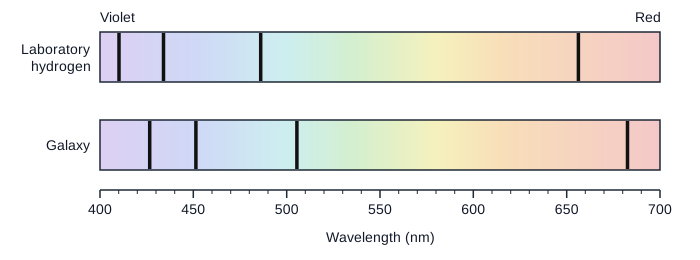
The diagram shows four dark lines in each spectrum, on the same wavelength scale.

Explain how the astronomer can tell from the diagram that:
• the four lines in the galaxy's spectrum are lines of hydrogen
• the galaxy is moving away from the Earth.

Two horizontal spectrum strips, one above the other, each shaded from violet on the left to red on the right, with a wavelength scale from 400 nm to 700 nm below them. The top strip, labelled Laboratory hydrogen, has four dark lines, at about 410 nm, 434 nm, 486 nm and 656 nm. The bottom strip, labelled Galaxy, has four dark lines, at about 427 nm, 451 nm, 506 nm and 683 nm.

Model answer

The four lines in the galaxy's spectrum have the same pattern as the hydrogen lines, in the same order and with almost the same gaps between them, but every line has moved by about the same fraction. All of the lines are at longer wavelengths, nearer the red end of the spectrum: for example, the line at 656 nm is at about 683 nm. The light is red-shifted, so the galaxy is moving away from the Earth.

Explanation

Each element absorbs light at its own set of wavelengths, so astronomers recognise an element in a galaxy from the pattern of its lines, even when the whole pattern has moved. A shift to longer wavelengths (red-shift) means that the source is moving away; a shift to shorter wavelengths would mean it is moving towards us. Saying only that 'the lines have moved' is not enough: the direction must be given.

Mark scheme
  1. 1 mark

    (hydrogen) the lines in the galaxy's spectrum have the same pattern as the laboratory hydrogen lines: the same order and (almost) the same spacing, but all moved / each line is shifted by about the same fraction

    ALLOW the gaps between the lines are (nearly) the same / the four lines have all moved by about the same proportion (about 4%). DO NOT ALLOW the lines are in the same places.

  2. 1 mark

    (moving away) all of the lines are at longer wavelengths / are shifted towards the red end of the spectrum, which is red-shift

    ALLOW use of data, for example the line at 656 nm is at about 683 nm in the galaxy's spectrum. ALLOW the light has a lower frequency. ALLOW 'the lines are red-shifted' only if the direction of the shift (towards the red end / longer wavelengths) is clear. DO NOT ALLOW the lines have moved to shorter wavelengths / towards the violet end.

Question 3

3 marks

In the Big Bang model, space expands. The distances between galaxies increase, but the total mass of the matter in a large region of space stays the same.

Today, a large cube-shaped region of space has sides of length 2.0 × 10²⁴ m. The mass of the matter in this region is 2.2 × 10⁴⁶ kg.

About 8 billion years ago, the sides of the same region were half as long as they are today.

Calculate the density of the matter in the region about 8 billion years ago.

Use the equation: density = mass ÷ volume

Model answer

side then = 2.0 × 10²⁴ ÷ 2 = 1.0 × 10²⁴ m
volume then = (1.0 × 10²⁴)³ = 1.0 × 10⁷² m³
density = mass ÷ volume = 2.2 × 10⁴⁶ ÷ 1.0 × 10⁷² = 2.2 × 10⁻²⁶ kg/m³
(This is 8 times today's density of 2.75 × 10⁻²⁷ kg/m³.)

Explanation

Halving every length divides the volume by 2 × 2 × 2 = 8, so with the same mass the density was 8 times greater; halving the volume instead is the commonest error. Going further back in time, the universe was denser and denser, which fits the Big Bang model of a universe that began very small, hot and dense.

Mark scheme
  1. 1 mark

    volume 8 billion years ago = (1.0 × 10²⁴)³ = 1.0 × 10⁷² m³; or a correct final answer of 2.2 × 10⁻²⁶ kg/m³ with no working

    An answer of 2.2 × 10⁻²⁶ kg/m³ with no working scores 3 marks. ALLOW the volume was one eighth of today's volume (8.0 × 10⁷² m³ ÷ 8). ALLOW 1 mark for 2.75 × 10⁻²⁷ kg/m³ / 2.8 × 10⁻²⁷ kg/m³ (today's volume used). ALLOW 1 mark for 5.5 × 10⁻²⁷ kg/m³ (today's volume halved instead of divided by 8).

  2. 1 mark

    substitution: density = 2.2 × 10⁴⁶ ÷ 1.0 × 10⁷²; or a correct final answer of 2.2 × 10⁻²⁶ kg/m³ with no working

    ALLOW ECF from their volume.

  3. 1 mark

    evaluation: 2.2 × 10⁻²⁶ (kg/m³)

    ALLOW 0.000 000 000 000 000 000 000 000 022 (kg/m³). IGNORE units unless the question asks for them.

Question 4

4 marks

A galaxy is 2.8 × 10²⁴ m from the Earth. The red-shift of its light shows that it is moving away from the Earth at a speed of 6300 km/s.

1 year = 3.2 × 10⁷ s

Calculate the increase in the galaxy's distance from the Earth in 100 years, as a percentage of its distance from the Earth now.

Use your answer to explain why astronomers find the speeds of galaxies from the red-shift of their light, instead of measuring how their distances change.

Model answer

speed = 6300 km/s = 6.3 × 10⁶ m/s; time = 100 × 3.2 × 10⁷ = 3.2 × 10⁹ s
increase in distance = speed × time = 6.3 × 10⁶ × 3.2 × 10⁹ = 2.0 × 10¹⁶ m
percentage = 2.0 × 10¹⁶ ÷ 2.8 × 10²⁴ × 100 = 7.2 × 10⁻⁷ %
In 100 years the distance changes by less than a millionth of one per cent. This is far too small to measure, because distances to galaxies are only known to within a few per cent. The red-shift can be measured from the galaxy's spectrum at any one time, so it gives the speed straight away.

Explanation

Convert to SI units before using distance = speed × time: km/s to m/s, and years to seconds. Forgetting to multiply the fraction by 100 is a common slip. The tiny answer shows why astronomers cannot watch galaxies moving apart: they rely on the red-shift of their light to find how fast each galaxy is moving away.

Mark scheme
  1. 1 mark

    conversions: speed = 6.3 × 10⁶ m/s and time = 100 × 3.2 × 10⁷ = 3.2 × 10⁹ s; or a correct final answer of 7.1 × 10⁻⁷ % to 7.2 × 10⁻⁷ % with no working

    An answer from 7.1 × 10⁻⁷ % to 7.2 × 10⁻⁷ % with no working scores marking points 1, 2 and 3. ALLOW 0.00000071 % to 0.00000072 %. ALLOW 2 marks for 7.1 × 10⁻⁹ to 7.2 × 10⁻⁹ (the fraction, not multiplied by 100). ALLOW 2 marks for 7.1 × 10⁻¹⁰ % to 7.2 × 10⁻¹⁰ % (speed not converted from km/s to m/s). ALLOW 2 marks for 2.2 × 10⁻¹⁴ % to 2.3 × 10⁻¹⁴ % (time left in years). ALLOW working in km throughout for marking point 1: time = 3.2 × 10⁹ s and distance now = 2.8 × 10²¹ km, with the speed left as 6300 km/s.

  2. 1 mark

    recall and use distance = speed × time: increase in distance = 6.3 × 10⁶ × 3.2 × 10⁹ = 2.0 × 10¹⁶ m; or a correct final answer of 7.1 × 10⁻⁷ % to 7.2 × 10⁻⁷ % with no working

    ALLOW 2.016 × 10¹⁶ m. ALLOW 2.0 × 10¹³ km (working in km). ALLOW ECF from incorrect conversions.

  3. 1 mark

    evaluation: (2.0 × 10¹⁶ ÷ 2.8 × 10²⁴ × 100 =) 7.1 × 10⁻⁷ to 7.2 × 10⁻⁷ (%)

    ALLOW ECF from their increase in distance.

  4. 1 mark

    the change in distance is far too small to measure (in a human lifetime) / is much smaller than the uncertainty in measuring a galaxy's distance, but red-shift can be measured from the galaxy's spectrum (in one observation) and gives its speed directly

    Both ideas are needed for this mark: the change in distance is too small to detect AND red-shift gives the speed from (an observation of) the spectrum. ALLOW ECF from their percentage if it is very small.

Ready to try the rest? Every answer you write is marked against the mark scheme, so you can see exactly where the marks are.

Study Helper Hints first, answers after you try

Stuck on this one? Ask for a hint and I’ll point you in the right direction, without giving the answer away. Once you’ve checked your answer, I’ll show you how the marks are awarded.