
Level:
Correct: 0
Incorrect: 0
Marks: 0/0
Exam Practice
Course:
Topics:
OCR GCSE Physics (Paper 4) Smart practice A mixed round aimed at your weak spots
Unit 5
Waves in matter
Unit 6
Radioactivity
Unit 7
Energy
Unit 8
Global challenges
Unit 9
Practical skills
Avg
score:
–
Topics
done:
0/33

Half-life

Practise 16 exam-style questions on Half-life for OCR GCSE Physics (Paper 4). Write your answer as you would in the exam and get it marked in seconds against the mark scheme, point by point, with the Study Helper on hand if you get stuck.

  • 16 questions
  • 1–6 marks each
  • Instant marking
  • No sign-up needed
16 questions, marked as you go

Sample questions with model answers

Here are 4 of the questions in this topic, each with a model answer, an explanation of why it earns the marks and the mark scheme an examiner would use.

Question 1

1 mark

Sample X and sample Y are both samples of radon-222. Sample X contains four times as many undecayed nuclei as sample Y.

Which statement compares the two samples correctly?

Choose your answer.

  • A X has a quarter of the half-life of Y, and four times the activity.
  • B X has four times the half-life of Y, and the same activity.
  • C X has the same half-life as Y, and four times the activity.
  • D X has the same half-life as Y, and the same activity.

Model answer

C

Explanation

Half-life is a property of the isotope, so it is the same for any amount of radon-222. Activity is the number of nuclei decaying each second; with four times as many undecayed nuclei, four times as many decay each second. Students often wrongly think a bigger sample takes longer to halve.

Mark scheme
  1. 1 mark

    C / X has the same half-life as Y, and four times the activity

    The only correct answer is C: both samples are the same isotope, so they have the same half-life; each nucleus has the same chance of decaying in a given time, so four times as many nuclei give four times as many decays per second. A is not correct because the half-life does not depend on the number of nuclei; B is not correct because the half-life is the same, and more nuclei give a greater activity; D is not correct because the activity is proportional to the number of undecayed nuclei, so X has the greater activity. ALLOW the letter or the option. If more than one option is given, do not award the mark.
Question 2

2 marks

A sealed source contains an isotope with a half-life of 30 years. A teacher places a Geiger-Müller tube near the source. The counter records these numbers of counts in five 10-second periods, one after another:

41   36   47   39   44

Explain why the counts are different, and why counting for a much longer time would give a more reliable value for the count rate.

Model answer

Radioactive decay is random: it is impossible to predict when any particular nucleus will decay, so the number of nuclei that happen to decay in each 10-second interval varies, even though the activity is almost constant. Counting for a much longer time records many more counts, so the random ups and downs average out and are a much smaller fraction of the total, giving a count rate closer to the true value.

Explanation

With a half-life of 30 years the activity cannot change noticeably in a minute, so the differences come from the random nature of decay. Random variations average out over a large number of counts, so a long count, or the mean of many readings, gives a more reliable count rate. Saying that a longer count is 'more accurate' without a reason gains no credit.

Mark scheme
  1. 1 mark

    radioactive decay is random: it is not possible to predict when each nucleus will decay, so the number of decays (detected) in each 10 s varies

    ALLOW the number of nuclei decaying each second varies randomly. IGNORE background radiation as the only reason. DO NOT ALLOW the activity or the half-life is changing (with a half-life of 30 years the activity hardly changes in a minute).

  2. 1 mark

    in a longer time many more counts are recorded, so the random variations average out / are a smaller fraction of the total (so the mean count rate is closer to the true value)

    ALLOW a mean of more readings is more reliable because the random variations average out. IGNORE 'more accurate' with no reason. DO NOT ALLOW counting for longer makes the decay less random.

Question 3

3 marks

Scandium-46 decays to titanium-46, which is stable. A sample contains only scandium-46 at the start.

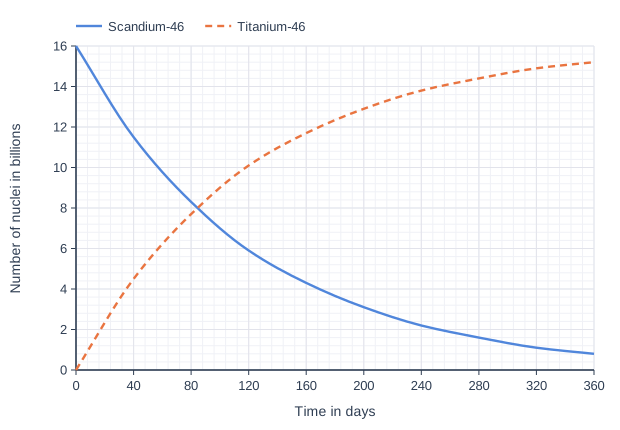
The graph shows how the numbers of scandium-46 nuclei and titanium-46 nuclei in the sample change with time.

Use the graph to determine the half-life of scandium-46.

Explain why the two lines cross at a time equal to the half-life.

Line graph of number of nuclei in billions (y-axis, 0 to 16) against time in days (x-axis, 0 to 360). "Scandium-46" is a smooth curve through (0, 16), (40, 11.5), (80, 8.3), (120, 5.9), (160, 4.3), (200, 3.1), (240, 2.2), (280, 1.6), (320, 1.1), (360, 0.8). "Titanium-46" (dashed) is a smooth curve through (0, 0), (40, 4.5), (80, 7.7), (120, 10.1), (160, 11.7), (200, 12.9), (240, 13.8), (280, 14.4), (320, 14.9), (360, 15.2).

Model answer

Half of the starting 16 billion scandium-46 nuclei is 8 billion. The scandium-46 line falls to 8 billion at about 84 days, where the two lines cross, so the half-life is about 84 days.
Every scandium-46 nucleus that decays becomes a stable titanium-46 nucleus, so the total number of nuclei stays at 16 billion. After one half-life, half of the scandium-46 nuclei have decayed, so there are 8 billion of each and the lines cross.

Explanation

Find half of the starting number of scandium-46 nuclei on the vertical axis and read across to the curve, then down to the time axis. Because each decay turns one scandium-46 nucleus into one titanium-46 nucleus, the numbers are equal when half of the scandium-46 has decayed, which is one half-life. Reading the time when the titanium-46 line reaches 16 billion, or halving the time axis, are common errors.

Mark scheme
  1. 1 mark

    reads the time at which the number of scandium-46 nuclei has fallen to 8 billion (half of 16 billion) / the time where the two lines cross; or a correct final answer from 80 to 88 days with no working

    An answer from 80 to 88 days with no working scores marking points 1 and 2. On the grid each large square is 40 days and 2 billion nuclei, divided into 5 small squares of 8 days and 0.4 billion nuclei.

  2. 1 mark

    half-life = 84 days (ALLOW 80 to 88 days)

    IGNORE units unless they are wrong.

  3. 1 mark

    each scandium nucleus that decays becomes a titanium nucleus, so the total number of nuclei stays the same; after one half-life half of the scandium nuclei have decayed, so there are equal numbers of scandium and titanium nuclei

    ALLOW the lines cross where each line is at half of the starting number of scandium nuclei. DO NOT ALLOW the titanium nuclei decay into scandium.

Question 4

4 marks

Some robots sent to the Moon were kept warm during the long lunar night by a heater containing polonium-210. Polonium-210 has a half-life of 138 days. The thermal power of the heater is proportional to the activity of the polonium-210.

At the start of a mission, the heater supplies a thermal power of 120 W.

414 days after the start of the mission, the heater warms a 2.0 kg aluminium block for 1.0 hour. Assume that all the energy from the heater is transferred to the block.

Specific heat capacity of aluminium = 900 J/kg °C

Calculate the increase in the block's temperature.

Use the equation: change in thermal energy = mass × specific heat capacity × change in temperature

Model answer

414 ÷ 138 = 3 half-lives, so the power falls to 120 ÷ 2 ÷ 2 ÷ 2 = 15 W.
energy transferred = power × time = 15 × 3600 = 54 000 J
change in temperature = change in thermal energy ÷ (mass × specific heat capacity) = 54 000 ÷ (2.0 × 900) = 30 °C

Explanation

First find how far the heater's power has fallen: three half-lives reduce it to one-eighth. Then the energy supplied in one hour is power × time, with the time in seconds, and the temperature rise comes from rearranging change in thermal energy = mass × specific heat capacity × change in temperature. Common errors are halving only once, using 120 W, or leaving the time in hours.

Mark scheme
  1. 1 mark

    414 ÷ 138 = 3 half-lives, so power = 120 ÷ 8 = 15 (W); or a correct final answer of 30 °C with no working

    An answer of 30 °C with no working scores 4 marks. ALLOW 3 marks (marking points 2, 3 and 4 by ECF) for 240 °C (power not reduced), 120 °C (one half-life only) or 60 °C (two half-lives). ALLOW 3 marks (marking points 1, 3 and 4 by ECF) for 0.0083 °C (time used as 1.0 hour, energy 15 J) or 0.5 °C (time used as 60 minutes, energy 900 J).

  2. 1 mark

    recall and substitution: energy transferred = power × time (E = P × t) = 15 × 3600 = 54 000 (J); or a correct final answer of 30 °C with no working

    1.0 hour = 3600 s. ALLOW 54 kJ.

  3. 1 mark

    rearrangement and substitution: change in temperature = 54 000 ÷ (2.0 × 900); or a correct final answer of 30 °C with no working

    ALLOW 54 000 = 2.0 × 900 × Δθ. ALLOW ECF from a wrong energy shown in the working.

  4. 1 mark

    evaluation: 30 (°C)

    IGNORE units unless they are wrong.

Ready to try the rest? Every answer you write is marked against the mark scheme, so you can see exactly where the marks are.

Study Helper Hints first, answers after you try

Stuck on this one? Ask for a hint and I’ll point you in the right direction, without giving the answer away. Once you’ve checked your answer, I’ll show you how the marks are awarded.