
Level:
Correct: 0
Incorrect: 0
Marks: 0/0
Exam Practice
Course:
Topics:
OCR GCSE Physics (Paper 4) Smart practice A mixed round aimed at your weak spots
Unit 5
Waves in matter
Unit 6
Radioactivity
Unit 7
Energy
Unit 8
Global challenges
Unit 9
Practical skills
Avg
score:
–
Topics
done:
0/33

Transverse and longitudinal waves

Practise 15 exam-style questions on Transverse and longitudinal waves for OCR GCSE Physics (Paper 4). Write your answer as you would in the exam and get it marked in seconds against the mark scheme, point by point, with the Study Helper on hand if you get stuck.

  • 15 questions
  • 1–6 marks each
  • Instant marking
  • No sign-up needed
15 questions, marked as you go

Sample questions with model answers

Here are 4 of the questions in this topic, each with a model answer, an explanation of why it earns the marks and the mark scheme an examiner would use.

Question 1

1 mark

A loudspeaker produces a sound wave with a frequency of 500 Hz. The sound travels through the air towards a listener.

Which statement describes the motion of the air particles caused by the sound wave?

Choose your answer.

  • A They move away from the loudspeaker at the speed of sound.
  • B They vibrate backwards and forwards along the direction of travel, 500 times each second.
  • C They vibrate up and down, at right angles to the direction of travel, 500 times each second.
  • D They vibrate backwards and forwards 500 times each second while drifting towards the listener.

Model answer

B (they vibrate backwards and forwards along the direction of travel, 500 times each second)

Explanation

In a longitudinal sound wave, each air particle vibrates backwards and forwards along the direction of travel about a fixed position, once for every wave that passes, so it vibrates at the frequency of the sound. The particles pass the vibration on but are not carried along. Up-and-down vibrations belong to transverse waves such as ripples.

Mark scheme
  1. 1 mark

    B / they vibrate backwards and forwards along the direction of travel, 500 times each second

    The only correct answer is B: sound in air is a longitudinal wave, so the air particles vibrate parallel to the direction the wave travels, about fixed positions, at the frequency of the wave (500 complete vibrations each second). A is not correct because the particles do not travel with the wave: the wave and its energy travel, not the air; C is not correct because vibrations at right angles to the direction of travel would make a transverse wave; D is not correct because the air is not carried towards the listener: each particle vibrates about the same position. ALLOW the letter or the option. If more than one option is given, do not award the mark.
Question 2

2 marks

A teacher uses ripples in a ripple tank as a model of transverse waves.

Give two reasons why ripples on water are a good model of transverse waves.

Model answer

The surface of the water vibrates up and down, at right angles to the direction in which the ripples travel across the tank, just as in any transverse wave. Also, the ripples move slowly and are large enough to see: a lamp above the tank shows the crests as bright lines on paper underneath, so the wavelength, frequency and speed can be measured.

Explanation

A model is useful when it behaves like the real thing and is easier to observe. Ripples have the defining feature of a transverse wave (vibration at right angles to travel) and are slow and visible, unlike light. Weak answers simply state that ripples are transverse without saying why.

Mark scheme
  1. 2 marks

    any two from: the water surface vibrates (up and down) at right angles to the direction the ripples travel / the ripples are slow enough and large enough to be seen and measured (wavelength, frequency, speed) / a lamp above the tank shows the crests as bright lines (wavefronts) on paper underneath, so the wave pattern can be seen / the ripples carry energy across the tank but the water stays in place (a floating object only bobs up and down) / ripples can show how waves are reflected or refracted

    1 mark for each different reason, max 2. ALLOW the frequency can be controlled (with a motor or signal generator). IGNORE 'water waves are transverse' with no reason.

Question 3

3 marks

People are standing close together in a long queue. Someone at the back trips and bumps into the person in front. Each person is pushed forwards into the next person and then steps back to their own place. A 'bump' travels along the queue to the front.

The bump can be used as a model of a wave.

State whether it is a model of a transverse wave or a longitudinal wave, and explain your answer. Explain how the model shows that a wave transfers energy without transferring matter.

Model answer

It is a model of a longitudinal wave, because each person moves forwards and backwards along the line of the queue, which is parallel to the direction in which the bump travels. Each person ends up back in their own place, so no one travels along the queue, but the bump - the energy of the push - is passed from person to person all the way to the front. In the same way a wave transfers energy without transferring matter.

Explanation

Decide the type by comparing the direction of the movement with the direction the disturbance travels: here both are along the queue, so it is longitudinal (like sound in air). The people act like particles of a medium, which vibrate about fixed positions. A common error is to say 'transverse' because the people are standing up.

Mark scheme
  1. 1 mark

    longitudinal

    DO NOT ALLOW transverse. Contradictory answers (both types named) score 0 for this mark.

  2. 1 mark

    each person moves forwards and backwards parallel to the direction the bump travels (along the queue)

    ALLOW the movement of the people is in the same direction as the wave travels / the direction of energy transfer. ALLOW people are pushed closer together, like a compression. This mark can be awarded even if the first mark is not.

  3. 1 mark

    each person ends up back in their own place / no person travels along the queue, but the bump (the energy) travels to the front

    ALLOW the people are like particles that only move a short distance about a fixed position, while the disturbance moves along. IGNORE 'the people do not move' (they do move a little).

Question 4

4 marks

Students measure the speed of sound on a large playing field. One student bangs two blocks of wood together. Other students stand at measured distances from her. Each one starts a stopwatch when they see the blocks hit and stops it when they hear the bang.

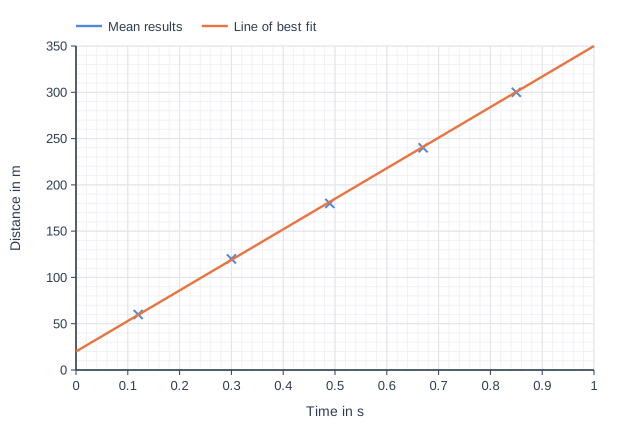
The graph shows the mean time measured at each distance, with a line of best fit. The line of best fit does not pass through the origin.

Determine the speed of sound from the graph. Explain why this value is more accurate than a value calculated from the result at 60 m alone.

Line graph of distance in m (y-axis, 0 to 350) against time in s (x-axis, 0 to 1). "Mean results" is shown as plotted points only (no line), at (0.12, 60), (0.3, 120), (0.49, 180), (0.67, 240), (0.85, 300). "Line of best fit" joins the points (0, 20), (1, 350).

Model answer

Gradient of the line of best fit, using the points (0, 20) and (1.0, 350):
speed = change in distance ÷ change in time = (350 − 20) ÷ (1.0 − 0) = 330 m/s
The line does not pass through the origin because every measured time has about the same error: here each time is about 0.06 s too short, for example because the students react more slowly to seeing the blocks hit than to hearing the bang. Using only the 60 m result gives 60 ÷ 0.12 = 500 m/s, because the 0.06 s error is a large fraction of a time of only 0.12 s. The gradient uses the change in distance divided by the change in time, so the same error in every time cancels out and the speed is much more accurate.

Explanation

On a distance-time graph the gradient is the speed. A systematic error that is the same in every reading moves the whole line, so it no longer passes through the origin, but it does not change the gradient. That is why plotting results at several distances and using the gradient gives a better value than one distance divided by one time, especially for short times.

Mark scheme
  1. 1 mark

    gradient of the line used, for example (350 − 20) ÷ (1.0 − 0) or (300 − 60) ÷ (0.85 − 0.12); or a correct final answer of 315 to 345 m/s with no working

    An answer from 315 to 345 m/s with no working scores marking points 1 and 2. ALLOW any two points on the line, or two results far apart. DO NOT ALLOW one distance divided by its own time (for example 60 ÷ 0.12 = 500 m/s or 300 ÷ 0.85 = 353 m/s) for this mark.

  2. 1 mark

    speed of sound = 330 (m/s)

    ALLOW 315 to 345 (m/s): the line of best fit gives 330 m/s, and results far apart give 324 to 333 m/s.

  3. 1 mark

    every measured time contains about the same (systematic) error, for example from the students' reaction times / every time is too short by about the same amount

    ALLOW the line does not go through the origin because every time is out by the same amount. ALLOW a correct reference to the size of the error (the line crosses the time axis about 0.06 s before zero / meets the distance axis at 20 m). ALLOW either direction for the error.

  4. 1 mark

    a gradient uses the change in distance ÷ the change in time, so a constant error in the times cancels out; one distance ÷ its own time includes the whole error, which is a large fraction of a short time

    ALLOW the result at 60 m alone gives 60 ÷ 0.12 = 500 m/s, which is far too high. ALLOW the gradient is not changed by an error that shifts every point by the same amount.

Ready to try the rest? Every answer you write is marked against the mark scheme, so you can see exactly where the marks are.

Study Helper Hints first, answers after you try

Stuck on this one? Ask for a hint and I’ll point you in the right direction, without giving the answer away. Once you’ve checked your answer, I’ll show you how the marks are awarded.