
Level:
Correct: 0
Incorrect: 0
Marks: 0/0
Exam Practice
Course:
Topics:
OCR GCSE Physics (Paper 4) Smart practice A mixed round aimed at your weak spots
Unit 5
Waves in matter
Unit 6
Radioactivity
Unit 7
Energy
Unit 8
Global challenges
Unit 9
Practical skills
Avg
score:
–
Topics
done:
0/33

Radiation emitted by bodies and the Earth's temperature

Practise 12 exam-style questions on Radiation emitted by bodies and the Earth's temperature for OCR GCSE Physics (Paper 4). Write your answer as you would in the exam and get it marked in seconds against the mark scheme, point by point, with the Study Helper on hand if you get stuck.

  • 12 questions
  • 1–6 marks each
  • Instant marking
  • No sign-up needed
12 questions, marked as you go

Sample questions with model answers

Here are 4 of the questions in this topic, each with a model answer, an explanation of why it earns the marks and the mark scheme an examiner would use.

Question 1

1 mark

Which object emits radiation with its greatest intensity at the longest wavelength?

Choose your answer.

  • A a lamp filament at 2500 °C
  • B a person's skin at 33 °C
  • C an electric hob ring at 700 °C
  • D the surface of the Sun at 5500 °C

Model answer

B

Explanation

All bodies emit radiation, even at everyday temperatures, and the wavelength of greatest intensity gets shorter as the temperature rises. So the coolest object, skin, has its peak at the longest wavelength, in the infrared. Students who think that only glowing objects emit radiation may wrongly rule out the skin.

Mark scheme
  1. 1 mark

    B / a person's skin at 33 °C

    The only correct answer is B: the lower the temperature of an object, the longer the wavelength at which it emits most intensely; skin at 33 °C emits most strongly in the infrared, at about 10 μm (1 × 10⁻⁵ m). A is not correct because a filament at 2500 °C emits most intensely at about 1 μm, a much shorter wavelength than skin; C is not correct because a hob ring at 700 °C emits most intensely at about 3 μm, still shorter than skin; D is not correct because the Sun's surface is the hottest, so its emission peaks at the shortest wavelength, about 500 nm. ALLOW the letter or the option. If more than one option is given, do not award the mark.
Question 2

2 marks

Some people claim that the rise in the Earth's mean surface temperature in recent decades has been caused by changes in the Sun.

NASA reports that satellites have measured the energy from the Sun reaching the Earth since 1978, and that there has been no upward trend. Between 1978 and 2024, the Earth's mean surface temperature rose by about 1 °C.

Explain whether this evidence supports the claim.

Suggest one other factor that could explain the rise in temperature.

Model answer

The evidence does not support the claim. If the Sun were the cause, more of its energy would have to be reaching the Earth, but the measurements show no upward trend while the temperature rose by about 1 °C.
Another factor is the increase in greenhouse gases, such as carbon dioxide, in the atmosphere. They absorb more of the infrared radiation emitted by the Earth's surface, so the Earth emits less radiation into space than it absorbs, and its temperature rises.

Explanation

The Earth's temperature depends on the balance between the radiation it absorbs from the Sun and the radiation it emits into space. If the incoming energy has not increased, the warming must come from a change on the Earth's side of the balance, such as more greenhouse gases reducing the radiation that escapes. Simply stating 'it is not the Sun' without using the evidence scores nothing.

Mark scheme
  1. 1 mark

    the evidence does not support the claim: the energy from the Sun reaching the Earth has not increased, but the temperature has risen, so the rise must have another cause

    ALLOW for the Sun to cause the rise, more energy from the Sun would have to reach (and be absorbed by) the Earth. A statement that the evidence does not support the claim, without a reason, does not score.

  2. 1 mark

    more greenhouse gases (such as carbon dioxide or methane) in the atmosphere absorb more of the infrared radiation emitted by the Earth's surface, so less radiation escapes into space / the Earth emits less radiation than it absorbs

    ALLOW more carbon dioxide (from burning fossil fuels) in the atmosphere / an increased greenhouse effect. ALLOW less ice and snow, so the Earth reflects less and absorbs more of the Sun's radiation. IGNORE pollution / the ozone layer / global warming (on their own).

Question 3

3 marks

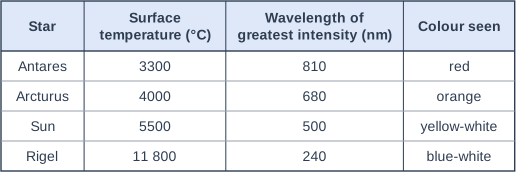
The table shows data for four stars. The wavelength of greatest intensity is the wavelength at which a star emits the most radiation. Visible light has wavelengths from about 400 nm (violet) to about 700 nm (red).

Describe the relationship between the surface temperature of a star and its wavelength of greatest intensity.

Antares emits most strongly in the infrared, but it looks red. Rigel emits most strongly in the ultraviolet, but it looks blue-white. Explain why each of these two stars has the colour seen.

Table with columns "Star", "Surface temperature (°C)", "Wavelength of greatest intensity (nm)", "Colour seen". Star: Antares; Surface temperature (°C): 3300; Wavelength of greatest intensity (nm): 810; Colour seen: red | Star: Arcturus; Surface temperature (°C): 4000; Wavelength of greatest intensity (nm): 680; Colour seen: orange | Star: Sun; Surface temperature (°C): 5500; Wavelength of greatest intensity (nm): 500; Colour seen: yellow-white | Star: Rigel; Surface temperature (°C): 11 800; Wavelength of greatest intensity (nm): 240; Colour seen: blue-white.

Model answer

The higher the surface temperature, the shorter the wavelength of greatest intensity: it falls from 810 nm for Antares at 3300 °C to 240 nm for Rigel at 11 800 °C.
Both stars emit a continuous range of wavelengths, including the whole visible range. Antares's peak is at 810 nm, beyond the red end, so across the visible range its intensity is greatest at the red end: it gives out more red light than blue light, so it looks red. Rigel's peak is at 240 nm, beyond the violet end, so it gives out more blue and violet light than red light; it still emits all the colours, so it looks blue-white.

Explanation

The colour of a hot object depends on the mix of visible wavelengths it emits, not only on where its peak is. Because the emission is a continuous range, a star whose peak lies just outside the visible range still emits plenty of visible light, weighted towards the side nearer the peak. Saying that a red star emits only red light is a common error.

Mark scheme
  1. 1 mark

    the higher the surface temperature, the shorter the wavelength of greatest intensity / ORA (allow the reverse argument)

    ALLOW use of data, for example Antares at 3300 °C has its greatest intensity at 810 nm and Rigel at 11 800 °C at 240 nm. IGNORE (inversely) proportional. DO NOT ALLOW a hotter star has a longer wavelength of greatest intensity.

  2. 1 mark

    Antares emits a continuous range of wavelengths, including visible light; its greatest intensity is beyond the red end, so in the visible range it emits more red (longer-wavelength) light than blue or violet light

    ALLOW the intensity of its visible light increases towards the red end. The idea that it emits more red light than blue (or other colours) is needed. DO NOT ALLOW it emits only red light.

  3. 1 mark

    Rigel's greatest intensity is beyond the violet end, so in the visible range it emits more blue and violet (shorter-wavelength) light than red light (but it emits all of the visible colours, so it looks blue-white)

    ALLOW the intensity of its visible light increases towards the blue / violet end. DO NOT ALLOW it emits only blue light.

Question 4

5 marks

A student places a thin metal plate under an infrared lamp.

• The plate is made of aluminium, has a mass of 0.040 kg and is painted matt black.
• In the first 30 s after the lamp is switched on, the temperature of the plate rises from 20.0 °C to 26.0 °C.
• After about 15 minutes, the temperature of the plate is steady at 55 °C. The student then switches off the lamp.

The specific heat capacity of aluminium is 900 J/kg °C.

Assume that the plate absorbs energy from the lamp at a constant rate while the lamp is on, that it loses almost no energy to its surroundings during the first 30 s, and that it absorbs no energy from the lamp after the lamp is switched off.

Use the equations:
change in thermal energy = mass × specific heat capacity × change in temperature
energy transferred = power × time

Calculate the rate at which the plate absorbs energy from the lamp.

Use your answer to estimate the rate at which the temperature of the plate falls, in °C/s, just after the lamp is switched off. Explain your reasoning.

Model answer

change in thermal energy = 0.040 × 900 × (26.0 − 20.0) = 216 J
power = energy ÷ time = 216 ÷ 30 = 7.2 W, so the plate absorbs energy from the lamp at 7.2 W.

At 55 °C the temperature of the plate is steady, so it loses energy to its surroundings (by emitting radiation and heating the air) at the same rate as it absorbs energy from the lamp: 7.2 W.
Just after the lamp is switched off, the plate is still at 55 °C, so it still loses energy at 7.2 W, but it no longer absorbs any energy from the lamp. Its thermal energy store decreases by 7.2 J every second.
fall in temperature each second = 7.2 ÷ (0.040 × 900) = 7.2 ÷ 36 = 0.20 °C/s
This is the same rate at which the temperature rose at the start. As the plate cools, it emits energy more slowly, so the rate of fall then gets smaller.

Explanation

At first almost all the absorbed energy goes into the plate's thermal store, so the temperature rise gives the power absorbed: change in thermal energy = m × c × Δθ, then power = energy ÷ time; using 26.0 °C instead of the change of 6.0 °C is a common slip. At the steady temperature the rate of energy loss equals the rate of absorption, and the rate of loss depends on the plate's temperature, so just after the lamp goes off the plate still loses 7.2 W with nothing coming in. A common mistake is to think that a body at a steady temperature has stopped emitting radiation.

Mark scheme
  1. 1 mark

    change in thermal energy in the first 30 s = 0.040 × 900 × 6.0 = 216 (J); or a correct final answer of 7.2 W with no working

    An answer of 7.2 W with no working scores marking points 1 and 2. An answer of 0.20 °C/s with no working scores marking point 5 only: marking points 3 and 4 are for the reasoning, which must be given. A value of 216 J on its own scores marking point 1 only. ALLOW ECF for marking point 2 from an incorrect change in temperature (for example 936 J from 26.0 °C gives 31 W, which scores marking point 2).

  2. 1 mark

    evaluation: rate at which the plate absorbs energy = 216 ÷ 30 = 7.2 (W); or a correct final answer of 7.2 W with no working

    ALLOW ECF from their energy. IGNORE units unless the question asks for them.

  3. 1 mark

    at the steady temperature the plate loses energy to its surroundings (by emitting radiation and heating the air) at the same rate as it absorbs energy from the lamp, so it loses energy at the rate found in the first calculation

    That is, 7.2 W (ALLOW ECF from their rate of absorption). ALLOW the rate of emission (and other losses) balances the rate of absorption, so there is no net gain of energy. DO NOT ALLOW the plate stops absorbing or emitting radiation when its temperature is steady.

  4. 1 mark

    just after the lamp is switched off, the plate is still at the same temperature, so it still loses energy at this rate, but it no longer absorbs energy from the lamp, so its thermal energy store decreases at this rate

    ALLOW the net rate of loss of energy just after the lamp is switched off is 7.2 W (or their value). ALLOW the reasoning that, just after the lamp is switched off, the plate loses energy at the same rate as it gained energy just after the lamp was switched on, so its temperature falls at the rate at which it first rose. A calculation on its own does not score this mark: the reasoning must be stated.

  5. 1 mark

    evaluation: rate of fall of temperature = 7.2 ÷ (0.040 × 900) = 0.20 (°C/s)

    ALLOW 0.2 °C/s or 12 °C per minute. ALLOW 6.0 ÷ 30 = 0.20 °C/s (the rate at which the temperature first rose). ALLOW ECF from their rate in marking point 2.

Ready to try the rest? Every answer you write is marked against the mark scheme, so you can see exactly where the marks are.

Study Helper Hints first, answers after you try

Stuck on this one? Ask for a hint and I’ll point you in the right direction, without giving the answer away. Once you’ve checked your answer, I’ll show you how the marks are awarded.