
Level:
Correct: 0
Incorrect: 0
Marks: 0/0
Exam Practice
Course:
Topics:
OCR GCSE Physics (Paper 4) Smart practice A mixed round aimed at your weak spots
Unit 5
Waves in matter
Unit 6
Radioactivity
Unit 7
Energy
Unit 8
Global challenges
Unit 9
Practical skills
Avg
score:
–
Topics
done:
0/33

Energy resources and trends in their use

Practise 16 exam-style questions on Energy resources and trends in their use for OCR GCSE Physics (Paper 4). Write your answer as you would in the exam and get it marked in seconds against the mark scheme, point by point, with the Study Helper on hand if you get stuck.

  • 16 questions
  • 1–6 marks each
  • Instant marking
  • No sign-up needed
16 questions, marked as you go

Sample questions with model answers

Here are 4 of the questions in this topic, each with a model answer, an explanation of why it earns the marks and the mark scheme an examiner would use.

Question 1

1 mark

When a large power station suddenly breaks down, other power stations must increase the electricity they generate within a few minutes.

Which energy resource is used in power stations whose output can be increased within a few minutes, whatever the weather?

Choose your answer.

  • A hydroelectricity
  • B nuclear fuel
  • C the Sun
  • D wind

Model answer

A

Explanation

A hydroelectric power station stores energy in the gravitational potential energy store of water in its reservoir, so it can be switched on or turned up quickly by opening the gates to the turbines. Wind and solar outputs depend on the weather, not on the demand for electricity. Nuclear power stations are slow to change their output, so they are best for supplying a steady amount of electricity all the time.

Mark scheme
  1. 1 mark

    A / hydroelectricity

    The only correct answer is A: in a hydroelectric power station, water stored in a reservoir can be released through the turbines as soon as it is needed, so the output can be increased within minutes. B is not correct because the output of a nuclear power station can only be changed slowly, over hours, so nuclear power stations are run at a steady output. C is not correct because the output of solar cells depends on the amount of sunlight, which cannot be increased when it is needed. D is not correct because the output of wind turbines depends on the wind speed, which cannot be increased when it is needed. ALLOW the letter or the option. If more than one option is given, do not award the mark.
Question 2

2 marks

On a dairy farm, cow manure is kept in a sealed tank, where bacteria break it down. This produces biogas, which is mainly methane. The farm burns the biogas in an engine that turns a generator.

Natural gas is also mainly methane.

Give one similarity and one difference between using biogas and using natural gas to generate electricity.

Model answer

Similarity: both are burned, and both release carbon dioxide when they are burned.
Difference: biogas is renewable, because the cows keep producing manure, but natural gas is a fossil fuel that took millions of years to form, so it is non-renewable and will run out.

Explanation

Biogas and natural gas are both mostly methane, so they are used in the same way: burned to release energy, producing carbon dioxide. The difference is where they come from. Biogas is a biofuel made continuously from waste, while natural gas is a fossil fuel that is not being replaced. Repeating that both are methane does not score, because the question gives it.

Mark scheme
  1. 1 mark

    (similarity) both are burned (to release energy) / both release carbon dioxide when they are burned / both can be used to generate electricity whenever it is needed (whatever the weather)

    Max 1 if the answer gives only similarities or only differences. ALLOW both release energy from a chemical store. ALLOW both can be stored until they are needed. IGNORE 'both are gases' or 'both are methane' (given in the question).

  2. 1 mark

    (difference) biogas is renewable / is made again as fast as it is used (the cows keep producing manure), but natural gas is non-renewable / took millions of years to form / will run out

    ALLOW ORA (allow the reverse argument). ALLOW the carbon dioxide released by biogas was taken from the air recently by the grass that the cows ate, so it adds little extra carbon dioxide overall, but natural gas releases carbon dioxide that was locked away for millions of years. ALLOW natural gas is a fossil fuel but biogas is a biofuel. IGNORE 'biogas is cheaper' or 'biogas is better for the environment' with no reason.

Question 3

3 marks

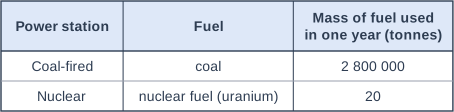
An engineer compares a coal-fired power station and a nuclear power station. Both have the same electrical power output.

The table shows the engineer's estimates of the mass of fuel each power station uses in one year.

Calculate how many times greater the mass of coal is than the mass of nuclear fuel.

Use the data to suggest one advantage of using nuclear fuel instead of coal. Give one disadvantage of using nuclear fuel instead of coal.

Table with columns "Power station", "Fuel", "Mass of fuel used in one year (tonnes)". Power station: Coal-fired; Fuel: coal; Mass of fuel used in one year (tonnes): 2 800 000 | Power station: Nuclear; Fuel: nuclear fuel (uranium); Mass of fuel used in one year (tonnes): 20.

Model answer

2 800 000 ÷ 20 = 140 000, so the mass of coal is 140 000 times greater.
Advantage: far less nuclear fuel is needed for the same output, so much less fuel has to be mined, transported to the power station and stored there.
Disadvantage: a nuclear power station produces radioactive waste, which stays dangerous for thousands of years and must be stored securely.

Explanation

Divide the larger mass by the smaller one: each kilogram of nuclear fuel releases far more energy than a kilogram of coal. The advantage must use this data, so it is about mining, transporting and storing much less fuel. 'Non-renewable' is not a disadvantage of nuclear fuel compared with coal, because coal is non-renewable too; the radioactive waste is the key disadvantage.

Mark scheme
  1. 1 mark

    2 800 000 ÷ 20 = 140 000 (times)

    An answer of 140 000 with no working scores marking point 1. ALLOW 1.4 × 10⁵ (typed as 1.4E5, or 1.4 times 10 to the power 5). DO NOT ALLOW 0.000 007 (the ratio the wrong way round).

  2. 1 mark

    (advantage) much less fuel needs to be mined / transported / stored (for the same electrical output)

    The advantage must come from the data (the much smaller mass of fuel). ALLOW far fewer trains, ships or lorries are needed to deliver the fuel. ALLOW less land is damaged by mining. IGNORE 'it releases no carbon dioxide' for this mark (it does not use the data), but do not treat it as a contradiction.

  3. 1 mark

    (disadvantage) it produces radioactive waste that stays dangerous for a very long time / must be stored securely for thousands of years

    ALLOW there is a (small) risk of an accident that releases radioactive material. ALLOW nuclear power stations are very expensive to build or to take apart (decommission) at the end of their lives. ALLOW the output of a nuclear power station cannot be changed quickly. IGNORE 'it is non-renewable' (coal is also non-renewable). DO NOT ALLOW 'it releases carbon dioxide' or 'it causes acid rain'.

Question 4

4 marks

Water from a reservoir flows through the turbines of a hydroelectric power station.

• 1.5 m³ of water flows through the turbines each second.
• The water falls through a vertical height of 68 m before it reaches the turbines.
• The density of water is 1000 kg/m³.
• The efficiency of the power station is 0.85.

Gravitational field strength = 10 N/kg

Calculate the electrical power output of the power station in kW.

Model answer

Mass of water each second = density × volume = 1000 × 1.5 = 1500 kg
GPE transferred each second = m × g × h = 1500 × 10 × 68 = 1 020 000 J
So the input power = 1 020 000 W
Useful output power = efficiency × input power = 0.85 × 1 020 000 = 867 000 W
= 867 kW

Explanation

Work out the mass of water falling each second from its density, then the gravitational potential energy it loses each second: the energy transferred per second is the input power. Multiply by the efficiency to find the useful electrical output, and convert watts to kilowatts. Common errors are forgetting the efficiency, dividing by it, or leaving the answer in watts.

Mark scheme
  1. 1 mark

    mass of water each second = density × volume = 1000 × 1.5 = 1500 (kg); or a correct final answer of 867 kW with no working

    An answer of 867 kW (or 870 kW) with no working scores 4 marks. ALLOW use of 9.8 N/kg, which gives 850 kW (849.66 kW) for 4 marks. ALLOW 3 marks for 1020 kW (efficiency not used). ALLOW 3 marks for 867 000 W (not converted to kW). ALLOW 2 marks for 1200 kW (divided by the efficiency instead of multiplying).

  2. 1 mark

    gravitational potential energy transferred each second = mass × gravitational field strength × height = 1500 × 10 × 68 = 1 020 000 (J); or a correct final answer of 867 kW with no working

    ALLOW 1 020 000 W / 1020 kW as the input power. ALLOW ECF from a wrong mass shown in the working. ALLOW 999 600 J if 9.8 N/kg is used.

  3. 1 mark

    useful (electrical) power output = 0.85 × 1 020 000 = 867 000 (W); or a correct final answer of 867 kW with no working

    ALLOW efficiency = useful output ÷ input, rearranged. ALLOW ECF from a wrong input power shown in the working. ALLOW 849 660 W if 9.8 N/kg is used.

  4. 1 mark

    867 (kW)

    ALLOW 870 (kW). ALLOW 850 or 849.66 (kW) if 9.8 N/kg is used. ALLOW ECF for the conversion to kW from a wrong value in W shown in the working.

Ready to try the rest? Every answer you write is marked against the mark scheme, so you can see exactly where the marks are.

Study Helper Hints first, answers after you try

Stuck on this one? Ask for a hint and I’ll point you in the right direction, without giving the answer away. Once you’ve checked your answer, I’ll show you how the marks are awarded.