Level:
Correct: 0
Incorrect: 0
Marks: 0/0
Exam Practice
Course:
Topics:
OCR GCSE Physics (Paper 4) Smart practice A mixed round aimed at your weak spots
Unit 5
Waves in matter
Unit 6
Radioactivity
Unit 7
Energy
Unit 8
Global challenges
Unit 9
Practical skills
Avg
score:
–
Topics
done:
0/33

Ray diagrams, lenses and colour

Practise 15 exam-style questions on Ray diagrams, lenses and colour for OCR GCSE Physics (Paper 4). Write your answer as you would in the exam and get it marked in seconds against the mark scheme, point by point, with the Study Helper on hand if you get stuck.

  • 15 questions
  • 1–6 marks each
  • Instant marking
  • No sign-up needed
15 questions, marked as you go

Sample questions with model answers

Here are 4 of the questions in this topic, each with a model answer, an explanation of why it earns the marks and the mark scheme an examiner would use.

Question 1

1 mark

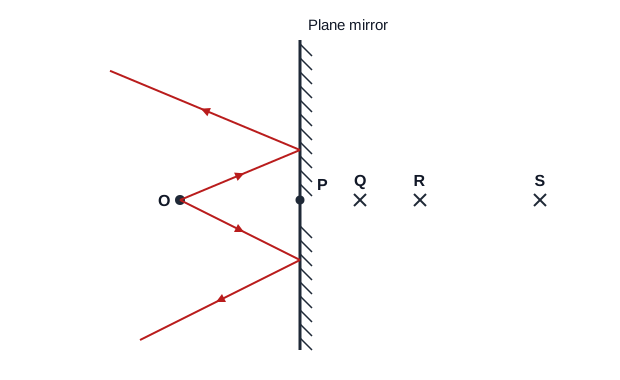
A student draws a ray diagram to find the image of a small object, O, in a plane mirror. The diagram shows two rays from O that are reflected by the mirror.

Points P, Q, R and S are on a line through O at 90° to the mirror. Point P is on the surface of the mirror.

Which point shows the position of the image of O?

Choose your answer.

  • A P
  • B Q
  • C R
  • D S
A ray diagram. A vertical plane mirror has its back shaded on the right. A small object, O, is on the left, in front of the mirror. Two rays go from O to the mirror, one to a point above O and one to a point below O, and are reflected back to the left. Four points lie on a horizontal line through O: P is on the mirror; Q is behind the mirror, half as far from it as O is in front of it; R is behind the mirror, as far from it as O is in front of it; S is behind the mirror, twice as far from it as O is in front of it.

Model answer

C: R

Explanation

To find the image, extend the two reflected rays backwards behind the mirror (as dashed lines): they meet at the point the reflected light appears to come from. For a plane mirror this point is on the line through the object at 90° to the mirror, and as far behind the mirror as the object is in front of it. The image is virtual, because no light actually reaches it.

Mark scheme
  1. 1 mark

    C / R

    The only correct answer is C: the image in a plane mirror is on the line through the object at 90° to the mirror, the same distance behind the mirror as the object is in front of it; the two reflected rays, extended backwards behind the mirror, meet at R. A is not correct because the image is not on the surface of the mirror: P is only where the line through O meets the mirror. B is not correct because Q is only half as far behind the mirror as O is in front of it. D is not correct because S is twice as far behind the mirror as O is in front of it. ALLOW the letter or the option. If more than one option is given, do not award the mark.
Question 2

2 marks

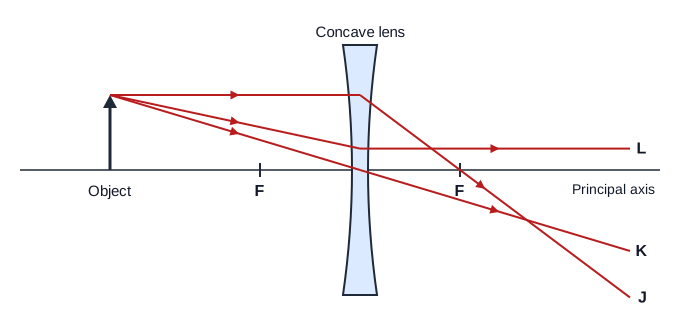
The diagram shows a concave lens and three rays, J, K and L, that start from the top of an object. F marks the principal focus on each side of the lens.

Before it reaches the lens, ray J is parallel to the principal axis, ray K is travelling towards the centre of the lens, and ray L is travelling towards the principal focus F on the right of the lens.

One of the rays has been drawn wrongly after it passes through the lens.

Give the letter of this ray, and describe the path it should take after it passes through the lens.

A ray diagram. A concave lens stands on a horizontal principal axis, with F marked on the axis on each side of the lens, the same distance from it. An upright object arrow stands on the axis on the left, further from the lens than F. Three rays, J, K and L, go from the top of the object to the lens and continue to the right of it. J reaches the lens parallel to the axis; after the lens it slopes down, crosses the axis at the F on the right and continues below the axis. K travels towards the centre of the lens and continues in a straight line, sloping down. L reaches the lens slightly above the axis, travelling towards the F on the right; after the lens it travels parallel to the axis.

Model answer

Ray J. After the lens, J should bend away from the principal axis (diverge), travelling as if it came from the principal focus F on the left of the lens.

Explanation

A concave lens makes rays diverge. A ray parallel to the principal axis leaves the lens moving away from the axis, along a line that comes from the principal focus on the same side as the object; ray J has been drawn as if the lens were convex. Rays K and L are correct: the ray through the centre does not change direction, and the ray travelling towards the far principal focus leaves parallel to the axis.

Mark scheme
  1. 1 mark

    J

    If more than one letter is given, do not award this mark.

  2. 1 mark

    (after the lens J should) bend away from the principal axis / diverge, travelling as if it came from the principal focus F on the left (the same side as the object)

    This mark can only be awarded if J is given. ALLOW 'it should spread out away from the axis, along a line from F on the left through the point where J meets the lens'. 'Bends upwards (away from the axis)' scores without F. DO NOT ALLOW 'it should pass through F on the right' (this is how J has been drawn). IGNORE references to rays K and L.

Question 3

3 marks

Molecules in the air scatter some of the sunlight that passes through the atmosphere, sending it in all directions. They scatter short wavelengths, such as blue light, much more than long wavelengths, such as red light.

At sunset, light from the Sun travels through a much greater thickness of air to reach an observer than it does at midday.

Explain why the sky looks blue at midday, and why the Sun looks orange-red at sunset.

Model answer

Sunlight is white light, a mixture of all the colours. As it passes through the air, the molecules scatter blue light much more than the other colours, sending it in all directions. So when you look at any part of the sky away from the Sun, scattered blue light reaches your eyes and the sky looks blue.

At sunset, light from the Sun travels through a much greater thickness of air, so almost all of the blue light, and much of the green, is scattered out of the beam before it reaches you. The light that comes straight from the Sun is then mainly red and orange light, the long wavelengths that are scattered least, so the Sun looks orange-red.

Explanation

The colours we see depend on which wavelengths are scattered and which are transmitted. Short wavelengths (blue) are scattered most, so they reach us from all over the sky; long wavelengths (red) are transmitted best, so they make up most of the direct light from the Sun after a long path through the air. A common error is to say that the air 'turns' the light blue or red: scattering only changes the direction of the light.

Mark scheme
  1. 1 mark

    blue light is scattered (in all directions) much more than the other colours in sunlight, so scattered blue light reaches the eye from all parts of the sky, not just from the direction of the Sun, so the sky looks blue

    ALLOW 'wherever you look in the sky, you see blue light that has been scattered towards you'. IGNORE repeats of the information in the question (that the air scatters blue light more than red light) on their own: the idea that scattered blue light reaches the eye from all directions (all over the sky) is needed. IGNORE references to violet light. DO NOT ALLOW 'the air reflects blue light from the sea' or 'the air turns the light blue'.

  2. 1 mark

    at sunset the light passes through more air, so (almost) all of the blue light (and much of the green) is scattered out of the light travelling directly from the Sun

    ALLOW 'the blue light is removed / scattered away before it reaches the observer'.

  3. 1 mark

    so the light that reaches the eye directly from the Sun is mainly red and orange light: the long wavelengths, which are scattered least / are transmitted through the air

    ALLOW 'red light is scattered least, so most of it gets through'.

Question 4

5 marks

A camping solar shower is a black plastic bag of water that is hung up in sunshine. A flat sheet of smooth, polished aluminium is set up beside the bag and angled so that it reflects extra sunlight onto the bag.

The bag contains 8.0 kg of water at 15 °C. The bag absorbs energy from the sunlight at a rate of 280 W. Assume that all of this energy heats the water.

Specific heat capacity of water = 4200 J/kg °C

Use the equations:
change in thermal energy = mass × specific heat capacity × change in temperature
energy transferred = power × time

Calculate the time taken for the water to reach 39 °C. Give your answer in minutes.

Explain why the bag is black and why the aluminium sheet is smooth.

Model answer

Change in thermal energy = 8.0 × 4200 × (39 − 15) = 8.0 × 4200 × 24 = 806 400 J
Time = energy ÷ power = 806 400 ÷ 280 = 2880 s
2880 ÷ 60 = 48 minutes

The bag is black because a black surface absorbs almost all the colours of light that fall on it and reflects very little, so as much energy as possible is transferred to the water. The aluminium sheet is smooth so that it gives specular reflection: parallel rays of sunlight are all reflected in the same direction, so the sheet can be angled to send the light onto the bag. A rough sheet would scatter the light in all directions and much of it would miss the bag.

Explanation

The temperature change is 39 − 15 = 24 °C, not 39 °C: using the final temperature is a common error. Rearrange energy transferred = power × time to find the time in seconds, then divide by 60 to give minutes. The design uses two ideas about light: a black surface absorbs all wavelengths, and a smooth surface reflects light in one direction instead of scattering it.

Mark scheme
  1. 1 mark

    change in thermal energy = 8.0 × 4200 × (39 − 15) = 806 400 (J); or a correct final answer of 48 minutes with no working

    An answer of 48 minutes with no working scores marking points 1, 2 and 3. ALLOW 806 000 J or 8.06 × 10⁵ J. ALLOW ECF from a wrong change in temperature for marking points 2 and 3: for example 8.0 × 4200 × 39 = 1 310 400 J, giving 4680 s = 78 minutes, scores marking points 2 and 3. ALLOW 2 marks for 2880 s (not converted to minutes).

  2. 1 mark

    time = 806 400 ÷ 280 = 2880 (s); or a correct final answer of 48 minutes with no working

    ALLOW 2879 s (from 806 000 J).

  3. 1 mark

    evaluation: 48 (minutes)

    ALLOW 48.0 minutes. ALLOW ECF from a wrong time in seconds correctly divided by 60.

  4. 1 mark

    black: the bag absorbs (almost) all the colours / wavelengths of light that fall on it and reflects very little, so it absorbs as much of the energy as possible

    ALLOW 'black absorbs the most light (radiation)'. DO NOT ALLOW 'black attracts heat (or light)'. IGNORE ideas about emitting radiation.

  5. 1 mark

    a smooth sheet gives specular reflection, so the (parallel) rays of sunlight are all reflected in the same direction, onto the bag / a rough (matt) sheet would scatter the light in all directions, so much of it would miss the bag

    ALLOW 'every ray is reflected at the same angle as it hits, so the sheet can be angled to send all the light to the bag'. IGNORE 'a smooth sheet is shinier' on its own.

Ready to try the rest? Every answer you write is marked against the mark scheme, so you can see exactly where the marks are.

Study Helper Hints first, answers after you try

Stuck on this one? Ask for a hint and I’ll point you in the right direction, without giving the answer away. Once you’ve checked your answer, I’ll show you how the marks are awarded.