
Level:
Correct: 0
Incorrect: 0
Marks: 0/0
Exam Practice
Course:
Topics:
OCR GCSE Physics (Paper 4) Smart practice A mixed round aimed at your weak spots
Unit 5
Waves in matter
Unit 6
Radioactivity
Unit 7
Energy
Unit 8
Global challenges
Unit 9
Practical skills
Avg
score:
–
Topics
done:
0/33

Describing waves and wave speed

Practise 18 exam-style questions on Describing waves and wave speed for OCR GCSE Physics (Paper 4). Write your answer as you would in the exam and get it marked in seconds against the mark scheme, point by point, with the Study Helper on hand if you get stuck.

  • 18 questions
  • 1–6 marks each
  • Instant marking
  • No sign-up needed
18 questions, marked as you go

Sample questions with model answers

Here are 4 of the questions in this topic, each with a model answer, an explanation of why it earns the marks and the mark scheme an examiner would use.

Question 1

1 mark

A sensor at one point in a ripple tank records how the height of the water surface changes as ripples pass. A data logger shows the readings as a graph of the displacement of the water surface against time.

Which two quantities can both be found from this graph alone?

Choose your answer.

  • A amplitude and frequency
  • B amplitude and wavelength
  • C frequency and wavelength
  • D wavelength and wave speed

Model answer

A (amplitude and frequency)
Amplitude: the maximum displacement shown on the graph.
Frequency: read the period (the time between neighbouring peaks), then frequency = 1 ÷ period.

Explanation

A displacement-time graph follows one point on the wave as time passes, so the spacing of its peaks is the period, not the wavelength. The wavelength can only be read from a displacement-distance graph, which shows the whole wave at one instant. Confusing the two kinds of graph is a very common error.

Mark scheme
  1. 1 mark

    A / amplitude and frequency

    The only correct answer is A: the amplitude is the greatest displacement shown on the graph, and the time between neighbouring peaks is the period, so frequency = 1 ÷ period. B is not correct because the wavelength is a distance, which needs a graph of displacement against distance, not against time; C is not correct because the time between neighbouring peaks on a time axis is the period, not the wavelength; D is not correct because neither the wavelength nor the wave speed can be found without a distance measurement. ALLOW the letter or the option. If more than one option is given, do not award the mark.
Question 2

2 marks

A tuning fork vibrates and produces a sound wave in the air. The period of the sound wave is 2.0 ms.

Use the definitions of period and frequency to explain why the frequency of the sound wave is 500 Hz.

Model answer

The period is the time taken for one complete wave to pass a point, so one complete wave passes every 2.0 ms (0.0020 s). The frequency is the number of complete waves that pass a point each second. In one second, 1 ÷ 0.0020 = 500 complete waves pass, so the frequency is 500 Hz.

Explanation

Period and frequency are two ways of describing the same thing: how often complete waves pass. If each wave takes 0.0020 s, then 500 of them fit into one second. Remember to convert milliseconds to seconds (or count the milliseconds in one second); just quoting 'frequency = 1 ÷ period' does not use the definitions.

Mark scheme
  1. 1 mark

    the period is the time taken for one complete wave to pass a point / for one complete oscillation (vibration)

    ALLOW the time for one cycle / for one complete wave to be produced. DO NOT ALLOW 'the time taken for a wave' with no idea of one complete wave.

  2. 1 mark

    the frequency is the number of (complete) waves passing a point each second, and 1 s ÷ 0.0020 s = 500, so 500 waves pass each second

    The definition of frequency and the link to 500 are both needed for this mark. ALLOW 1000 ms ÷ 2.0 ms = 500 (waves in one second). ALLOW the number of oscillations (vibrations) each second. DO NOT ALLOW frequency = 1 ÷ period on its own, with no definition of frequency.

Question 3

3 marks

A tin whistle can play notes with frequencies from 0.59 kHz to 2.35 kHz. The speed of sound in air is 340 m/s.

Calculate the difference between the wavelength in air of the lowest note and the wavelength in air of the highest note.

Use the equation: wave speed = frequency × wavelength

Give your answer in metres to 2 significant figures.

Model answer

Lowest note: frequency = 0.59 kHz = 590 Hz
wavelength = wave speed ÷ frequency = 340 ÷ 590 = 0.576 m
Highest note: frequency = 2.35 kHz = 2350 Hz
wavelength = 340 ÷ 2350 = 0.145 m
Difference = 0.576 − 0.145 = 0.4316 m = 0.43 m (2 significant figures)

Explanation

Convert kilohertz to hertz (× 1000), find each wavelength with wavelength = wave speed ÷ frequency, then subtract, rounding only at the end. The lowest note has the longest wavelength. A common error is to divide the speed by the difference in the frequencies, which does not give a difference in wavelengths.

Mark scheme
  1. 1 mark

    wavelength of the lowest note = 340 ÷ 590 = 0.576 (m); or a correct final answer of 0.43 m with no working

    An answer of 0.43 m with no working scores 3 marks. ALLOW the equation rearranged to wavelength = wave speed ÷ frequency. ALLOW 2 marks for 430 or 432 (frequencies left in kHz: 340 ÷ 0.59 − 340 ÷ 2.35). ALLOW 2 marks for 0.432 or 0.4316 (correct difference not given to 2 significant figures). DO NOT ALLOW 340 ÷ (2350 − 590) = 0.19 m: a wavelength cannot be found from a difference in frequencies.

  2. 1 mark

    wavelength of the highest note = 340 ÷ 2350 = 0.145 (m); or a correct final answer of 0.43 m with no working

    ALLOW 0.1447 (m). ALLOW 1.45 × 10⁻¹ m.

  3. 1 mark

    difference = 0.576 − 0.145 = 0.43 (m), given to 2 significant figures

    ALLOW 4.3 × 10⁻¹ (m). ALLOW ECF for this mark from wrong wavelengths that are correctly subtracted and given to 2 significant figures.

Question 4

4 marks

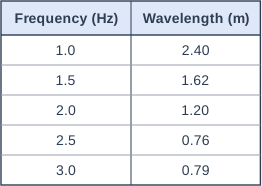
A student makes transverse waves on a long stretched spring. She changes the frequency of the waves and measures the wavelength each time. The table shows her results.

She concludes:

'The wavelength of the waves is inversely proportional to their frequency (wavelength ∝ 1 ÷ frequency). My result at 3.0 Hz is anomalous.'

Evaluate the student's conclusion. Use calculations from the data in the table in your answer.

Table with columns "Frequency (Hz)", "Wavelength (m)". Frequency (Hz): 1.0; Wavelength (m): 2.40 | Frequency (Hz): 1.5; Wavelength (m): 1.62 | Frequency (Hz): 2.0; Wavelength (m): 1.20 | Frequency (Hz): 2.5; Wavelength (m): 0.76 | Frequency (Hz): 3.0; Wavelength (m): 0.79.

Model answer

If wavelength ∝ 1 ÷ frequency, then frequency × wavelength (the wave speed) should be constant.
1.0 × 2.40 = 2.40; 1.5 × 1.62 = 2.43; 2.0 × 1.20 = 2.40; 2.5 × 0.76 = 1.90; 3.0 × 0.79 = 2.37.
For four of the results frequency × wavelength is about 2.4 m/s, so the wavelength is inversely proportional to the frequency, as she says. For example, doubling the frequency from 1.0 Hz to 2.0 Hz halves the wavelength from 2.40 m to 1.20 m.
However, the 3.0 Hz result is not anomalous, because 3.0 × 0.79 = 2.37, which fits the pattern. The anomalous result is at 2.5 Hz: 2.5 × 0.76 = 1.9, and the wavelength should have been about 2.4 ÷ 2.5 = 0.96 m. She should repeat that measurement.

Explanation

Inverse proportion means the product of the two quantities is constant, so multiplying frequency by wavelength for each row is the quickest test, and the product here is the wave speed. Good answers use the calculations both to support the relationship and to find the real anomaly. A common error is to judge the anomaly by eye from the wavelengths alone.

Mark scheme
  1. 1 mark

    frequency × wavelength (the wave speed) calculated for at least two results, for example 1.0 × 2.40 = 2.4 and 2.0 × 1.20 = 2.4

    Max 2 if no calculations from the table are used. ALLOW 1.5 × 1.62 = 2.43 and 3.0 × 0.79 = 2.37. ALLOW the speed with or without the unit m/s.

  2. 1 mark

    frequency × wavelength is (about) the same / about 2.4 m/s for the other results, so the wavelength is inversely proportional to the frequency: the first part of the conclusion is supported

    ALLOW doubling the frequency halves the wavelength, with data: 1.0 Hz to 2.0 Hz gives 2.40 m to 1.20 m, or 1.5 Hz to 3.0 Hz gives 1.62 m to 0.79 m (about half).

  3. 1 mark

    the result at 3.0 Hz is not anomalous, because 3.0 × 0.79 = 2.37 / about 2.4, which fits the pattern

    ALLOW 0.79 m is about half of 1.62 m (the value at 1.5 Hz).

  4. 1 mark

    the result at 2.5 Hz is anomalous, because 2.5 × 0.76 = 1.9, which is much less than 2.4 / the wavelength at 2.5 Hz should be about 0.96 m

    ALLOW 2.4 ÷ 2.5 = 0.96 m as the expected wavelength. ALLOW the 2.5 Hz result should be repeated, if it has been identified as the anomaly with a reason.

Ready to try the rest? Every answer you write is marked against the mark scheme, so you can see exactly where the marks are.

Study Helper Hints first, answers after you try

Stuck on this one? Ask for a hint and I’ll point you in the right direction, without giving the answer away. Once you’ve checked your answer, I’ll show you how the marks are awarded.