
Level:
Correct: 0
Incorrect: 0
Marks: 0/0
Exam Practice
Course:
Topics:
OCR GCSE Chemistry (Paper 2) Smart practice A mixed round aimed at your weak spots
Unit 4
Predicting and identifying reactions and products
Unit 5
Monitoring and controlling chemical reactions
Unit 6
Global challenges
Unit 7
Practical skills
Avg
score:
–
Topics
done:
0/34

The Haber process and fertilisers

Practise 14 exam-style questions on The Haber process and fertilisers for OCR GCSE Chemistry (Paper 2). Write your answer as you would in the exam and get it marked in seconds against the mark scheme, point by point, with the Study Helper on hand if you get stuck.

  • 14 questions
  • 1–6 marks each
  • Instant marking
  • No sign-up needed
14 questions, marked as you go

Sample questions with model answers

Here are 4 of the questions in this topic, each with a model answer, an explanation of why it earns the marks and the mark scheme an examiner would use.

Question 1

1 mark

A factory makes a nitrogen fertiliser in several linked processes. The only raw materials that the factory uses are air, natural gas (methane, CH₄) and water.

Which fertiliser could the factory make?

Choose your answer.

  • A ammonium chloride, NH₄Cl
  • B ammonium nitrate, NH₄NO₃
  • C ammonium sulfate, (NH₄)₂SO₄
  • D potassium nitrate, KNO₃

Model answer

B (ammonium nitrate, NH₄NO₃)

Explanation

Atoms are not made or destroyed in chemical reactions, so every element in a product must come from the raw materials. Air supplies nitrogen and oxygen, and methane and water supply hydrogen, so the factory can only make a fertiliser that contains just these elements. Other fertilisers need a variety of other raw materials, such as sulfur for ammonium sulfate and a potassium compound for potassium fertilisers.

Mark scheme
  1. 1 mark

    B / ammonium nitrate, NH₄NO₃

    The only correct answer is B: every element in the fertiliser must come from the raw materials, and ammonium nitrate contains only nitrogen, hydrogen and oxygen. The nitrogen and oxygen come from the air, and the hydrogen comes from the methane and the water. A is not correct because ammonium chloride contains chlorine, which is not in air, methane or water; C is not correct because ammonium sulfate contains sulfur, so the factory would also need a raw material such as sulfur (to make sulfuric acid); D is not correct because potassium nitrate contains potassium, so the factory would also need a raw material that contains potassium, such as potassium chloride dug from mines. ALLOW the letter or the option. If more than one option is given, do not award the mark.
Question 2

2 marks

An NPK fertiliser for greenhouse crops is a mixture of ionic compounds. It contains these ions:

potassium ion: K⁺
ammonium ion: NH₄⁺
nitrate ion: NO₃⁻
phosphate ion: PO₄³⁻

Write the formula of:
• potassium phosphate
• ammonium phosphate.

Model answer

Potassium phosphate: K₃PO₄ (three K⁺ ions, total charge 3+, balance one PO₄³⁻ ion)
Ammonium phosphate: (NH₄)₃PO₄ (three NH₄⁺ ions, total charge 3+, balance one PO₄³⁻ ion)

Explanation

In an ionic compound the positive and negative charges must cancel. A phosphate ion has a 3− charge, so it needs three ions with a 1+ charge: three K⁺ ions or three NH₄⁺ ions. An ammonium ion contains more than one atom, so it goes in brackets with the 3 after the bracket; a single potassium ion needs no brackets.

Mark scheme
  1. 1 mark

    (potassium phosphate) K₃PO₄

    ALLOW K3PO4 typed without subscripts. DO NOT ALLOW KPO₄, K(PO₄)₃ or K₃(PO₄)₃. IGNORE charges shown in the formula, for example (K⁺)₃PO₄³⁻.

  2. 1 mark

    (ammonium phosphate) (NH₄)₃PO₄

    ALLOW (NH4)3PO4 typed without subscripts. The brackets around NH₄ are needed: DO NOT ALLOW NH₄₃PO₄, NH₄PO₄ or N₃H₁₂PO₄. IGNORE charges shown in the formula. Mark each formula separately; the formulae must be clearly matched to their names if they are given in a different order.

Question 3

2 marks

Urea, CO(NH₂)₂, and ammonium nitrate, NH₄NO₃, are both used as nitrogen fertilisers.

Relative atomic mass (Ar): N = 14.0
Relative formula mass (Mr): urea = 60.0 ammonium nitrate = 80.0

Explain why 1 kg of urea contains a larger mass of nitrogen than 1 kg of ammonium nitrate.

Model answer

Each formula contains two nitrogen atoms, so each contains 2 × 14.0 = 28.0 of nitrogen. Urea has a smaller relative formula mass (60.0) than ammonium nitrate (80.0), so nitrogen is a larger fraction of its mass: 28.0 ÷ 60.0 × 100 = 46.7% for urea, but 28.0 ÷ 80.0 × 100 = 35.0% for ammonium nitrate. So 1 kg of urea contains more nitrogen.

Explanation

Count the nitrogen atoms in each formula: CO(NH₂)₂ has two (the 2 outside the bracket doubles the NH₂) and NH₄NO₃ has two. The same mass of nitrogen is spread over a smaller relative formula mass in urea, so its percentage by mass of nitrogen is higher. Working out the two percentages is another correct way to explain this.

Mark scheme
  1. 1 mark

    each formula contains two nitrogen atoms / the same mass of nitrogen, 2 × 14.0 = 28.0

    ALLOW a correct percentage by mass of nitrogen for either compound: urea 28.0 ÷ 60.0 × 100 = 46.7% (ALLOW 46.6% to 47%); ammonium nitrate 28.0 ÷ 80.0 × 100 = 35(.0)%. DO NOT ALLOW 'urea contains more nitrogen atoms' (both formulae contain two).

  2. 1 mark

    urea has the smaller relative formula mass (60.0 compared with 80.0), so nitrogen makes up a larger fraction / percentage of its mass

    ALLOW a correct comparison of the two percentages: 46.7% (or 47%) for urea is greater than 35% for ammonium nitrate. ALLOW 'the 28.0 of nitrogen is shared over a smaller total mass in urea'. ORA (allow the reverse argument): ammonium nitrate has the larger relative formula mass, so nitrogen is a smaller fraction of its mass. IGNORE references to how well the fertilisers work or how soluble they are.

Question 4

4 marks

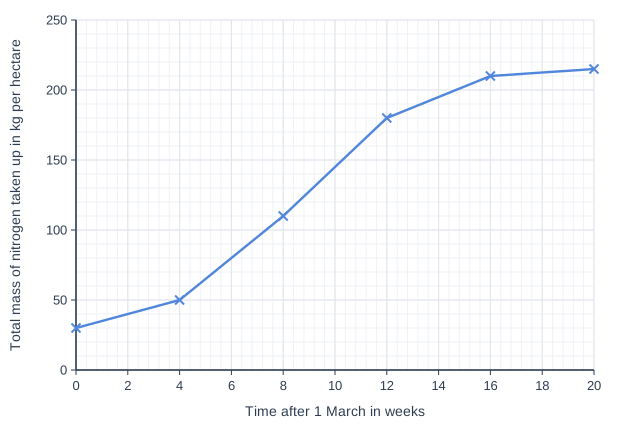
Wheat plants take up nitrogen compounds from the soil as they grow. A scientist measured the total mass of nitrogen taken up by the wheat in one field, starting on 1 March.

The graph shows her results.

Use the graph to calculate the mean rate at which the wheat took up nitrogen between week 8 and week 12. Give the unit.

The farmer spreads ammonium nitrate fertiliser on this field once each spring. Use the graph to suggest when she should spread it. Explain your answer.

Line graph of total mass of nitrogen taken up in kg per hectare (y-axis, 0 to 250) against Time after 1 March in weeks (x-axis, 0 to 20). The line joins the points (0, 30), (4, 50), (8, 110), (12, 180), (16, 210), (20, 215).

Model answer

Rate = (180 − 110) ÷ (12 − 8) = 70 ÷ 4 = 17.5 kg per hectare per week

She should spread the fertiliser at about week 4 (early April). The graph is steepest from week 4 to week 12, so this is when the wheat takes up nitrogen fastest. Ammonium nitrate dissolves in the water in the soil, so the nitrogen is there when the wheat needs most of it. In early March the wheat takes up very little nitrogen, so fertiliser spread then is not used straight away.

Explanation

On a graph of total mass against time, the mean rate between two times is the change in mass ÷ the change in time: the gradient of that part of the line. The steepest part of the graph shows when the wheat takes up nitrogen fastest, so fertiliser spread just before then is used most fully. Dividing the total by the whole time since 1 March (180 ÷ 12 = 15) gives a different mean rate, not the rate between week 8 and week 12.

Mark scheme
  1. 1 mark

    rate = change in mass ÷ change in time = (180 − 110) ÷ (12 − 8) / 70 ÷ 4; or a correct final answer of 17.5 (or 18) with no working

    An answer of 17.5 (or 18) with no working scores marking points 1 and 2 only. Marking point 3 is the independent unit mark and marking point 4 is for the suggestion. DO NOT ALLOW 180 ÷ 12 (= 15, the mean rate since 1 March, not between week 8 and week 12), 110 ÷ 8 or time ÷ mass for this point.

  2. 1 mark

    17.5 / 18

    ALLOW ECF: a wrong reading from the graph, correctly divided by 4.

  3. 1 mark

    unit: kg per hectare per week / kg/ha per week

    The unit mark is independent of the value. ALLOW kg/hectare/week / kg per ha per week. DO NOT ALLOW kg per week or kg per hectare on its own.

  4. 1 mark

    spread it at about week 4 (early April) / just before the steepest part of the graph, because the wheat takes up nitrogen fastest from about week 4 to week 12, so the nitrogen is in the soil when the wheat needs most of it

    ALLOW any time from week 2 to week 8 if the reason links it to the fastest uptake (the steepest part of the graph). A time with no reason scores 0. DO NOT ALLOW week 0 (1 March) or week 16 and later, unless the reason correctly uses the graph. IGNORE references to the cost of the fertiliser.

Ready to try the rest? Every answer you write is marked against the mark scheme, so you can see exactly where the marks are.

Study Helper Hints first, answers after you try

Stuck on this one? Ask for a hint and I’ll point you in the right direction, without giving the answer away. Once you’ve checked your answer, I’ll show you how the marks are awarded.