
Level:
Correct: 0
Incorrect: 0
Marks: 0/0
Exam Practice
Course:
Topics:
OCR GCSE Chemistry (Paper 2) Smart practice A mixed round aimed at your weak spots
Unit 4
Predicting and identifying reactions and products
Unit 5
Monitoring and controlling chemical reactions
Unit 6
Global challenges
Unit 7
Practical skills
Avg
score:
–
Topics
done:
0/34

Comparing materials and selecting them for uses

Practise 12 exam-style questions on Comparing materials and selecting them for uses for OCR GCSE Chemistry (Paper 2). Write your answer as you would in the exam and get it marked in seconds against the mark scheme, point by point, with the Study Helper on hand if you get stuck.

  • 12 questions
  • 1–4 marks each
  • Instant marking
  • No sign-up needed
12 questions, marked as you go

Sample questions with model answers

Here are 4 of the questions in this topic, each with a model answer, an explanation of why it earns the marks and the mark scheme an examiner would use.

Question 1

1 mark

Each leg of a camera tripod is made of an aluminium alloy and has a mass of 540 g.

The company makes another tripod with legs of exactly the same size and shape from a carbon-fibre composite.

Density of the aluminium alloy = 2.7 g/cm³
Density of the carbon-fibre composite = 1.6 g/cm³

Use the equation: density = mass ÷ volume

What is the mass of one leg made of the carbon-fibre composite?

Choose your answer.

  • A 200 g
  • B 320 g
  • C 864 g
  • D 911 g

Model answer

B - 320 g (volume = 540 ÷ 2.7 = 200 cm³; mass = 200 × 1.6 = 320 g)

Explanation

Legs of the same size and shape have the same volume. Find the volume from the aluminium leg (mass ÷ density = 540 ÷ 2.7 = 200 cm³), then multiply by the density of the composite (200 × 1.6 = 320 g). Check that the answer makes sense: the composite is less dense than the aluminium alloy, so its leg must be lighter than 540 g.

Mark scheme
  1. 1 mark

    B / 320 g

    The only correct answer is B: volume of one leg = 540 ÷ 2.7 = 200 cm³, so the mass of a composite leg = 200 × 1.6 = 320 g (or 540 × 1.6 ÷ 2.7 = 320 g). A is not correct because 200 is the volume of the leg in cm³, not the mass of the composite leg; C is not correct because 864 g is 540 × 1.6, which multiplies the mass (not the volume) by the density; D is not correct because 911 g is 540 × 2.7 ÷ 1.6, which uses the ratio of the densities the wrong way round and gives a heavier leg, although the composite is less dense. ALLOW the letter or the option. If more than one option is given, do not award the mark.
Question 2

2 marks

The windscreens of cars are made of laminated glass. Laminated glass is two sheets of glass with a thin sheet of a clear polymer called PVB stuck between them.

Explain why laminated glass is described as a composite material.

Suggest why laminated glass is safer than a single sheet of ordinary glass if the windscreen is broken in a crash.

Model answer

Laminated glass is a composite because it is made of two different materials, glass and a polymer, joined together.

If the glass breaks, the pieces stay stuck to the polymer layer, so the windscreen stays in one piece and sharp pieces of glass do not fly into the car and cut the people inside.

Explanation

A composite is made of two or more different materials combined, so that it has useful properties of each. Glass is transparent and hard but brittle; the polymer layer is clear and flexible and holds the broken pieces of glass in place. A single sheet of ordinary glass can break into sharp pieces that fly apart.

Mark scheme
  1. 1 mark

    it is made of two (or more) different materials (glass and a polymer) joined / combined together

    ALLOW it combines two different types of material (a ceramic and a polymer), AW. ALLOW it has the properties of both materials. IGNORE 'it is a mixture' on its own. IGNORE 'it has layers' on its own.

  2. 1 mark

    when the glass breaks, the pieces stick to the polymer / are held together by the polymer, so they do not fly into the car / cut the people inside

    ALLOW the windscreen stays in one piece / does not shatter into loose pieces, AW. ALLOW the polymer stops people or objects going through the windscreen. IGNORE 'it is stronger' on its own.

Question 3

2 marks

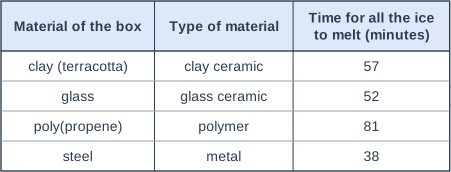
A student compares how well four materials keep ice cold. She puts 50 g of ice into a small box made of each material. The boxes are the same size and shape, and their walls are the same thickness. She times how long it takes for all the ice in each box to melt.

The table shows her results.

Use the results to explain which material is the best thermal insulator.

Suggest why the ice melted fastest in the steel box.

Table with columns "Material of the box", "Type of material", "Time for all the ice to melt (minutes)". Material of the box: clay (terracotta); Type of material: clay ceramic; Time for all the ice to melt (minutes): 57 | Material of the box: glass; Type of material: glass ceramic; Time for all the ice to melt (minutes): 52 | Material of the box: poly(propene); Type of material: polymer; Time for all the ice to melt (minutes): 81 | Material of the box: steel; Type of material: metal; Time for all the ice to melt (minutes): 38.

Model answer

Poly(propene) is the best thermal insulator, because the ice in the poly(propene) box took the longest time to melt (81 minutes).

Steel is a metal and a good thermal conductor, so energy from the warm room was transferred through the steel walls to the ice faster than through the other materials.

Explanation

Ice melts when energy is transferred to it from the warmer surroundings, so the longer the ice lasts, the better the box insulates. Metals are good thermal conductors, ceramics are poorer conductors and polymers are poor conductors (good insulators), which matches the order of the results. Heat is transferred into the box: cold does not travel out.

Mark scheme
  1. 1 mark

    poly(propene), because the ice in it took the longest time to melt (81 minutes)

    The answer must name poly(propene) and give a reason from the results. ALLOW the polymer. ALLOW the ice took longest to melt / energy was transferred to the ice most slowly in the poly(propene) box, AW.

  2. 1 mark

    steel is a metal, which is a good thermal conductor, so energy (heat) from the warmer surroundings is transferred through its walls (to the ice) fastest

    ALLOW heat travels through steel quickly / steel conducts heat well, AW. DO NOT ALLOW steel lets the cold out / conducts the cold (energy is transferred from the warmer surroundings to the ice).

Question 4

3 marks

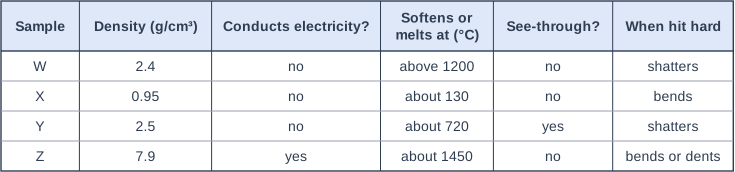
A technician has four unlabelled samples of material, W, X, Y and Z. One sample is a metal, one is a polymer, one is glass and one is a clay ceramic.

The table shows the results of some tests on the samples.

Use the table to identify the metal, the polymer, the glass and the clay ceramic.

Table with columns "Sample", "Density (g/cm³)", "Conducts electricity?", "Softens or melts at (°C)", "See-through?", "When hit hard". Sample: W; Density (g/cm³): 2.4; Conducts electricity?: no; Softens or melts at (°C): above 1200; See-through?: no; When hit hard: shatters | Sample: X; Density (g/cm³): 0.95; Conducts electricity?: no; Softens or melts at (°C): about 130; See-through?: no; When hit hard: bends | Sample: Y; Density (g/cm³): 2.5; Conducts electricity?: no; Softens or melts at (°C): about 720; See-through?: yes; When hit hard: shatters | Sample: Z; Density (g/cm³): 7.9; Conducts electricity?: yes; Softens or melts at (°C): about 1450; See-through?: no; When hit hard: bends or dents.

Model answer

Metal: Z (it conducts electricity and bends or dents).
Polymer: X (low density, softens at about 130 °C, bends).
Glass: Y (you can see through it, and it shatters).
Clay ceramic: W (not see-through, shatters, softens only above 1200 °C).

Explanation

Use the property that only one type of material has. Only metals conduct electricity, so Z is the metal. Polymers have low densities and soften at low temperatures, so X is the polymer. Glass and clay ceramics are both brittle and do not conduct, but only glass is transparent, so Y is the glass and W is the clay ceramic.

Mark scheme
  1. 1 mark

    metal: Z

    Z is the only sample that conducts electricity (and it has the highest density, and bends or dents instead of shattering).

  2. 1 mark

    polymer: X

    X has a very low density and softens at a low temperature, and it bends instead of shattering.

  3. 1 mark

    glass: Y and clay ceramic: W

    Both letters must be correct for this point. Y is the glass because it is the one you can see through; W is the clay ceramic because it is not see-through and softens only above 1200 °C. If a letter is given for more than one material, do not award the points that use that letter.

Ready to try the rest? Every answer you write is marked against the mark scheme, so you can see exactly where the marks are.

Study Helper Hints first, answers after you try

Stuck on this one? Ask for a hint and I’ll point you in the right direction, without giving the answer away. Once you’ve checked your answer, I’ll show you how the marks are awarded.