
Level:
Correct: 0
Incorrect: 0
Marks: 0/0
Exam Practice
Course:
Topics:
OCR GCSE Chemistry (Paper 2) Smart practice A mixed round aimed at your weak spots
Unit 4
Predicting and identifying reactions and products
Unit 5
Monitoring and controlling chemical reactions
Unit 6
Global challenges
Unit 7
Practical skills
Avg
score:
–
Topics
done:
0/34

Functional groups and homologous series

Practise 15 exam-style questions on Functional groups and homologous series for OCR GCSE Chemistry (Paper 2). Write your answer as you would in the exam and get it marked in seconds against the mark scheme, point by point, with the Study Helper on hand if you get stuck.

  • 15 questions
  • 1–6 marks each
  • Instant marking
  • No sign-up needed
15 questions, marked as you go

Sample questions with model answers

Here are 4 of the questions in this topic, each with a model answer, an explanation of why it earns the marks and the mark scheme an examiner would use.

Question 1

1 mark

Three of these compounds have the same functional group.

Which compound has a different functional group from the other three?

Choose your answer.

  • A butanoic acid
  • B butanol
  • C methanoic acid
  • D propanoic acid

Model answer

B - butanol

Explanation

The end of the name shows the functional group: -oic acid means a carboxylic acid (–COOH) and -ol means an alcohol (–OH). So methanoic acid, propanoic acid and butanoic acid all have the –COOH group and are in the same homologous series, and butanol is not. The start of the name (meth-, prop-, but-) only tells you the number of carbon atoms, so butanol and butanoic acid share it even though their functional groups are different.

Mark scheme
  1. 1 mark

    B / butanol

    The only correct answer is B: butanol is an alcohol (functional group –OH, name ending -ol), but the other three compounds are carboxylic acids (functional group –COOH, name ending -oic acid). A is not correct because butanoic acid is a carboxylic acid, like methanoic acid and propanoic acid (it has the same stem, butan-, as butanol, but a different functional group); C is not correct because methanoic acid is a carboxylic acid; D is not correct because propanoic acid is a carboxylic acid. ALLOW the letter or the option. If more than one option is given, do not award the mark.
Question 2

2 marks

Ethane, C₂H₆, and ethene, C₂H₄, both have two carbon atoms in each molecule.

In a molecule of ethane, the two carbon atoms are joined by a single bond. In a molecule of ethene, the two carbon atoms are joined by a double bond.

Use the formulae, and the number of covalent bonds that each carbon atom and each hydrogen atom forms, to explain this difference.

Model answer

Each carbon atom forms four covalent bonds and each hydrogen atom forms one.

In ethane, C₂H₆, each carbon atom is bonded to three hydrogen atoms, so it has one bond left, which joins it to the other carbon atom: a single bond.

In ethene, C₂H₄, each carbon atom is bonded to only two hydrogen atoms, so it has two bonds left, and both join it to the other carbon atom: a double bond.

Explanation

Share out the hydrogen atoms between the two carbon atoms: ethane has three on each carbon atom and ethene has two. A carbon atom always forms four bonds, so the bonds that are not used by hydrogen atoms must join the carbon atoms together. This is why an alkene has two fewer hydrogen atoms than the alkane with the same number of carbon atoms (CₙH₂ₙ compared with CₙH₂ₙ₊₂).

Mark scheme
  1. 1 mark

    ethane: each carbon atom is bonded to three hydrogen atoms, so it has one of its four bonds left, which joins it to the other carbon atom (a single bond)

    Max 1 if the answer does not use the idea that each carbon atom forms four bonds. 1 mark for each of points 1 and 2. ALLOW 3 bonds to hydrogen + 1 bond to carbon = 4 bonds for each carbon atom in ethane. ALLOW the six hydrogen atoms are shared between the two carbon atoms, three on each.

  2. 1 mark

    ethene: each carbon atom is bonded to only two hydrogen atoms, so it has two of its four bonds left, and both join it to the other carbon atom (a double bond)

    ALLOW 2 bonds to hydrogen + 2 bonds to carbon = 4 bonds for each carbon atom in ethene. DO NOT ALLOW 'ethene has a double bond because it is an alkene' with no reference to the bonds that each carbon atom forms. DO NOT ALLOW each carbon atom in ethene has a spare bond that is not joined to anything.

Question 3

2 marks

Methanol, ethanol, propanol and butanol all have the same functional group. They all react with acidified potassium manganate(VII) in the same way.

Explain what is meant by a functional group, and why compounds with the same functional group react in the same way.

Model answer

A functional group is a particular atom or group of atoms in a molecule, such as the –OH group in an alcohol. The reactions of an organic compound are decided by its functional group, because that is the part of the molecule that reacts; the rest of the carbon chain does not change. So all the alcohols react with acidified potassium manganate(VII) in the same way.

Explanation

A functional group is the reactive part of an organic molecule: C=C in alkenes, –OH in alcohols and –COOH in carboxylic acids. Because the reaction happens at the functional group, chemists can predict the reactions of a compound they have never used, just from its functional group. Do not confuse a functional group (part of one molecule) with a homologous series (a family of compounds).

Mark scheme
  1. 1 mark

    a (particular) atom or group of atoms in a molecule (such as –OH, C=C or –COOH)

    ALLOW a part of a molecule / a group of atoms bonded in a particular way. DO NOT ALLOW a group of molecules / a group of compounds / a family of compounds (that is a homologous series).

  2. 1 mark

    the reactions of a compound are decided by its functional group (not by the rest of the carbon chain), so compounds with the same functional group have similar reactions

    ALLOW the reaction happens at the functional group / the –OH group, and the rest of the molecule does not change. ALLOW AW. IGNORE 'they are in the same homologous series' with no reference to the functional group deciding the reactions.

Question 4

4 marks

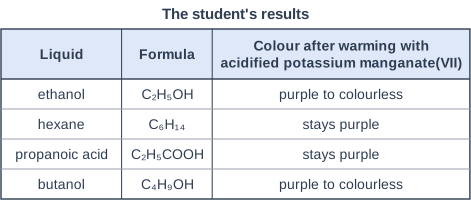
A student warms a few drops of four liquids, one at a time, with acidified potassium manganate(VII) solution, which is purple.

The table shows her results.

Explain her results. Name the organic product made in each reaction that takes place.

The student's results. Table with columns "Liquid", "Formula", "Colour after warming with acidified potassium manganate(VII)". Liquid: ethanol; Formula: C₂H₅OH; Colour after warming with acidified potassium manganate(VII): purple to colourless | Liquid: hexane; Formula: C₆H₁₄; Colour after warming with acidified potassium manganate(VII): stays purple | Liquid: propanoic acid; Formula: C₂H₅COOH; Colour after warming with acidified potassium manganate(VII): stays purple | Liquid: butanol; Formula: C₄H₉OH; Colour after warming with acidified potassium manganate(VII): purple to colourless.

Model answer

Ethanol and butanol are alcohols: they have the –OH functional group. Acidified potassium manganate(VII) oxidises alcohols, so it reacted with them and the purple colour disappeared. Ethanol was oxidised to ethanoic acid, and butanol was oxidised to butanoic acid.

Hexane is an alkane. It has no functional group, only C–C and C–H bonds, so it was not oxidised and the solution stayed purple. Propanoic acid is already a carboxylic acid, the product you get by oxidising propanol, so it was not oxidised any further.

Explanation

The results sort the liquids by functional group: both alcohols react in the same way, and the two liquids without an alcohol group do not. Each alcohol keeps its number of carbon atoms, so ethanol gives ethanoic acid and butanol gives butanoic acid. A carboxylic acid is the end product of this oxidation, which is why propanoic acid does not react.

Mark scheme
  1. 1 mark

    ethanol and butanol are alcohols / contain the –OH (functional) group, so they are oxidised (by the potassium manganate(VII)) / react, so the purple colour disappears

    Max 4 from points 1 to 5. ALLOW the potassium manganate(VII) oxidises the alcohols. ALLOW AW.

  2. 1 mark

    ethanoic acid (is made from ethanol)

    ALLOW CH₃COOH. DO NOT ALLOW ethanol / ethene / methanoic acid.

  3. 1 mark

    butanoic acid (is made from butanol)

    ALLOW C₃H₇COOH / CH₃CH₂CH₂COOH. DO NOT ALLOW propanoic acid / butanol / pentanoic acid.

  4. 1 mark

    hexane is an alkane / has no functional group / has only C–C and C–H single bonds, so it is not oxidised (and the colour stays purple)

    ALLOW hexane has no –OH group, so it does not react. DO NOT ALLOW 'hexane is not reactive' with no reason.

  5. 1 mark

    propanoic acid is already a carboxylic acid / is the product of oxidising propanol / has no –CH₂OH group, so it is not oxidised (further)

    ALLOW propanoic acid is not an alcohol / has a –COOH group, not an –OH group on its own. DO NOT ALLOW 'propanoic acid is an acid so it does not react' with no link to oxidation or to the alcohol group.

Ready to try the rest? Every answer you write is marked against the mark scheme, so you can see exactly where the marks are.

Study Helper Hints first, answers after you try

Stuck on this one? Ask for a hint and I’ll point you in the right direction, without giving the answer away. Once you’ve checked your answer, I’ll show you how the marks are awarded.