
Level:
Correct: 0
Incorrect: 0
Marks: 0/0
Exam Practice
Course:
Topics:
OCR GCSE Chemistry (Paper 2) Smart practice A mixed round aimed at your weak spots
Unit 4
Predicting and identifying reactions and products
Unit 5
Monitoring and controlling chemical reactions
Unit 6
Global challenges
Unit 7
Practical skills
Avg
score:
–
Topics
done:
0/34

Alloys and corrosion

Practise 15 exam-style questions on Alloys and corrosion for OCR GCSE Chemistry (Paper 2). Write your answer as you would in the exam and get it marked in seconds against the mark scheme, point by point, with the Study Helper on hand if you get stuck.

  • 15 questions
  • 1–6 marks each
  • Instant marking
  • No sign-up needed
15 questions, marked as you go

Sample questions with model answers

Here are 4 of the questions in this topic, each with a model answer, an explanation of why it earns the marks and the mark scheme an examiner would use.

Question 1

1 mark

Rusting is one type of corrosion.

Which change is rusting?

Choose your answer.

  • A Aluminium window frames slowly turn dull grey.
  • B Copper roofs slowly turn green.
  • C Lead roofs slowly turn white-grey.
  • D Steel gates slowly turn orange-brown.

Model answer

D - steel gates slowly turning orange-brown

Explanation

Corrosion is the slow reaction of a metal with substances around it, such as oxygen and water. Many metals corrode, but the word rusting is used only for the corrosion of iron and steel, which forms orange-brown hydrated iron(III) oxide. Aluminium, copper and lead corrode too, but their corrosion is not called rusting.

Mark scheme
  1. 1 mark

    D / Steel gates slowly turn orange-brown.

    The only correct answer is D: rusting is the corrosion of iron, and of steel, which is mainly iron; the iron reacts with oxygen and water to form orange-brown rust (hydrated iron(III) oxide). A is not correct because this is the corrosion of aluminium, which forms a thin layer of aluminium oxide, not rust; B is not correct because this is the corrosion of copper, which forms a green layer of copper compounds; C is not correct because this is the corrosion of lead. All four changes are corrosion, but only the corrosion of iron and steel is called rusting. ALLOW the letter or the option. If more than one option is given, do not award the mark.
Question 2

2 marks

An angler has a fishing knife made of ordinary steel. After a day's fishing in the sea, she rinses the knife in fresh tap water. Then she dries it with a towel before she puts it away.

Explain how each of these two steps helps to stop the knife rusting.

Model answer

Rinsing the knife in fresh water washes off the salt from the sea water. Salt makes steel rust much faster, so removing it slows down rusting.

Drying the knife removes the water. Iron needs both water and oxygen to rust, so a dry knife cannot rust, even though there is oxygen in the air.

Explanation

Iron and steel rust only when both water and oxygen are present. Salt is not needed for rusting, but salt dissolved in the water makes rusting much faster, which is why steel rusts quickly at the seaside. The oxygen in the air cannot easily be kept away from the knife, so removing the salt and then the water is the practical way to protect it.

Mark scheme
  1. 1 mark

    rinsing washes off the salt (from the sea water), and salt makes iron / steel rust faster

    The answer must link removing the salt to slower rusting. ALLOW salt water speeds up rusting / steel rusts more quickly in salty water, AW. IGNORE rinsing washes off dirt / fish scales / blood unless salt is named. DO NOT ALLOW salt is needed for rusting / iron cannot rust without salt (iron rusts in fresh water too).

  2. 1 mark

    drying removes the water, and iron (in the steel) needs (both) water and oxygen to rust, so the dry knife cannot rust

    ALLOW moisture for water. ALLOW rusting needs water, so without water the knife does not rust, AW. IGNORE 'drying stops it rusting' with no reference to water being needed. DO NOT ALLOW drying removes the oxygen / the towel keeps air away from the knife.

Question 3

2 marks

Stainless steel is an alloy of iron that contains chromium. The chromium forms a very thin layer of chromium oxide on the surface of the steel.

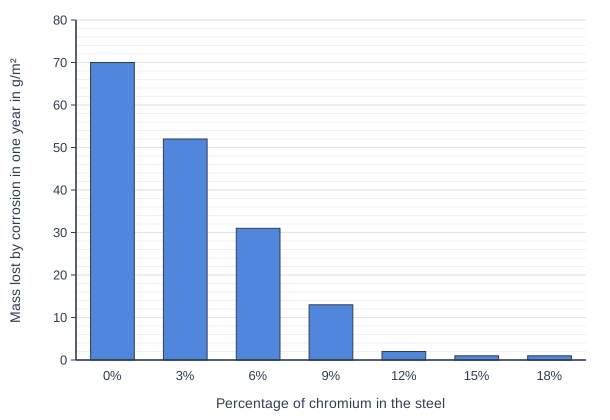
A scientist made steels with different percentages of chromium. She left a plate of each steel outdoors for one year and then measured the mass lost from each square metre (m²) of the plate by corrosion.

The bar chart shows her results.

Describe how the percentage of chromium affects the mass lost by corrosion.

Steel for knives and forks must lose less than 5 g/m² in a year. Use the bar chart to find the smallest percentage of chromium, of those tested, that meets this.

Bar chart of mass lost by corrosion in one year in g/m² for each percentage of chromium in the steel: 0% 70, 3% 52, 6% 31, 9% 13, 12% 2, 15% 1, 18% 1.

Model answer

As the percentage of chromium increases, the mass lost by corrosion decreases. It falls quickly from about 70 g/m² with no chromium to about 2 g/m² at 12% chromium, then stays close to zero.

Smallest percentage = 12%

Explanation

Read the height of each bar: the mass lost falls as more chromium is added, and from 12% upwards it is almost zero. The 9% bar is above 5 g/m², so 12% is the smallest percentage tested that meets the limit. With enough chromium, the thin chromium oxide layer covers the whole surface and keeps oxygen and water away from the iron, which is why stainless steel cutlery does not rust.

Mark scheme
  1. 1 mark

    the greater the percentage of chromium, the smaller the mass lost (by corrosion) / the less the steel corrodes

    ALLOW the mass lost falls quickly up to 12% chromium and then hardly changes / stays close to zero, AW. ALLOW negative correlation. IGNORE data quoted with no trend. DO NOT ALLOW 'inversely proportional' / 'proportional'.

  2. 1 mark

    12 (%)

    DO NOT ALLOW 9% (the 9% steel loses about 13 g/m², more than 5 g/m²). DO NOT ALLOW 15% or 18% (they meet the limit, but they are not the smallest percentage that does).

Question 4

4 marks

Steel lamp posts are galvanised: they are coated with a layer of zinc. The zinc slowly reacts with oxygen and water in the air, so the layer gets thinner each year. The first product that forms is zinc oxide:

zinc + oxygen → zinc oxide

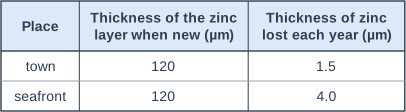
The table shows a company's estimates for the zinc layer on its lamp posts. (1 µm is one thousandth of a millimetre.)

Calculate how many more years the zinc layer will last on a lamp post in a town than on a lamp post on a seafront.

Explain why the reaction of zinc with oxygen is an oxidation reaction.

Table with columns "Place", "Thickness of the zinc layer when new (µm)", "Thickness of zinc lost each year (µm)". Place: town; Thickness of the zinc layer when new (µm): 120; Thickness of zinc lost each year (µm): 1.5 | Place: seafront; Thickness of the zinc layer when new (µm): 120; Thickness of zinc lost each year (µm): 4.0.

Model answer

Town: 120 ÷ 1.5 = 80 years
Seafront: 120 ÷ 4.0 = 30 years
Difference: 80 − 30 = 50 years

The zinc layer lasts 50 years longer in the town.

The reaction is an oxidation because the zinc gains oxygen to form zinc oxide.

Explanation

Find how long the layer lasts in each place by dividing the thickness of the layer by the thickness lost each year, then subtract. Do not subtract the two rates first: 120 ÷ 2.5 = 48 is not a meaningful answer. Oxidation is the gain of oxygen, so zinc is oxidised when it forms zinc oxide; the zinc layer is used up first, which protects the steel underneath for many years.

Mark scheme
  1. 1 mark

    years in the town: 120 ÷ 1.5 = 80 (years); or a correct final answer of 50 years with no working

    An answer of 50 years with no working scores marking points 1 to 3 only. ALLOW the two lives (80 years and 30 years) found correctly with no subtraction for 2 marks (points 1 and 2).

  2. 1 mark

    years on the seafront: 120 ÷ 4.0 = 30 (years); or a correct final answer of 50 years with no working

    Mark points 1 and 2 in either order.

  3. 1 mark

    evaluation: 80 − 30 = 50 (years)

    ALLOW ECF: a wrong value from point 1 or point 2 correctly subtracted. DO NOT ALLOW 48 (years) from 120 ÷ (4.0 − 1.5) (a wrong method), which scores 0 for the calculation.

  4. 1 mark

    zinc gains oxygen / oxygen is added to the zinc

    ALLOW zinc combines with oxygen. ALLOW zinc (atoms) lose electrons. DO NOT ALLOW zinc loses oxygen / zinc is reduced / zinc gains electrons.

Ready to try the rest? Every answer you write is marked against the mark scheme, so you can see exactly where the marks are.

Study Helper Hints first, answers after you try

Stuck on this one? Ask for a hint and I’ll point you in the right direction, without giving the answer away. Once you’ve checked your answer, I’ll show you how the marks are awarded.