
Level:
Correct: 0
Incorrect: 0
Marks: 0/0
Exam Practice
Course:
Topics:
OCR GCSE Chemistry (Paper 2) Smart practice A mixed round aimed at your weak spots
Unit 4
Predicting and identifying reactions and products
Unit 5
Monitoring and controlling chemical reactions
Unit 6
Global challenges
Unit 7
Practical skills
Avg
score:
–
Topics
done:
0/34

Predicting reactions from the Periodic Table

Practise 14 exam-style questions on Predicting reactions from the Periodic Table for OCR GCSE Chemistry (Paper 2). Write your answer as you would in the exam and get it marked in seconds against the mark scheme, point by point, with the Study Helper on hand if you get stuck.

  • 14 questions
  • 1–6 marks each
  • Instant marking
  • No sign-up needed
14 questions, marked as you go

Sample questions with model answers

Here are 4 of the questions in this topic, each with a model answer, an explanation of why it earns the marks and the mark scheme an examiner would use.

Question 1

1 mark

Element Z is in Group 7 and Period 5 of the Periodic Table. The letter Z is not a chemical symbol.

Which prediction about element Z is correct?

Choose your answer.

  • A It displaces bromine from potassium bromide solution.
  • B It forms a compound with sodium that has the formula NaZ.
  • C It is a gas at room temperature.
  • D It is more reactive than chlorine.

Model answer

B (It forms a compound with sodium that has the formula NaZ.)

Explanation

An element's group tells you how it reacts: Group 7 elements react with metals to form compounds in which the halogen ion has a 1− charge, so with sodium the formula is NaZ. Its period tells you where it is in the group: Period 5 puts Z (iodine) below chlorine and bromine, so it is less reactive than both and is a solid at room temperature.

Mark scheme
  1. 1 mark

    B / it forms a compound with sodium that has the formula NaZ

    The only correct answer is B: all Group 7 atoms gain one electron to form ions with a 1− charge, and sodium forms Na⁺ ions, so the compound is NaZ (Z is iodine, and the compound is sodium iodide, NaI). A is not correct because Z is below bromine in Group 7, so it is less reactive than bromine and cannot displace it; C is not correct because the melting and boiling points increase down Group 7, so the element in Period 5 is a solid at room temperature; D is not correct because reactivity decreases down Group 7, so Z is less reactive than chlorine. ALLOW the letter or the option. If more than one option is given, do not award the mark.
Question 2

2 marks

Sodium is in Group 1 of the Periodic Table.

Sodium is found in nature only in compounds, such as the sodium chloride in rock salt, which is found in thick layers underground in Cheshire. Sodium metal is never found in nature.

Use the position of sodium in the Periodic Table to explain why sodium metal is never found in nature.

Model answer

Sodium is in Group 1, so it is a very reactive metal: its atoms lose their one outer electron easily. Any sodium metal in nature would quickly react with oxygen and water in the air, the rocks and the sea, forming compounds. That is why sodium is only found in compounds, as Na⁺ ions, such as in sodium chloride.

Explanation

The position of an element predicts how reactive it is. Group 1 metals are so reactive that they have all reacted to form compounds. Unreactive elements, such as the Group 0 gases in the air, can be found uncombined.

Mark scheme
  1. 1 mark

    sodium is in Group 1 / is an alkali metal, so it is very reactive (its atoms lose their outer electron easily)

    1 mark for each point. The link to Group 1 or to being very reactive is needed. ALLOW sodium is near the left of the Periodic Table / is a reactive metal.

  2. 1 mark

    so sodium would react with substances around it, such as oxygen and water (in the air, rocks and the sea), forming compounds (in which it is present as Na⁺ ions)

    ALLOW any sodium metal would quickly react to form a compound such as sodium oxide, sodium hydroxide or sodium chloride. IGNORE 'it is too reactive' with no idea of reacting to form compounds.

Question 3

2 marks

Councils spread rock salt, which is sodium chloride, on icy roads. Sodium is in Group 1 and chlorine is in Group 7.

Some de-icers for pavements near plants use a different compound of a Group 1 metal with a Group 7 element.

Suggest the name of a compound that is likely to have similar properties to sodium chloride. Explain your choice using the Periodic Table.

Model answer

Potassium chloride. Potassium is in the same group as sodium (Group 1), so it forms the same type of ion, K⁺, and reacts with chlorine in the same way. Potassium chloride is an ionic compound made of 1+ and 1− ions, like sodium chloride, so it is likely to have similar properties.

Explanation

Elements in the same group react in similar ways, so their compounds are similar too. Any Group 1 metal combined with any Group 7 element gives a white ionic solid with the same type of formula as sodium chloride. Potassium chloride is in fact sold as a de-icer.

Mark scheme
  1. 1 mark

    a compound of another Group 1 metal and a Group 7 element / of sodium and another Group 7 element, such as potassium chloride, lithium chloride, sodium bromide or potassium bromide

    1 mark for each point. ALLOW any correct name of a Group 1 halide other than sodium chloride. DO NOT ALLOW sodium chloride, calcium chloride or magnesium chloride (Group 2, not Group 1). This includes fluorides, such as potassium fluoride.

  2. 1 mark

    its elements are in the same groups as sodium and chlorine, so it is made of the same types of ions (1+ and 1−) / it is a similar ionic compound

    ALLOW elements in the same group react in the same way, so they form similar compounds. IGNORE references to how de-icers melt ice.

Question 4

4 marks

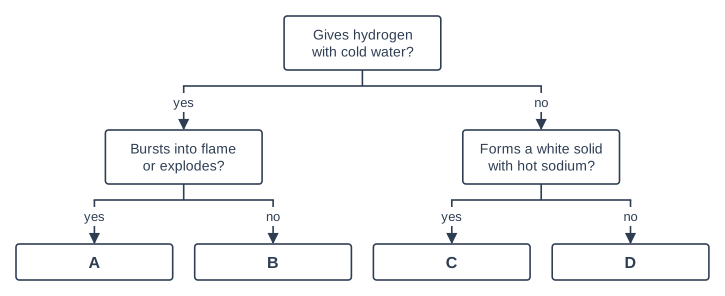
The flow chart sorts elements by how they react.

The positions of four elements in the Periodic Table are:
• caesium: Group 1, Period 6
• lithium: Group 1, Period 2
• bromine: Group 7, Period 4
• argon: Group 0, Period 3.

Use the positions of these elements to predict which box, A, B, C or D, each element would end in. Each letter may be used once, more than once or not at all.

Flow chart of 7 boxes joined by arrows, read from top to bottom. The first box is "Gives hydrogen with cold water?". From "Gives hydrogen with cold water?", 2 arrows branch out side by side: the left arrow, labelled "yes", leads to "Bursts into flame or explodes?"; the right arrow, labelled "no", leads to "Forms a white solid with hot sodium?". From "Bursts into flame or explodes?", 2 arrows branch out side by side: the left arrow, labelled "yes", leads to box A; the right arrow, labelled "no", leads to box B. From "Forms a white solid with hot sodium?", 2 arrows branch out side by side: the left arrow, labelled "yes", leads to box C; the right arrow, labelled "no", leads to box D.

Model answer

caesium: A
lithium: B
bromine: C
argon: D

Explanation

Group 1 metals all react with cold water to give hydrogen, and the reaction gets more vigorous going down the group, so caesium (Period 6) explodes but lithium (Period 2) only fizzes steadily. Group 7 elements react with metals such as sodium to form white salts, and Group 0 elements do not react at all.

Mark scheme
  1. 1 mark

    caesium: A

    1 mark for each element. Caesium is near the bottom of Group 1, so it reacts with cold water so vigorously that it explodes.

  2. 1 mark

    lithium: B

    Lithium is at the top of Group 1: it reacts with cold water to give hydrogen, but only steadily, without catching fire. DO NOT ALLOW A.

  3. 1 mark

    bromine: C

    Bromine is a Group 7 non-metal: it does not give hydrogen with water, but it reacts with hot sodium to form sodium bromide, a white solid.

  4. 1 mark

    argon: D

    Argon is in Group 0, so it does not react with water or with sodium.

Ready to try the rest? Every answer you write is marked against the mark scheme, so you can see exactly where the marks are.

Study Helper Hints first, answers after you try

Stuck on this one? Ask for a hint and I’ll point you in the right direction, without giving the answer away. Once you’ve checked your answer, I’ll show you how the marks are awarded.