Level:
Correct: 0
Incorrect: 0
Marks: 0/0
Exam Practice
Course:
Topics:
OCR GCSE Chemistry (Paper 2) Smart practice A mixed round aimed at your weak spots
Unit 4
Predicting and identifying reactions and products
Unit 5
Monitoring and controlling chemical reactions
Unit 6
Global challenges
Unit 7
Practical skills
Avg
score:
–
Topics
done:
0/34

Potable water

Practise 14 exam-style questions on Potable water for OCR GCSE Chemistry (Paper 2). Write your answer as you would in the exam and get it marked in seconds against the mark scheme, point by point, with the Study Helper on hand if you get stuck.

  • 14 questions
  • 1–6 marks each
  • Instant marking
  • No sign-up needed
14 questions, marked as you go

Sample questions with model answers

Here are 4 of the questions in this topic, each with a model answer, an explanation of why it earns the marks and the mark scheme an examiner would use.

Question 1

1 mark

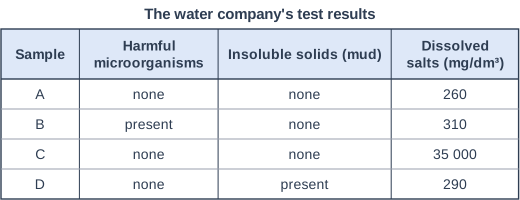
A water company tested four samples of water, A, B, C and D. The table shows the results.

Which sample is potable?

Choose your answer.

  • A Sample A
  • B Sample B
  • C Sample C
  • D Sample D
The water company's test results. Table with columns "Sample", "Harmful microorganisms", "Insoluble solids (mud)", "Dissolved salts (mg/dm³)". Sample: A; Harmful microorganisms: none; Insoluble solids (mud): none; Dissolved salts (mg/dm³): 260 | Sample: B; Harmful microorganisms: present; Insoluble solids (mud): none; Dissolved salts (mg/dm³): 310 | Sample: C; Harmful microorganisms: none; Insoluble solids (mud): none; Dissolved salts (mg/dm³): 35 000 | Sample: D; Harmful microorganisms: none; Insoluble solids (mud): present; Dissolved salts (mg/dm³): 290.

Model answer

A - Sample A

Explanation

Potable means safe to drink, not pure. Potable water can contain a low concentration of dissolved salts (sample A has 260 mg/dm³), but it must not contain harmful microorganisms, insoluble solids or a high concentration of salts. Each wrong sample fails on one of these.

Mark scheme
  1. 1 mark

    A / Sample A

    The only correct answer is A: potable water is water that is safe to drink, so it must contain no harmful microorganisms, no insoluble solids and only a low concentration of dissolved salts, and sample A meets all three. B is not correct because it contains harmful microorganisms, so it could cause disease; C is not correct because its concentration of dissolved salts (35 000 mg/dm³, like sea water) is far too high to drink; D is not correct because it still contains insoluble solids (mud), so it has not been filtered. ALLOW the letter or the option. If more than one option is given, do not award the mark.

Question 2

2 marks

At a water treatment works, chlorine is added to kill harmful microorganisms in the water. Scientists at the works then test samples of the treated water for microorganisms many times every day.

Suggest why the treated water is tested for microorganisms, even though chlorine has been added to kill them.

Model answer

The tests check that the chlorination has worked, for example that enough chlorine was added to kill all the harmful microorganisms. If any are found, the problem can be fixed, or the water can be stopped, before people drink it and catch diseases.

Explanation

Adding chlorine should make the water safe, but the amount added can be wrong or the equipment can fail. Regular testing is how the water company makes sure the water really is potable. This is a monitoring check, not another treatment stage.

Mark scheme
  1. 1 mark

    to check that the chlorination has worked / that enough chlorine was added to kill all the harmful microorganisms

    Mark the two points independently. ALLOW to check that the amount of chlorine is correct / that the chlorine dosing equipment has not failed. ALLOW some microorganisms may survive if too little chlorine is added.

  2. 1 mark

    so that if harmful microorganisms are found, the water can be treated again or stopped before people drink it and catch diseases

    ALLOW to make sure the water is potable / safe to drink, so that people do not get ill (such as from cholera or typhoid). IGNORE to make sure the water is pure.

Question 3

2 marks

An old house has water pipes made of lead. Lead compounds are poisonous. When water stands in lead pipes, small amounts of lead compounds can dissolve in it.

Explain why tap water in a house with lead pipes may not be potable, even though it was potable when it left the water treatment works.

Model answer

The lead compounds dissolve into the water while it stands in the lead pipes in the house, after it has left the treatment works, so the treatment could not remove them. Lead compounds are poisonous, so the water may no longer be safe to drink.

Explanation

Potable means safe to drink at the tap, not just at the works. Water treatment cannot remove a substance that gets into the water later, in the pipes. Because the lead compounds are dissolved and poisonous, the water can look clear but still be unsafe, which is why old lead pipes are replaced.

Mark scheme
  1. 1 mark

    lead compounds dissolve into the water in the pipes after it has left the treatment works, so they are not removed by the treatment

    Mark the two points independently. ALLOW the water picks up lead on its way to the tap / in the house.

  2. 1 mark

    lead compounds are poisonous / harmful, so the water is no longer safe to drink

    ALLOW lead is toxic, so the water is not potable. IGNORE the water is no longer pure (the question is about whether it is safe to drink).

Question 4

4 marks

A water treatment works supplies a town of 160 000 people. Each person uses an average of 145 litres of water each day.

Each filter bed at the works can filter 2 500 000 litres of water each day.

Calculate the smallest number of filter beds that the works needs. Explain how you decided on your answer.

Model answer

Water needed each day = 160 000 × 145 = 23 200 000 litres
Number of filter beds = 23 200 000 ÷ 2 500 000 = 9.28
Smallest number of filter beds = 10

I rounded up, because 9 filter beds could filter only 9 × 2 500 000 = 22 500 000 litres a day, which is less than the 23 200 000 litres the town needs, and the works cannot have part of a filter bed.

Explanation

First find the total volume of water needed each day, then divide by the volume one filter bed can treat. The answer, 9.28, must be rounded UP to 10, because 9 beds would leave the town short of water. Rounding 9.28 to the nearest whole number gives 9, which is the most likely wrong answer.

Mark scheme
  1. 1 mark

    water needed = 160 000 × 145 = 23 200 000 (litres per day); or a correct final answer of 10 filter beds with no working

    An answer of 10 filter beds with no working scores marking points 1 to 3 only. ALLOW 9 or 9.28 as the final answer for 2 marks (not rounded up to a whole number of beds that is enough).

  2. 1 mark

    number of beds = 23 200 000 ÷ 2 500 000 = 9.28; or a correct final answer of 10 filter beds with no working

    ALLOW ECF from a wrong volume in point 1 if it is divided by 2 500 000.

  3. 1 mark

    evaluation: 10 (filter beds)

    ALLOW ECF for a wrong value from point 2 rounded up to the next whole number.

  4. 1 mark

    reason for rounding up: nine beds would not filter enough water for the town, so the answer must be rounded up to the next whole number of beds

    ALLOW 9 beds would filter only 22 500 000 litres a day, which is less than the 23 200 000 litres needed. ALLOW you cannot have part of a filter bed, and 9 beds would not be enough. ALLOW 9.28 must be rounded up, not down, because 9 beds are not enough. IGNORE 'rounded to the nearest whole number' (9.28 to the nearest whole number is 9).

Ready to try the rest? Every answer you write is marked against the mark scheme, so you can see exactly where the marks are.

Study Helper Hints first, answers after you try

Stuck on this one? Ask for a hint and I’ll point you in the right direction, without giving the answer away. Once you’ve checked your answer, I’ll show you how the marks are awarded.